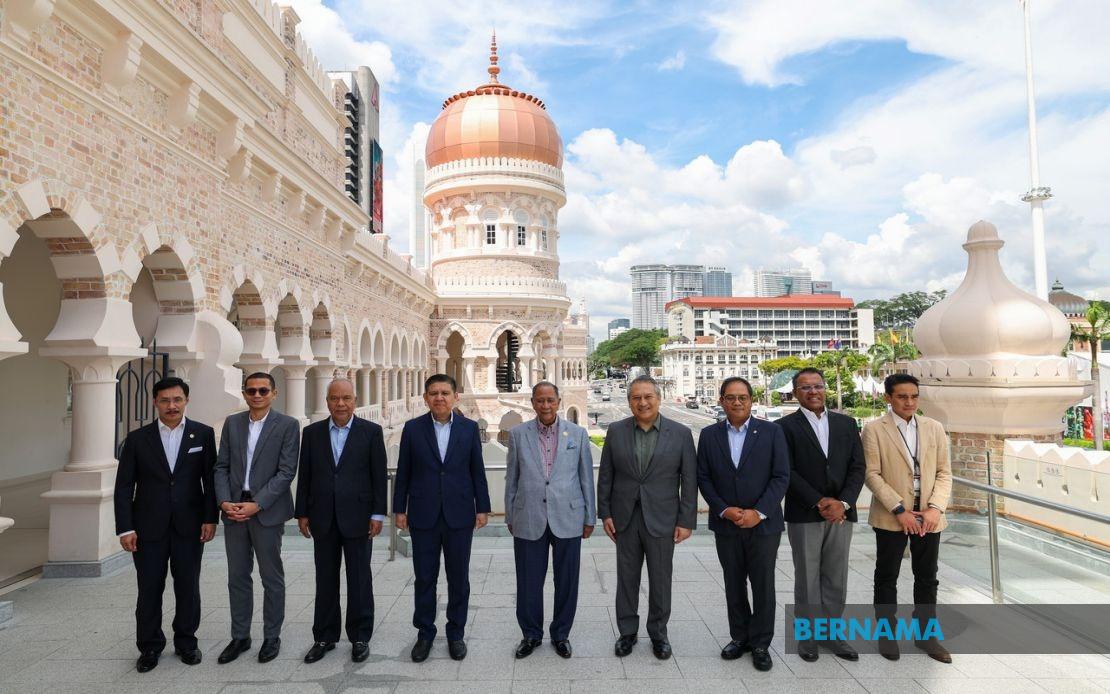
The Sultan of Kedah, Al Aminul Karim Sultan Sallehuddin Sultan Badlishah, toured the Sultan Abdul Samad Building (BSAS) in Kuala Lumpur on June 24, walking through the carefully restored galleries of one of Malaysia's most symbolically significant structures. Arriving shortly after 10.30 am, the royal visitor was received by Khazanah Nasional's managing director, Datuk Amirul Feisal Wan Zahir, and senior officials from the state fund manager, acknowledging the importance the institution attaches to the heritage project.
The morning's itinerary centred on the building's recently opened public galleries. The Sultan first visited the Confluence Hall, which presents an extensive account of Kuala Lumpur's origins and urban evolution through curated exhibits and displays. Think City's senior manager, Mariana Isa, provided detailed briefings on the gallery's content, allowing His Royal Highness to understand the narratives being preserved and shared with visitors. The Confluence Hall serves as a foundational entry point for understanding how the city transformed from a mining settlement into the nation's capital, with exhibits tracing centuries of development across political, social, and economic dimensions.
His subsequent stop was the Visionary Hall, which adopts a forward-looking approach to heritage interpretation. Rather than restricting itself to historical documentation, this space employs models and multimedia technologies to illustrate how Kuala Lumpur developed as a planned capital city and continues to evolve. The Sultan's visit to these interpretive spaces reflects broader recognition within Malaysia's royal institution of the value in maintaining accessible narratives about the nation's heritage and urban story. Before concluding the cultural portion of the visit, the Sultan accessed the balcony overlooking the Porte Cochere, the building's iconic architectural feature that has remained a defining visual element since its completion in 1897.
The royal itinerary expanded beyond heritage exhibits to encompass the building's contemporary community programming. The Sultan visited the School of Hard Knocks, an initiative operated by Royal Selangor that offers vocational and skills training within the heritage building's premises. This component of the visit signals how BSAS functions as a living institution rather than a static museum, integrating educational and economic opportunity-creation within a historically significant structure. The Sultan's engagement with the school demonstrated the multifunction nature of the restoration project, which aims to serve heritage preservation, public education, and community development simultaneously.
The visit concluded with a light luncheon before the Sultan's departure at approximately 1.15 pm, a modest formal component befitting the primarily educational and commemorative nature of the visit. Amirul Feisal commented afterwards that the royal engagement represented significant validation of Khazanah Nasional's conservation mandate. He framed the Sultan's visit as recognition extending beyond the physical restoration work itself, emphasizing that the institution's commitment encompasses preserving and communicating Malaysian history in ways that resonate with contemporary society and affirm the historical continuity valued by Malaysia's royal establishment.
Since the building opened to public access on February 2, it has attracted approximately 200,000 visitors, a figure demonstrating substantial public interest in engaging with Malaysia's architectural and historical heritage. This visitor volume suggests that properly contextualized and accessible heritage sites can effectively serve educational and cultural functions while generating community engagement. The BSAS project's reach extends across multiple demographic segments, from school groups to international tourists, making it an significant soft power asset for Malaysia's cultural positioning.
The Sultan Abdul Samad Building's historical weight derives from its role as the operational centre of colonial and post-colonial governance. As the former Secretariat Building, it served as the administrative nucleus where crucial decisions shaping the Malayan state were made. Most symbolically, BSAS witnessed the pivotal moment in August 1957 when the Union Jack was lowered and the Federation of Malaya flag was raised for the first time, marking the formal transition to independence. This singular event—the physical raising of a national flag—encapsulates the entire transformation of a colonial territory into a sovereign nation, making BSAS an irreplaceable tangible connection to Malaysia's foundational moment.
The restoration work that enabled public reopening represented an extensive conservation undertaking. His Majesty Sultan Ibrahim, King of Malaysia, officially inaugurated the completion of Phase One restoration efforts on January 31, following eleven months of intensive conservation work funded through the Khazanah Heritage Fund programme. This timeline indicates the scale and complexity of returning the building to public-ready condition while maintaining architectural and historical integrity. The phased approach suggests additional conservation stages may follow, with the building likely to continue as a long-term heritage project requiring ongoing investment and stewardship.
Khazanah Nasional's stewardship of BSAS reflects Malaysia's broader institutional commitment to heritage preservation at the highest policy level. The choice to invest substantially in the building's restoration and public programming positions heritage conservation as a matter of national significance rather than peripheral cultural concern. For Malaysia, maintaining visual and spatial connections to independence history serves both domestic and international constituencies—reinforcing national identity internally while presenting Malaysia's historical narrative to global audiences visiting heritage landmarks. The Sultan of Kedah's participation in the public engagement with the restored building amplifies its significance within Malaysia's royal and institutional framework, subtly endorsing heritage conservation as a priority worthy of royal attention and validation.