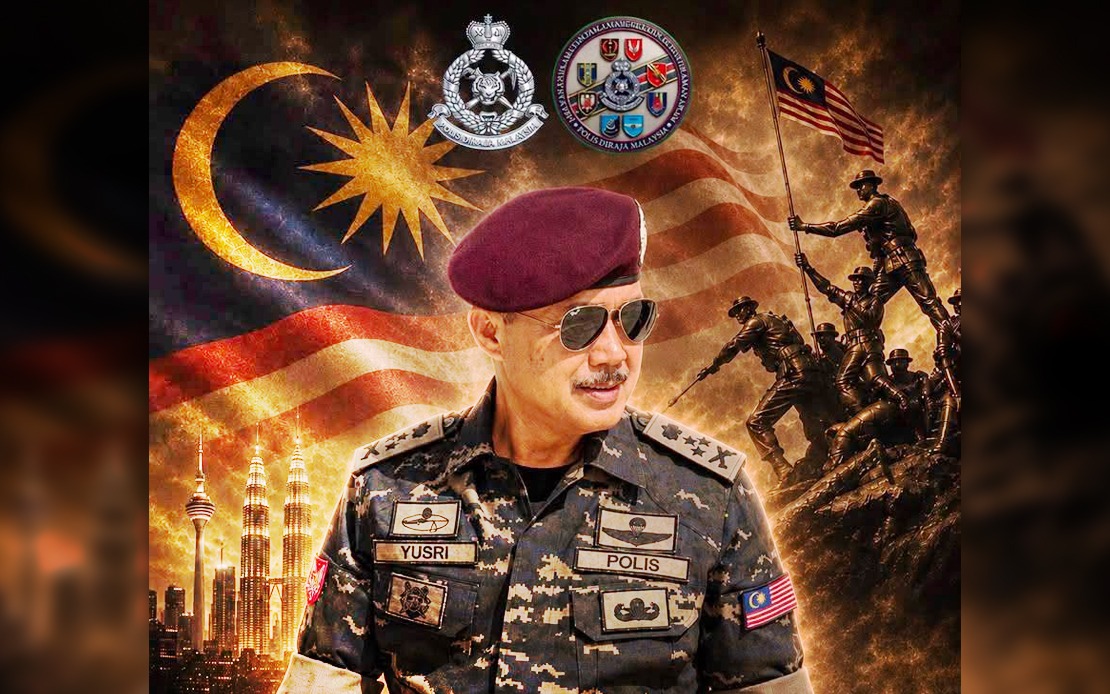
Datuk Seri Mohd Yusri Hassan Basri will oversee a significant shift in pageantry when he leads the Royal Malaysia Police contingent at the 69th National Day Parade this Monday at Dataran Putrajaya. The director of the Department of Internal Security and Public Order (KDNKA) has traded the thundering roar of last year's BMW R 1250 RT motorcycle for the measured cadence of a white horse named Al-Sakb, marking a striking transition in how senior police leadership presents itself during Malaysia's marquee national celebration.
The ceremonial change reflects evolving approaches to police representation at public events. Mohd Yusri will head a formidable contingent of 595 police officers ranging from senior command to junior personnel, all marching in formation through the capital's administrative heart. The spectacle will be anchored by the Federal Reserve Unit's Mounted Unit, a disciplined formation of 20 officers and personnel riding 20 horses, establishing the visual centrepiece of PDRM's presence at the parade.
The transition from motorcycles to horses represents more than mere ceremonial theatre. Mohd Yusri acknowledged the practical and psychological dimensions of the shift, noting that the change demanded considerable personal preparation. He underwent intensive training spanning more than a month to master horsemanship and ensure seamless coordination with the broader contingent. This commitment underscores the seriousness with which Malaysian police leadership approaches public-facing occasions and their symbolic weight in reinforcing institutional values.
Mohd Yusri's career trajectory illuminates the context of his new role. Previously, as director of the Traffic Investigation and Enforcement Department (JSPT), he had led departmental teams aboard motorcycles. His subsequent appointments heading the Bukit Aman Crime Prevention and Community Safety Department (JPJKK) broadened his administrative purview. Now, at the helm of KDNKA—a portfolio overseeing internal security and public order—his shift to equestrian leadership reflects the organization's broader operational diversity and institutional maturity.
The ceremonial dimension carries practical significance for institutional messaging. By choosing to lead on horseback, Mohd Yusri signals PDRM's connection to Malaysia's heritage and traditions whilst maintaining contemporary relevance. The Mounted Unit itself serves functional roles in crowd management, ceremonial duties, and community policing, making the choice substantively meaningful rather than purely decorative. This blending of tradition and functionality has become increasingly important as police forces worldwide navigate public perception and legitimacy.
Beyond the mounted contingent, KDNKA's parade presence will demonstrate the police force's operational spectrum and technological advancement. The General Operations Force (GOF) and Air Operations Force will feature alongside ground-based displays, creating a comprehensive portrait of PDRM's capabilities. This multi-dimensional approach serves to educate Malaysian citizens about the diverse functions police personnel undertake beyond routine traffic and criminal investigations.
Among the assets commanding particular attention will be ten newly acquired All Terrain Tactical Assault E-Bikes (ATEB), representing PDRM's embrace of electric mobility for security operations. These high-performance motorcycles are designed for border patrol duties, high-risk special operations, and tactical interventions—tasks where their electric powertrains offer silent approach capabilities and reduced environmental impact compared to fuel-burning alternatives. The inclusion of ATEB technology signals Malaysia's progressive stance on security force modernization, particularly relevant for a Southeast Asian nation increasingly focused on balancing operational efficiency with environmental responsibility.
Aerial capabilities will punctuate the ground-based displays through a flypast featuring an AW139 helicopter, emphasizing PDRM's multi-domain operational reach. This vertical element transforms the parade from a linear ground procession into a three-dimensional demonstration of police force sophistication. For Malaysian observers, such displays reinforce the professional standards and technological investment underpinning national security institutions.
The K9 Unit will introduce another dimension to the contingent's presentation. Sixteen trained dogs will demonstrate the specialized capabilities of police canine teams, whose roles span narcotics detection, tracking, search and rescue, and public order support. The visible presence of these animals personalizes police work in ways that resonate with civilian audiences, particularly families attending the celebration. K9 units have become integral to modern policing globally, and their inclusion in Malaysia's national celebration reinforces public familiarity with contemporary police methodology.
Mohd Yusri emphasized the importance of flawless execution and synchronized movement throughout the contingent. The extended training regimen for himself and the broader formation reflects institutional standards demanding precision and professionalism. For a nation marking its independence through a parade watched by hundreds of thousands of citizens and millions via broadcast media, such attention to detail carries diplomatic and internal messaging significance. The visual coherence of PDRM's presentation influences public confidence in institutional competence.
The KDNKA director appealed to Malaysians to attend the celebration with families, framing the parade as a moment for collective civic engagement. His invocation of prayers for favorable weather and broad public participation connects the ceremonial aspects to deeper national unity themes. These appeals acknowledge that national day parades function simultaneously as celebrations of independence, demonstrations of state capability, and opportunities for citizens to affirm their connection to national identity.
Preparations have proceeded at what KDNKA leadership characterizes as optimal levels, suggesting confidence in execution. However, the weather contingency mentioned by Mohd Yusri reflects practical considerations—Malaysia's equatorial climate, with its afternoon convective thunderstorms and high humidity, presents real challenges for sustained outdoor celebrations and public attendance. The explicit mention of weather prayers indicates the unpredictable environmental variables that can affect even meticulously planned national events.
For Southeast Asian observers, Malaysia's approach to national day celebrations offers instructive parallels. While many countries in the region emphasize military dominance in independence day parades, PDRM's integration of mounted units, K9 teams, specialized equipment, and air assets presents a police force as integral to national identity rather than auxiliary to military institutions. This distinction carries implications for how civilian security forces position themselves within broader state structures and public consciousness throughout the region.

