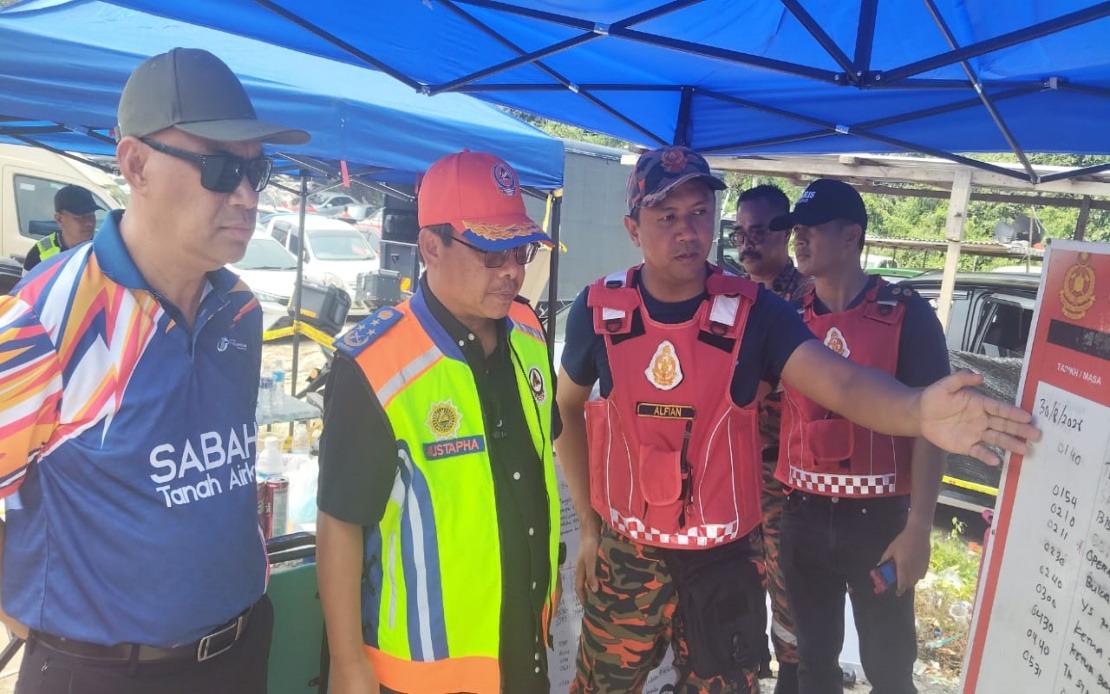
A major fire that swept through Kampung Lok Buta in Kota Kinabalu early on August 30 has left more than 200 families homeless and claimed the lives of three children, prompting authorities to establish emergency relief operations across the devastated residential area. The rapid response saw two temporary shelters activated at Dewan Kampung Likas and Dewan Damai, with officials prioritising registration, victim coordination, and the distribution of incoming donations from the public and government agencies.
The three fatalities have been identified as four-year-old Nana Abdullah, her six-year-old brother Mohd Asrul Abdullah, and their eight-year-old cousin Nurfarahdilah Mohd Tajihah. The deaths occurred shortly after the blaze ignited at 1.40 am, with the rapid spread of flames limiting escape opportunities for residents in the densely populated informal settlement. The loss of the young victims has compounded the tragedy and drawn immediate attention from federal and state leadership seeking to understand how such a catastrophic loss of life could occur in a populated village.
Datak Mustapha Sakmud, the Minister in the Prime Minister's Department responsible for Sabah and Sarawak affairs, visited the affected area and announced that Kota Kinabalu City Hall (DBKK) had formally declared Kampung Lok Buta a disaster zone. This designation unlocks access to emergency protocols and government assistance schemes designed to support communities recovering from large-scale calamities. The formal status recognises the scale of destruction and allows coordinated deployment of resources from multiple government departments and agencies working towards rehabilitation.
Mustapha underscored the importance of identifying students among the displaced families to prevent educational disruption during the school year. He committed to liaising with the Ministry of Education to ensure that affected young people from primary schools, secondary institutions, and Technical and Vocational Education and Training (TVET) centres receive targeted support to resume their studies without delay. This proactive approach acknowledges that sudden displacement and trauma can derail academic progress if not properly addressed through institutional support mechanisms.
The minister, who represents Sepanggar as Member of Parliament, indicated his intention to brief both Prime Minister Datuk Seri Anwar Ibrahim and Sabah Chief Minister Datuk Seri Hajiji Noor during an upcoming Malaysia Agreement 1963 Implementation Action Council meeting. This high-level forum provides an opportunity to escalate the needs of Kampung Lok Buta residents beyond local government channels and secure commitment from federal resources for reconstruction and rehabilitation efforts. The involvement of top-level leadership signals the political importance assigned to the disaster response and recovery process.
Joining Mustapha during the site visit was DBKK mayor and District Disaster Management Committee chairman Datuk Seri Dr Sabin Samitah, whose presence reflected the city's direct institutional responsibility for managing the emergency response and coordinating with the state government. The mayor's role encompasses both immediate humanitarian operations and longer-term planning for rebuilding the affected community. Officials have been directed to convene coordination meetings involving DBKK, emergency services, and relevant agencies to formulate a comprehensive assistance framework addressing housing, livelihood restoration, and psychological support for survivors.
Initial assistance packages have been prepared for the families of the three deceased children, representing the government's immediate acknowledgment of loss and commitment to supporting grieving relatives during this difficult period. Beyond emergency cash assistance, authorities must address longer-term needs including funeral arrangements, inheritance matters, and ongoing support for surviving family members who have lost breadwinners or significant household members. The death of three young children in a single incident places additional emphasis on community trauma counselling and mental health services for neighbours and classmates who witnessed the disaster's aftermath.
The fire's destruction of over 200 residential structures raises critical questions about building codes, fire safety enforcement, and the vulnerability of informal settlements to rapid fire spread. Many residents of Kampung Lok Buta likely live in wooden or semi-permanent structures with limited fire suppression infrastructure, creating conditions where small fires can escalate into community-wide disasters. The incident highlights ongoing tensions in Malaysian urban development between formal planning requirements and the reality of informal housing that accommodates lower-income populations in rapid-growth cities like Kota Kinabalu.
Disaster management experts and city planners in Southeast Asia have increasingly recognised that post-fire recovery extends far beyond emergency shelter provision. Long-term community reconstruction requires attention to psychosocial rehabilitation, livelihood restoration for displaced workers, transparent allocation of rebuilding resources, and prevention of exploitation by unscrupulous landlords or contractors seeking to profit from disaster situations. Kampung Lok Buta residents will require sustained support over months and potentially years as they navigate insurance claims, government housing schemes, and the emotional processing of displacement and bereavement.
The opening of relief centres represents the first stage of a protracted recovery process that will test both institutional capacity and community resilience. In Sabah, where informal settlements proliferate around urban centres like Kota Kinabalu, disasters affecting Kampung Lok Buta establish precedents for how subsequent fire incidents will be managed and how affected populations will be supported. The response will be scrutinised not only locally but across Malaysia as a benchmark for disaster governance and the state's commitment to protecting vulnerable residents in informal housing sectors.

