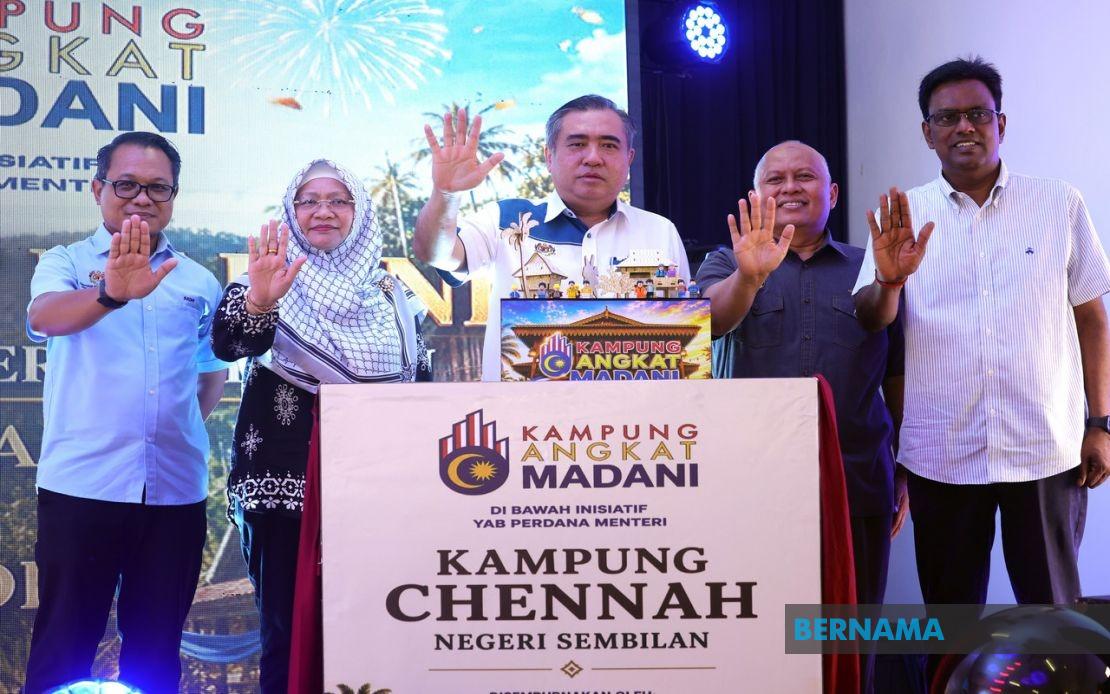
Transport Minister Anthony Loke Siew Fook has moved to dispel allegations that the Kampung Angkat MADANI programme is timed to coincide with state elections, asserting instead that the rural development initiative represents a longstanding commitment to improving infrastructure and socio-economic conditions in remote Malaysian villages. Speaking in Jelebu after launching the Land Public Transport Agency's (APAD) project at Kampung Chennah, Loke emphasised that the scheme was initiated two years ago and continues to be deployed systematically across different regions according to a predetermined schedule rather than electoral considerations.
The programme operates on a phased rollout designed to identify and address the specific needs of communities situated far from commercial and administrative centres. Loke explained that such villages frequently lack basic amenities and connectivity that urban populations take for granted, creating disparities that the government seeks to narrow through targeted interventions. By rolling out the initiative across multiple phases and involving various government agencies in implementation, the approach aims to ensure that assistance reaches those communities most requiring support rather than being concentrated in politically sensitive areas.
Acknowledging the strict electoral conduct guidelines in place, Loke reiterated that the government adheres to protocols established to maintain administrative propriety during election campaigns. He noted that no official government programmes or ceremonial events are permitted in constituencies undergoing electoral contests once the nomination period begins, a directive introduced under the Prime Minister's new administrative culture framework. This means that although Loke continues to perform his ministerial duties, he refrains from attending official government functions in contested constituencies during the active campaign phase, thereby separating government service delivery from electoral activity.
The timing of the Kampung Chennah project was justified on developmental rather than political grounds. Loke stated that APAD selected the village specifically because of its remote location and the community's demonstrated need for enhanced basic amenities and infrastructure development. The selection reflects genuine assessment of where interventions would generate the most meaningful improvement in residents' living standards, rather than strategic political calculus. This approach aligns with the programme's overarching objective of systematically identifying rural communities requiring assistance and channelling resources toward projects that directly enhance quality of life.
The allocation for Kampung Chennah demonstrates the concrete scale of government investment in this initiative. With RM500,000 committed to the village, the funds are being deployed across five specific projects that address multiple dimensions of community welfare. These include upgrading the library building to improve access to educational resources and digital connectivity, refurbishing the futsal court to provide recreational facilities for residents, and improving drainage systems around the mosque to address environmental health concerns. Such diverse project categories reflect a holistic understanding of rural development that extends beyond narrow infrastructure provision to encompass education, wellness, and social cohesion.
Implementation timelines for these projects are designed to maximise accountability and completion certainty. Loke indicated that all five initiatives at Kampung Chennah are projected to reach completion within a two to three-month window, with his ministry committed to close monitoring throughout the construction and execution phases. This hands-on oversight approach seeks to prevent project delays and cost overruns that frequently plague rural development schemes, ensuring that benefits reach communities within reasonable timeframes and allocated budgets remain respected.
Beyond the specific financial commitment to individual villages, Loke framed the Kampung Angkat MADANI programme as emblematic of a broader ministerial philosophy that extends transport and logistics responsibilities into genuine community development. The Transport Ministry's conventional mandate centres on regulating and developing ports, airports, railways, and public transport networks—all critical economic infrastructure. However, Loke articulated that authentic governance requires integration of social responsibility alongside core regulatory and infrastructure functions, necessitating direct engagement with communities to understand and ameliorate conditions affecting their wellbeing.
The programme's existence for two years prior to the current election cycle provides contextual evidence supporting Loke's assertion that the initiative is not electorally motivated. Established development programmes often continue operating through election periods, and their scheduling reflects operational logistics rather than political calculation. By pointing to previous implementations, including in an Orang Asli village in Lenggeng last year and across numerous areas through various agencies, Loke demonstrated that the programme represents institutionalised practice rather than ad hoc electoral positioning.
For rural Malaysian communities, particularly those in peripheral regions distant from commercial hubs and government administrative centres, programmes like Kampung Angkat MADANI represent significant opportunities for accessing development resources that might otherwise remain unavailable. Villages frequently face resource constraints that prevent local initiatives from addressing infrastructure deficits, making government-led interventions essential for achieving basic standard-of-life improvements. The emphasis on identifying remote communities and systematising their inclusion in development cycles helps counteract the historical tendency for government resources to concentrate in urbanised areas where political and economic power traditionally concentrates.
The delineation between government programme delivery and electoral campaigning that Loke underscored reflects internationally recognised principles of administrative impartiality during elections. Many established democracies enforce similar restrictions to prevent ruling parties from leveraging government resources and projects for electoral advantage, recognising that such conflation undermines democratic integrity. Malaysia's adoption of these guidelines, as introduced by the Prime Minister, signals commitment to maintaining clearer boundaries between government service and political activity, though practical implementation requires consistent ministerial compliance.
Looking forward, the success of initiatives like Kampung Angkat MADANI will partly depend on whether allocated resources generate sustainable improvements in community infrastructure and living standards. Rural development projects often falter during maintenance phases if communities lack technical capacity or financial resources for ongoing upkeep. Government support extending beyond initial construction to include training and capacity-building for local maintenance could enhance long-term project viability and ensure that investments deliver enduring benefits rather than deteriorating facilities.
The programme's continuation beyond the current election cycle will serve as practical validation of Loke's insistence that it represents genuine developmental commitment rather than short-term electoral positioning. If funding and implementation momentum persist following election results, this would provide empirical evidence supporting his characterisation. Conversely, if the programme diminishes after elections conclude, scepticism regarding its political motivations would find substantiation. Communities like Kampung Chennah will ultimately measure the initiative's legitimacy through concrete outcomes—completed projects, improved facilities, and measurable enhancements to residents' daily lives.

