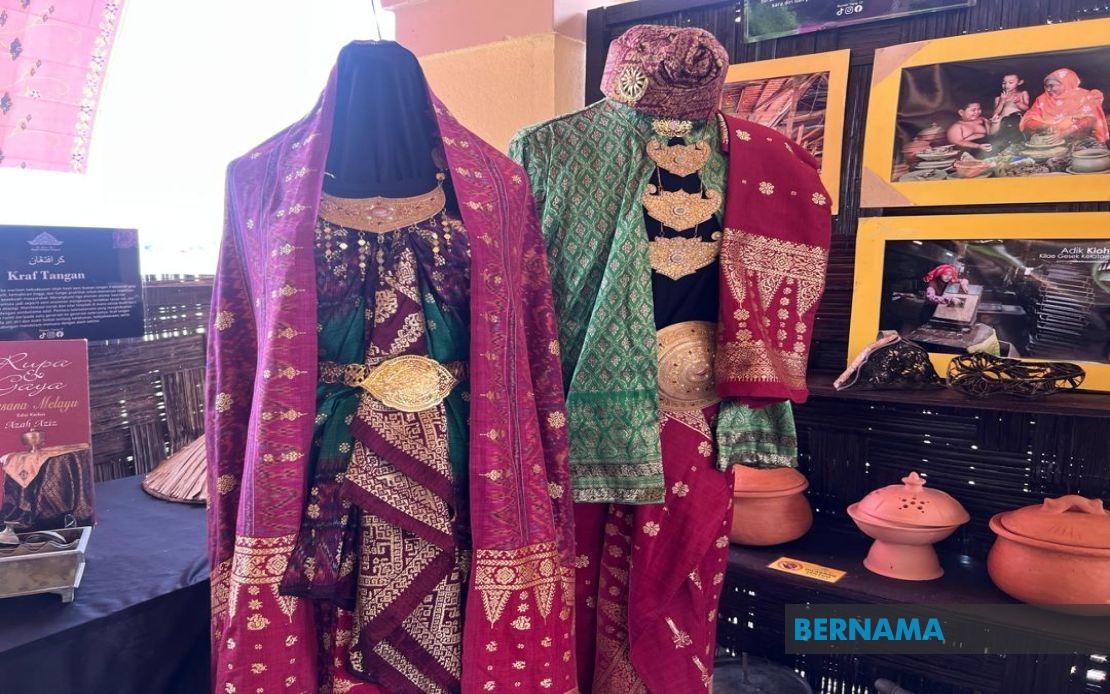
Malaysia's distinctive Kain Lima textile heritage stands on the brink of being lost entirely as the community of traditional weavers shrinks alarmingly. The warning comes from Nik Mohd Murdani Nik Hassan, caretaker of Galeri Rumah Tiang 12, who spoke during the Festival Kesenian Rakyat Kelantan (Kelantan Arts Festival) in Tok Bali, highlighting the urgent need to document and celebrate this disappearing craft before knowledge of its production vanishes from living memory.
Unlike the better-known songket that relies on gold or silver threadwork, Kain Lima represents a fundamentally different approach to textile artistry. The technique involves tying or tie-dyeing threads before weaving them together, a labour-intensive process that creates exceptionally fine motifs and a remarkable colour-reflection effect that catches light in ways ordinary fabrics cannot. This distinction matters profoundly for understanding why the craft commands such respect within Malaysia's textile heritage—it represents a sophisticated understanding of how different materials and techniques can interact to produce visual complexity.
The production demands placed on a single piece illustrate why Kain Lima has historically remained the preserve of the wealthy and well-connected. Each motif must be positioned with meticulous precision, requiring weavers to coordinate multiple coloured threads in predetermined arrangements before commencing the actual weaving process. This level of fine motor control and spatial planning means that mastering Kain Lima requires years of apprenticeship and sustained practice. Those familiar with traditional textiles can readily distinguish Kain Lima from its cousins through examining the patterns, the underlying structure of the weave, and the specific materials employed—a complexity that underscores just how much tacit knowledge exists within the craft.
Historically, Kain Lima occupied an exalted position within Malay material culture. The textile symbolised luxury and refinement, reserved for royalty who wore pieces as sarongs, shawls, and formal ceremonial garments. This association with the palace and the nobility gave Kain Lima enormous cultural prestige, yet that very rarity and expense may have contributed to its vulnerability. As modern lifestyles and fashion preferences shifted throughout the twentieth century, fewer people saw reason to commission or learn the craft, creating a vicious cycle where reduced demand discouraged new artisans from taking up the tradition.
Contemporary market pricing reflects both the fabric's historical value and its present scarcity. Individual pieces command between RM3,000 and over RM4,000 depending on factors including age, the complexity of motifs, physical condition, and the finesse evident in the weaving itself. Such prices, while substantial by Malaysian standards, arguably undervalue the hundreds of hours of skilled labour embedded in each cloth. For comparison, similar European or Asian heritage textiles routinely fetch far higher prices at auction, suggesting that Kain Lima remains undervalued even among collectors and cultural institutions.
Recognising this crisis, Galeri Rumah Tiang 12 has pivoted toward preservation and education rather than attempting to sustain active production. Since Nik Mohd Murdani joined the gallery in 2020, the institution has assembled collections of Kain Lima from private collectors, creating exhibitions designed to reintroduce these textiles to contemporary Malaysian audiences. This curatorial strategy serves multiple purposes: it prevents further dispersal of existing pieces, provides researchers and students with direct access to authentic examples, and communicates to younger Malaysians why these objects merit preservation and appreciation.
Exhibitions showcasing Kain Lima alongside songket and other traditional textiles perform the valuable function of making distinctions visible and tangible. Many Malaysians grow up with only a vague awareness that their heritage includes diverse textile traditions, rarely encountering opportunities to examine these fabrics closely or understand the technical differences that separate them. By displaying pieces side by side and explaining the specific techniques involved, galleries help visitors understand what makes Kain Lima remarkable and worth saving.
The educational impact extends beyond casual museum visitors. Handicraft maker Nur Anira Akmal Che Abdul Aziz, thirty-four years old from Pasir Mas, exemplifies how exposure to heritage textiles can energise contemporary creative practice. She attended the Kelantan Arts Festival exhibition specifically to deepen her knowledge of traditional forms, motifs, and production methods. Rather than viewing heritage as something to replicate exactly, she recognises how studying Kain Lima and related crafts can inspire new work that maintains local cultural identity while remaining responsive to modern sensibilities and market demands.
This intergenerational knowledge transfer represents perhaps the most crucial element in any preservation strategy. Unless younger craftspeople understand why Kain Lima matters, possess the technical skills needed to produce it, and can envision a viable economic future in the craft, the tradition will not revive. Nur Anira's approach—combining traditional inspiration with contemporary innovation—suggests one possible pathway forward. Such artists require not only direct access to heritage textiles but also mentorship from remaining practitioners, market support for heritage-inspired work, and genuine cultural recognition of their contribution.
The Malaysian government and cultural institutions have begun mobilising around textile heritage preservation, yet the pace of intervention may not match the speed of knowledge loss. When the last person fluent in a particular technique passes away, that knowledge cannot be recovered through research or documentation alone. Tacit understanding of how materials behave, how hands should move, how patterns emerge through the weaving process—these can only be transmitted through direct apprenticeship and years of shared practice.
Kain Lima's predicament mirrors challenges facing heritage crafts throughout Southeast Asia. Thailand, Indonesia, and other nations grapple with similar questions about how to sustain textile traditions in economic contexts where handmade goods struggle to compete with industrial production. Solutions likely require combining several approaches: supporting remaining practitioners through purchasing programmes and artist residencies, investing in exhibition and educational infrastructure, documenting techniques through video and written records before knowledge is lost, and cultivating markets among affluent consumers who value authenticity and heritage.
The broader significance of preserving Kain Lima extends beyond textile arts. Each disappearing craft represents lost understanding about materials, aesthetics, and how communities once solved creative problems. Malaysia's multicultural heritage encompasses numerous such traditions, many of them similarly endangered. A concerted effort to preserve Kain Lima while supporting the living practitioners who maintain that knowledge could establish models for protecting other heritage crafts across the region.

