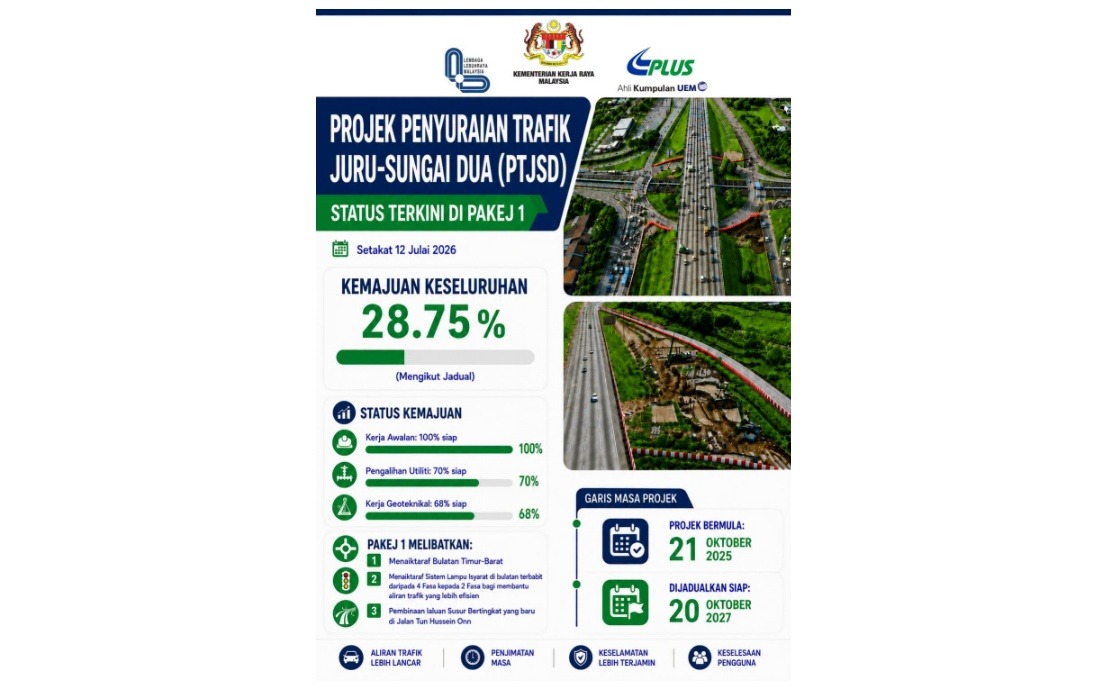
The Juru-Sungai Dua Traffic Dispersal Project (PTJSD) is maintaining its development momentum, with Package 1 reaching 28.75 per cent overall completion as of mid-July, according to PLUS Malaysia Berhad. The project remains aligned with its timeline, positioning it for completion in October 2027, when it will fundamentally reshape transport connectivity across northern Peninsular Malaysia and provide significant relief to the heavily congested corridor linking Penang with neighbouring states.
The ambitious RM3 billion infrastructure initiative represents a critical intervention in one of Malaysia's most strategically important transport corridors. The project's scope is substantial, stretching 17.3 kilometres across three main districts within Seberang Perai—the South, Central, and North zones—and will eventually serve approximately 200,000 daily route users. This scale underscores the magnitude of current congestion challenges on the Juru-Sungai Dua route, which functions as the primary thoroughfare connecting Penang's economic zones with the wider northern peninsula.
Progress on foundational elements has been encouraging. PLUS Malaysia highlighted that preliminary works have been entirely completed, establishing the critical groundwork necessary for subsequent construction phases. Beyond this, utility relocation efforts—a typically time-consuming component of major infrastructure projects involving the coordination of water, electricity, telecommunications, and gas services—have progressed to 70 per cent completion. Geotechnical investigations, essential for ensuring structural integrity given the corridor's geographic characteristics, have similarly advanced to 68 per cent, suggesting that engineering assessments and ground preparation are proceeding systematically.
Package 1 specifically encompasses several high-impact components designed to address immediate traffic bottlenecks. The project includes comprehensive upgrading of the East-West Roundabout, a perennial congestion point where multiple traffic streams intersect. Additionally, the scheme involves sophisticated improvements to the traffic light system at the roundabout itself, employing modern signal coordination to optimise traffic flow patterns. Complementing these surface-level improvements is the construction of a new elevated slip road along Jalan Tun Hussein Onn, which will allow vehicles to bypass conventional intersection points and reduce conflict zones where accidents commonly occur.
The anticipated outcomes of the PTJSD extend beyond simple traffic volume redistribution. By creating a dedicated direct route between Juru and Sungai Dua, the project is engineered to redirect approximately 30 per cent of current corridor traffic to the new alignment. This diversion is predicted to compress peak-hour travel times from the current one hour down to just 20 minutes—a transformative reduction that translates directly into economic productivity gains for commuters, commercial vehicle operators, and logistics providers who depend on this corridor. For a region that serves as a crucial logistics hub and industrial gateway, such time savings represent substantial cost benefits across multiple economic sectors.
Beyond travel time reduction, the project addresses several interconnected transportation challenges simultaneously. Enhanced traffic flow through improved signal systems and geometric design reduces the formation of congestion queues, which themselves contribute to increased vehicle emissions and safety risks. The roundabout upgrades and new slip road are explicitly intended to strengthen safety outcomes by minimising conflict points and providing grade-separated movements for high-volume traffic streams. For local residents living alongside the corridor, these improvements promise not only reduced noise pollution from idling vehicles but also enhanced air quality from smoother traffic movement patterns.
The implementation framework reflects pragmatic governance coordination. The Ministry of Works and Malaysian Highways Authority have partnered with PLUS Malaysia to develop and execute the project, recognising that addressing such a significant regional congestion challenge requires alignment across multiple institutional stakeholders. This collaborative approach acknowledges that surface transport infrastructure intersects with broader national development objectives and requires coordination at multiple government levels.
The timing of completion in October 2027 positions the project within Malaysia's longer-term infrastructure modernisation agenda. The corridor it serves has grown increasingly critical as economic activity in the northern peninsula has intensified, with Penang's continued manufacturing and technology sector expansion driving additional traffic volumes. By that target completion date, the PTJSD should help absorb projected traffic growth while maintaining acceptable congestion levels that support continued regional economic competitiveness.
For Malaysian and Southeast Asian observers, the PTJSD exemplifies the infrastructure investment requirements facing rapidly developing economies. The project's scale, cost, and strategic importance illustrate how regional connectivity directly enables economic integration and trade flow. The successful delivery of such ambitious transport infrastructure projects ultimately influences foreign investor confidence in Malaysia's ability to support manufacturing and logistics operations, particularly given the northern region's importance to regional supply chains.
The current progress trajectory suggests that PLUS Malaysia and its partners are navigating the complex coordination, environmental clearance, and technical challenges inherent in major highway construction. Maintaining the established schedule through the remaining 71.25 per cent of Package 1 work, and subsequently through remaining project packages, will require sustained project management rigour and adequate resource allocation. For stakeholders across the corridor—from daily commuters to freight operators and manufacturers—successful and timely delivery represents a significant economic and quality-of-life benefit.

