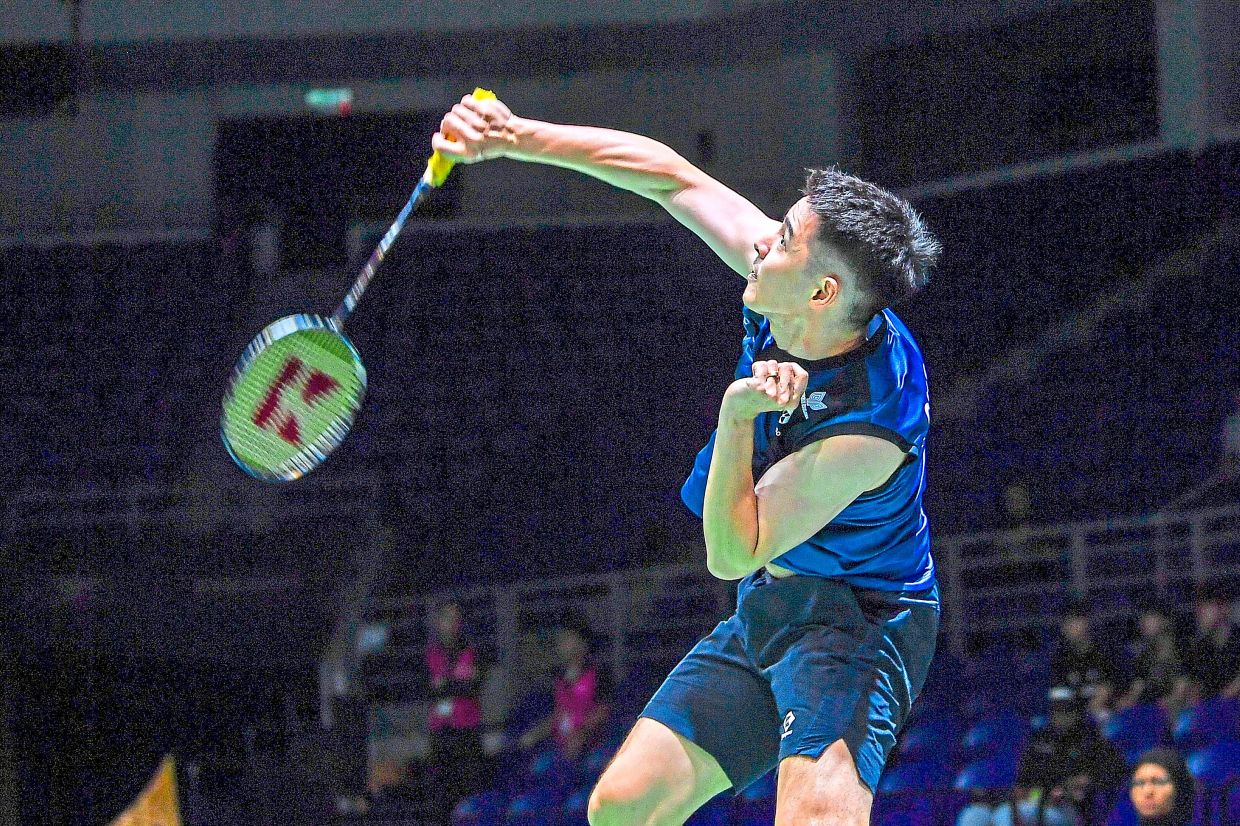
Cheam June Wei has solidified his place among Asia's emerging badminton talents by progressing to the semi-finals of the Korean Masters, dispatching Taiwan's Su Li-yang in a closely contested quarter-final encounter. The independent shuttler's victory on Friday at the Asan Yi Sun-sin Gymnasium in Petaling Jaya came courtesy of a three-set battle that demonstrated his resilience and tactical awareness, ultimately triumphing 23-21, 10-21, 21-18 over the seventh-seeded opponent.
June Wei's journey through the draw thus far has been nothing short of remarkable for a player competing outside the structure of a national federation. His scalping of higher-ranked opponents has garnered significant attention within the Malaysian badminton community, particularly given the scarcity of success stories from independent athletes in such competitive tournaments. Prior to his quarter-final heroics, he had already claimed two impressive victories: a stunning first-round upset against world number 29 Jason Teh, followed by a straight-sets victory over China's Dong Tianyao, who sits at world ranking 49.
Reflecting on his progress, June Wei struck a humble tone while acknowledging the unpredictability of his campaign. His readiness to embrace each challenge without preconceived expectations has evidently contributed to his mental fortitude on court. The player's strategic approach to competition, focusing on managing individual points rather than contemplating the broader tournament narrative, represents a mental discipline often associated with championship-calibre athletes. This point-by-point methodology has enabled him to navigate through high-pressure situations where the outcome remained uncertain until the final shuttle was struck.
Friday's encounter against Li-yang was characterised by extended rallies that tested both competitors' stamina and shot-making precision. June Wei's ability to emerge victorious in such demanding exchanges indicates not only his physical conditioning but also his capacity to maintain concentration during protracted baseline battles. The middle set, which Li-yang claimed with ease, briefly suggested momentum might shift decisively in the Taiwanese player's favour, yet June Wei demonstrated the composure necessary to reassert control and secure the decisive third set.
Beyond June Wei's individual triumph, Malaysian badminton achieved further success in the doubles categories at the Korean Masters. The men's doubles partnership of Man Wei Chong and Soh Wooi Yik navigated past India's Krishna Prasad Garaga and Pruthvi Krishnamurthy Roy with authoritative efficiency, overwhelmingly winning 21-7, 21-8. Their performance reflected the level of dominance expected from a seeded pairing accustomed to international competition.
In a domestic quarter-final clash, the all-Malaysian pairing of Tee Kai Wun and Yap Roy King overcame fellow nationals Aaron Chia and Aaron Tai through a decisive 21-12, 21-15 scoreline. This result, while eliminating one competitive Malaysian partnership, did preserve representation in the semi-final stages and demonstrated the competitive depth within Malaysia's doubles contingent.
The mixed doubles category, however, presented a starkly different narrative for Malaysia's representatives. Three Malaysian pairings collectively failed to advance past the quarter-final stage, marking a concerning weakness in this competitive discipline. Jimmy Wong and Cheng Su Yin encountered South Korea's second seeds Kim Jae-hyeon and Jang Ha-jeong, succumbing 17-21, 18-21 in a match that remained competitive until the concluding exchanges. The partnership's inability to convert crucial points at decisive moments illustrated the marginal differences that separate tournament progression from elimination at this level.
Loo Bing Kun and Noraqilah Maisarah Ramdan experienced a similar disappointment against China's third seeds Gao Jiaxuan and Wu Mengying, losing 14-21, 15-21. Their comprehensive defeats in both sets suggested they encountered opponents operating at a distinctly superior tactical and technical level during these matches. The scorelines indicate Malaysia's mixed doubles pairings encountered formidable opposition positioned high within the seeding structure.
Chen Tang Jie and Clarissa San completed the Malaysian mixed doubles exodus, failing to overcome Japan's Haruki Kawabe and Kokona Ishikawa in a match decided by the narrowest of margins across both sets. The 20-22, 17-21 defeat demonstrated that while the Malaysian pair remained competitive, the combination of Japanese technical proficiency and experience ultimately proved decisive in critical moments.
The Korean Masters thus represents a mixed tournament outcome for Malaysia's badminton representatives. While June Wei's independent campaign has captured imagination and demonstrated that competitive pathways exist outside traditional federation structures, the mixed doubles underperformance suggests tactical vulnerabilities that Malaysian coaching staff must address. The tournament continues to highlight both the achievements possible through dedicated individual effort and the areas requiring strategic development across specific disciplines within the sport.
For June Wei particularly, his semi-final berth offers opportunity to further establish himself as a fixture within Asia's elite badminton landscape. Whether he can sustain his impressive performance trajectory against increasingly elite opposition will provide valuable indicators regarding the viability of independent tournament campaigns within professional badminton. His trajectory represents both personal achievement and a potential alternative career pathway for Malaysian athletes seeking competition outside conventional structures.

