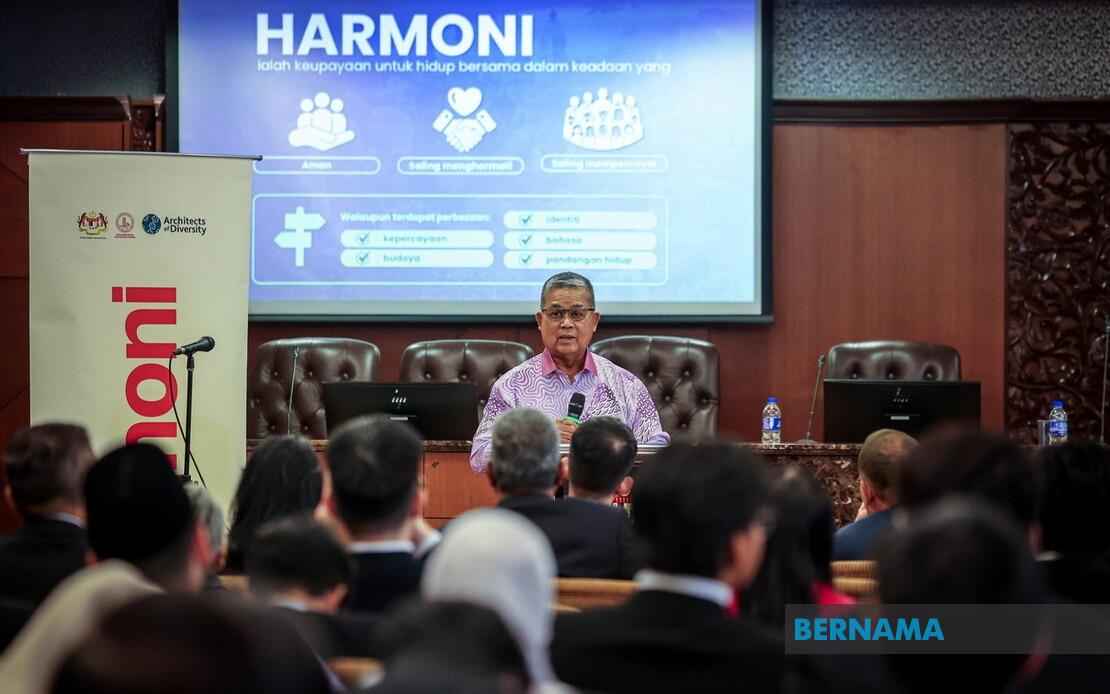
The Department of National Unity and National Integration has embarked on a comprehensive study to create a Community Tension Index that will measure the state of social cohesion across Malaysia and track emerging concerns related to sensitive matters of race, religion and respect for the monarchy. Minister of National Unity Datuk Aaron Ago Dagang outlined the initiative at the 2026 Harmony Symposium held at Parliament today, positioning the tool as a crucial instrument for government policymakers seeking to understand community dynamics and devise timely interventions before tensions escalate into broader societal friction.
The timing of this initiative reflects growing recognition within government circles that Malaysia's multicultural fabric faces challenges that have fundamentally transformed in nature and venue. Where communal tensions once played out primarily in physical spaces and traditional media channels, the epicentre of potential social friction has increasingly migrated to digital platforms, where algorithms and network effects can amplify divisions far more rapidly and with greater reach than previous generations experienced. This shift represents a qualitatively different threat landscape requiring novel measurement and monitoring approaches.
Recent enforcement data underscores the scale of problematic online content circulating across Malaysian digital spaces. Between January and June 2025, the Malaysian Communications and Multimedia Commission removed 1,493 pieces of online material touching on the three sensitive categories collectively known as 3R issues—matters involving race, religion and the institution of royalty. The volume of removals signals both the pervasiveness of inflammatory content and the ongoing need for systematic monitoring frameworks to track these trends over time. Such figures become meaningful only when contextualised within longer temporal patterns, highlighting precisely why a dedicated index would provide valuable diagnostic intelligence.
Datuk Aaron emphasised that contemporary social media environments create structural conditions prone to deepening polarisation through mechanisms that users may not fully appreciate. The phenomenon of filter bubbles—where algorithms preferentially show individuals content aligned with their existing preferences—combined with echo chambers where like-minded communities reinforce shared viewpoints, narrows exposure to diverse perspectives and understanding. This technological architecture can progressively widen interpretive gaps between different community segments, making genuine cross-community dialogue increasingly difficult even when such dialogue remains theoretically possible.
The proposed Community Tension Index would function as an early warning system, aggregating data signals that indicate rising communal stress before such stress manifests in visible social disruption. By establishing baseline measurements and tracking changes over time, government agencies can identify emerging friction points and deploy preventive resources strategically. This proactive orientation contrasts with reactive approaches that address problems only after they have crystallised into formal incidents or public crises. For a country as diverse as Malaysia, where harmony depends on millions of daily interactions across religious, ethnic and cultural lines, maintaining that early-warning capability carries substantial strategic value.
Parallel to developing the index, JPNIN has initiated broad stakeholder engagement to gather preliminary feedback on a complementary institutional proposal: the establishment of a National Harmony Commission. This proposed body would function as a dedicated mechanism for conflict prevention, mediation and resolution, approaching sensitive matters through frameworks explicitly designed to preserve social harmony rather than determine winners and losers through adversarial processes. The commission would also investigate issues deemed potentially damaging to national cohesion, providing institutional capacity specifically oriented toward unity objectives.
The National Harmony Commission concept acknowledges a structural gap in Malaysia's existing institutional architecture. While various bodies address specific grievances or enforce particular regulations, few mechanisms exist that explicitly foreground harmony as the paramount objective and empower dedicated institutions to work preventively across the full spectrum of potential friction points. Such a commission could serve as a neutral meeting ground where representatives from diverse communities address emerging tensions before they become entrenched positions, while also investigating situations that threaten cohesion from a perspective oriented toward resolution rather than punishment.
For Malaysian stakeholders invested in social stability, these developments signal government acknowledgement that unity cannot be assumed or maintained through passive neglect. Instead, maintaining harmony in a diverse society requires active, sustained institutional effort informed by systematic intelligence gathering and dedicated conflict resolution capacity. The Community Tension Index would provide the diagnostic intelligence, while the National Harmony Commission would supply the institutional mechanisms for prevention and resolution.
These initiatives also carry regional significance. Southeast Asia faces persistent challenges in managing religious sensitivities, communal relations and the transition of social conflict into digital spaces. Malaysia's experience developing measurement tools and institutional frameworks for these challenges could generate insights applicable across the region, where governments similarly navigate rapid digitalisation alongside ongoing efforts to nurture multicultural coexistence. The Malaysian approach of combining quantitative monitoring with dedicated institutional mechanisms represents a comprehensive strategy worthy of regional attention.
Implementing such initiatives effectively requires genuine commitment to early intervention and a willingness to address root causes of tension rather than merely suppress symptom manifestation. The success of both the Community Tension Index and the proposed National Harmony Commission will ultimately depend on whether findings drive substantive policy changes and whether the commission commands sufficient authority and resources to intervene meaningfully in disputes before they deteriorate. For Malaysia's diverse communities, the effectiveness of these tools in promoting genuine mutual understanding and harmonious coexistence will prove as consequential as their development.

