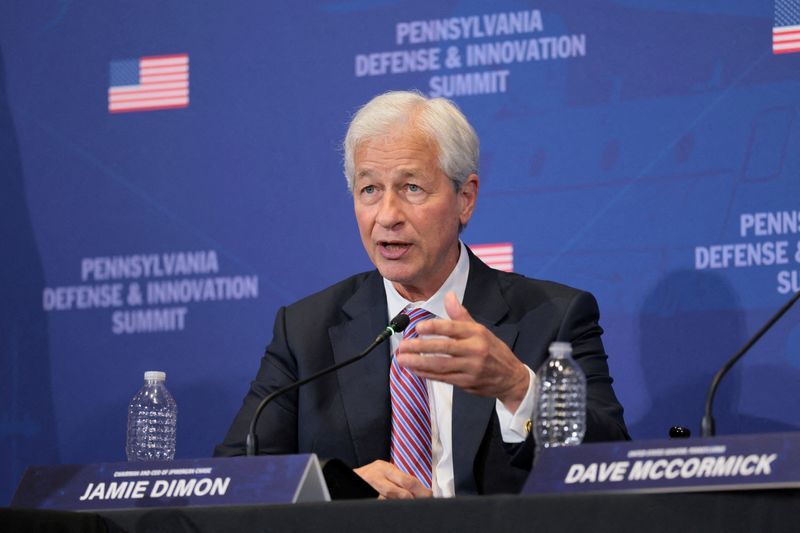
Jamie Dimon, chief executive of JPMorgan Chase and one of corporate America's most influential voices on economic and regulatory matters, is spearheading a coordinated industry response to the mounting risks posed by artificial intelligence deployment. The initiative, which has been expanding since July through personal outreach by Dimon to other senior executives, represents an acknowledgment among corporate leaders that the rapid adoption of AI technology across vital economic sectors demands structured governance and information sharing. Over 40 companies spanning financial services, energy generation, water systems, utilities, telecommunications, aviation, and rail transport have been invited to participate in what sources describe as a formal collaborative forum.
The organisational vehicle for this effort is the Alliance for Critical Infrastructure, an existing industry coalition that JPMorgan helped establish alongside Mastercard and Berkshire Hathaway Energy. Originally conceived to coordinate resilience planning and threat response across sectors dependent on technological systems, the ACI is being refocused and expanded to make artificial intelligence governance its central priority. Dimon's direct involvement in recruiting participants underscores both the seriousness with which he views the challenge and the credibility he commands within executive circles. The alliance intends to be fully operational in its enhanced form by the conclusion of this year, according to sources involved in the planning.
The timing of this corporate mobilisation reflects genuine urgency within senior business leadership. Recent cyberattacks targeting water infrastructure in Minnesota and elsewhere have demonstrated vulnerabilities in systems that millions of people depend upon daily. The convergence of increasingly sophisticated artificial intelligence capabilities with the potential for malicious deployment across interconnected critical infrastructure has prompted recognition that voluntary industry coordination may be essential before regulatory mandates impose solutions. Dimon's participation signals that major financial institutions view AI governance not merely as a compliance matter but as a fundamental threat to operational continuity.
What distinguishes Dimon's position within this broader discussion is his willingness to articulate specific concerns about advanced AI systems in unusually blunt language. In July, he publicly warned that providing access to sophisticated AI models like Anthropic's offerings would be equivalent to "giving ballistic missiles to individuals." This framing reflects anxieties held by significant portions of the financial and infrastructure sectors that the capabilities embedded in cutting-edge AI systems could enable actors—whether criminal, ideological, or hostile nations—to inflict damage on systems that are fundamental to economic function and public safety. The ACI effort aims to develop shared understanding of how AI is actually being deployed across industries, what specific risks emerge from those uses, and what safeguards are technically and operationally feasible.
The initiative's structure contemplates an information-sharing forum coupled with direct engagement with government officials. Rather than seeking to block or restrict AI deployment, the corporate coalition appears to be positioning itself as a collaborative partner with regulators in identifying emerging vulnerabilities, coordinating responses, and solving problems as they surface. This approach aligns with broader shifts in how the U.S. government is attempting to manage artificial intelligence risks. In July, the federal government launched an initiative called Gold Eagle, which brings together AI developers, operators of critical infrastructure, and federal agencies to share information about vulnerabilities that advanced models might exploit and to coordinate remediation efforts.
For Malaysian and Southeast Asian observers, this corporate and governmental coordination on AI risks carries significant implications. The region's rapidly developing digital economies are increasingly integrated with global financial systems, supply chains, and technology platforms. Infrastructure sectors critical to Malaysia's economic function—ports, power generation, telecommunications, financial transaction processing—are themselves dependent on interconnected systems increasingly incorporating artificial intelligence. The risk frameworks being developed in the United States will likely influence how regulators across the Asia-Pacific region approach AI governance. Moreover, as critical infrastructure becomes more dependent on AI systems to optimise operations and detect anomalies, the governance standards established in mature economies tend to cascade into emerging markets through regulatory pressure and investor expectations.
The breadth of industries participating in the ACI effort illustrates how thoroughly AI has penetrated operational decision-making across the economic landscape. That aviation, rail transport, energy utilities, and water systems are all seeking coordinated information-sharing arrangements on AI risks suggests that executives across diverse sectors recognise they face common vulnerabilities. A vulnerability discovered in how one industry's AI systems process information might reveal similar exposures in another sector's implementations. Information sharing can accelerate identification and remediation of these weaknesses before malicious actors exploit them systematically.
Dimon's role as convener deserves particular attention because it demonstrates how leadership in the financial sector carries outsized influence on broader corporate governance practices. JPMorgan Chase, as the largest bank in the United States, processes enormous transaction volumes and manages sensitive data for millions of customers and institutions. Its decisions on risk management, particularly regarding emerging technologies, influence practices among smaller financial institutions, many of which lack the resources to conduct independent research on complex technological threats. When Dimon signals that AI governance is a priority requiring board-level attention and cross-industry coordination, institutions across the financial system take note.
The distinction between the ACI's effort and a separate initiative involving banks testing Anthropic's AI capabilities indicates that the industry is pursuing parallel tracks: some experimentation with advanced AI systems to understand their capabilities and limitations, combined with governance structures to manage risks. This dual approach reflects a pragmatic recognition that complete avoidance of AI technology is neither economically feasible nor strategically advisable in an environment where competitors are deploying these systems. Instead, the objective is managed deployment coupled with systematic risk identification and mitigation.
As artificial intelligence continues its rapid integration into critical systems, the model being developed through the ACI suggests that corporate America is moving toward a self-regulatory framework supported by government participation rather than waiting for regulatory mandates. Whether this approach proves adequate will depend on the quality of threat analysis the alliance produces, the willingness of participating companies to share sensitive information about vulnerabilities, and the responsiveness of both corporate and governmental bodies to emerging problems. For Southeast Asia's developing economies, observing how this initiative functions will provide valuable lessons for structuring their own AI governance approaches before deployment reaches the scale and integration seen in mature markets.

