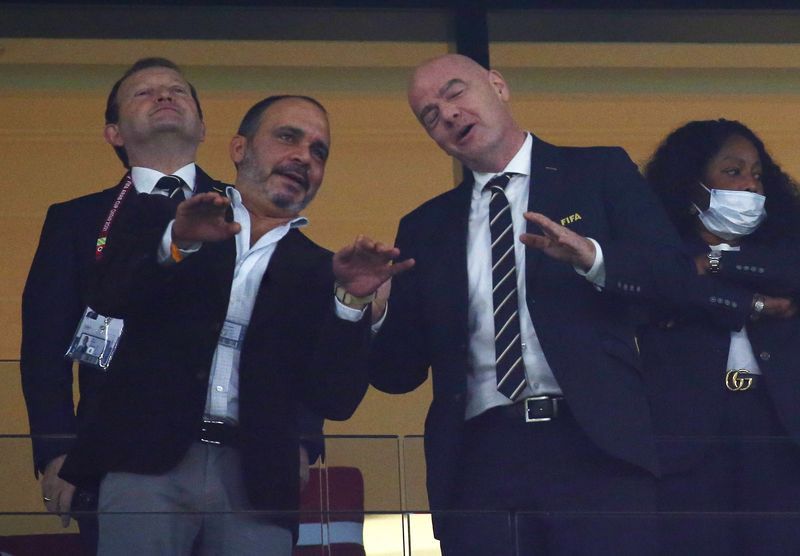
The head of Jordan's national soccer body has launched a scathing public rebuke of FIFA President Gianni Infantino, alleging that the world governing authority engaged in coercive tactics by suggesting that endorsing his leadership would facilitate resolution of longstanding problems affecting the Jordanian federation. Ali bin Hussein, who leads the Jordan Football Association, made his accusations public on Tuesday, describing the situation as amounting to "blackmail" and stating flatly that Jordan would not capitulate to such pressure regardless of the potential benefits offered.
According to Bin Hussein's account, FIFA representatives communicated informally during the recent World Cup that the Jordanian federation's endorsement of Infantino would substantially assist the association in securing support on various outstanding matters. This alleged quid pro quo came only after the Jordan FA had spent months unsuccessfully petitioning FIFA for assistance with multiple issues facing the federation. The Jordanian official emphasized that his association has consistently upheld ethical standards and declined to back Infantino previously, with no intention of changing that position now, even if circumstances might have shifted.
Bin Hussein's public criticism arrives at a particularly vulnerable moment for Infantino, whose authority within international soccer's leadership structures has weakened considerably. The FIFA president recently faced significant resistance and was compelled to withdraw a contentious proposal that would have involved privatizing a minority stake in FIFA's commercial operations, a move designed to generate billions of dollars earmarked for development initiatives worldwide. Multiple soccer confederations and national associations coalesced in opposition, with a September 19 deadline ultimately proving ineffective in securing the necessary backing for this financial restructuring.
Several prominent figures within FIFA's own organizational structure have distanced themselves from Infantino's leadership direction, signaling cracks in what once appeared to be consolidated support. Mattias Grafstrom, serving as FIFA's Secretary General, and Arsene Wenger, prominent within the federation's executive framework, have both stepped back from endorsing the controversial initiatives. Bin Hussein himself pointed to broader concerns about FIFA's governance, noting that fundamental problems exist within the organization's leadership.
The Jordan Football Association's catalogue of grievances extends far beyond the alleged blackmail attempt and illuminates the pressures facing smaller national federations within FIFA's hierarchical structure. Despite modest financial resources, Jordanian fans have confronted prohibitively expensive ticket pricing for matches, yet paradoxically remain unable to secure travel visas to attend World Cup fixtures in the United States. This disconnect between financial burden and access rights reflects a systemic issue within FIFA's tournament organization that disproportionately affects supporters from developing nations.
Financial compensation owed to Jordan represents another contentious issue. The federation has awaited payment since December for the national team's achievement in reaching the final of the 2025 Arab Cup, a tournament organized under FIFA's auspices. This delayed disbursement strikes Bin Hussein as particularly egregious given that FIFA maintains substantial financial reserves and frequently publicizes its fiscal strength. The contrast between FIFA's reported wealth accumulation and its reluctance to promptly settle obligations to participating federations has become a focal point of frustration for Jordan's leadership.
A distinctive tax burden has complicated Jordan's World Cup participation in ways that neighboring nations avoided. The United States government, through FIFA's administrative mechanisms, levied taxes on the Jordanian delegation for their involvement in the tournament—a financial imposition not similarly applied to teams based in Canada or Mexico. Bin Hussein emphasized that these unexpected tax liabilities drain resources that could otherwise support players and staff, effectively penalizing Jordan for its geographical location rather than any administrative choice. The situation exemplifies how structural inequities can emerge from FIFA's tournament hosting arrangements.
For Jordan, qualifying for the World Cup represented a historic achievement, breaking through after years of unsuccessful attempts. However, the group stage exit, combined with the administrative and financial challenges that accompanied participation, has left the experience marked by frustration. The supposed prestige of World Cup qualification has been substantially diminished by the practical obstacles and financial complications that the Jordanian federation has encountered in the tournament's aftermath.
Bin Hussein's decision to voice these accusations publicly reflects growing impatience among smaller federation leaders with FIFA's operational practices and power dynamics. The situation underscores a fundamental tension within international soccer governance: between FIFA's centralized authority and its accountability to the diverse membership it purports to serve. For Malaysian football stakeholders and other Southeast Asian federations facing similar resource constraints and structural disadvantages within FIFA's framework, the Jordan FA's public stance carries significant implications, potentially emboldening other voices to articulate grievances that have historically remained unspoken or contained within closed-door negotiations.
The broader context suggests that Infantino's authority is increasingly vulnerable to erosion from multiple quarters—not merely from established power brokers within soccer's elite circles, but from representatives of smaller nations demanding equitable treatment and transparent governance. As FIFA confronts renewed criticism over its operational integrity and leadership, the organization faces mounting pressure to address systemic inequities that affect federations with limited political leverage within the international soccer hierarchy.

