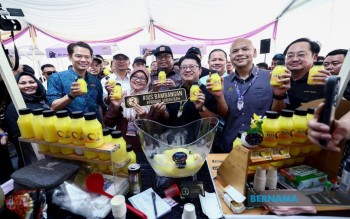
Chief Minister Datuk Seri Hajiji Noor has endorsed the JOM MALAYSIA movement as a transformative force for Sabah's economic trajectory, unveiling the initiative at the JOM MALAYSIA Festival 2026 in Sandakan. Rather than functioning as a conventional retail promotion or one-off sales event, the movement represents a comprehensive ecosystem designed to nurture entrepreneurship from conception through to global distribution. This strategic positioning reflects Kuala Lumpur's confidence in Sabah's capacity to drive growth across East Malaysia, with the selection of the state as a festival host location serving as formal recognition of its economic standing within the federation.
The alignment between JOM MALAYSIA and Sabah Maju Jaya 2.0 creates a coherent narrative around sustainable and inclusive growth. Hajiji outlined how the two initiatives operate in concert, moving beyond isolated interventions toward an integrated development chain. The progression—from initial entrepreneur capacity-building through product refinement to market access—addresses the structural challenges that have historically constrained Malaysian SMEs from scaling beyond domestic boundaries. By positioning government institutions, financial intermediaries, industry associations, and private enterprise within a single coordinated framework, the approach acknowledges that no single actor can unilaterally overcome the barriers confronting would-be exporters.
Recent performance data underscore why policymakers view Sabah as an emerging export powerhouse. In 2025, 124 SME operators from the state participated in 18 international trade exhibitions, generating RM95.9 million in potential sales—a gain of 37.12 percent compared to the preceding year's RM60.4 million. This trajectory demonstrates that Sabah-based manufacturers and suppliers possess genuine competitiveness when presented with structured market access opportunities. The growth rate substantially exceeds aggregate Malaysian SME export growth, suggesting that targeted investment and promotional effort yields measurable returns in the Sabahan context.
Critical to this expansion is the SME-UP Assistance Programme, a dedicated RM15 million initiative housed within the Department of Industrial Development and Research. The scheme targets 600 micro, small, and medium-sized enterprises with customised support packages designed to elevate operational capacity and product standards. By concentrating resources on this ecosystem segment—which collectively employs significant portions of Sabah's workforce and generates substantial tax contributions—the programme addresses equity concerns while simultaneously building the export pipeline. This represents a departure from blanket subsidy approaches toward diagnostic, need-based intervention.
Specialised sectoral support mechanisms further enhance the initiative's practical utility. The Sabah Ready-to-Eat Programme exemplifies this targeted approach, channelling development grants, retort machinery assistance, and halal certification support to food entrepreneurs. These interventions tackle genuine bottlenecks: commercialising traditional food products demands capital for modern processing equipment, rigorous food safety compliance, and religious certification credentials that individual producers struggle to obtain independently. By centralising these services, the programme accelerates commercialisation timelines while embedding quality and safety standards from inception.
The halal dimension warrants particular emphasis for Malaysian and regional readers. Sabah's positioning within global halal supply chains provides competitive advantage across Muslim-majority markets spanning the Middle East, North Africa, and Southeast Asia itself. International certification, increasingly demanded by buyers in these territories, requires traversing complex bureaucratic and technical requirements. State-level facilitation of this process effectively opens doorways to market segments representing trillions in purchasing power. For Malaysian exporters competing against producers from Turkey, Indonesia, and Bangladesh, certified authenticity constitutes a meaningful differentiator.
Tourism integration represents an underexploited vector for product promotion that the initiative appears poised to activate. Sabah recorded 3.79 million international visitor arrivals and RM8.74 billion in tourism revenue during the previous year, with projections for expansion tied to Visit Malaysia Year 2026 and Visit Sabah Year 2027. Tourism infrastructure concentrates affluent consumers with disposable income and propensity to purchase premium regional goods—precisely the demographic that premium Sabahan products target. Embedding product showcases within hotel networks, airport retail facilities, and curated visitor experiences transforms tourism infrastructure into distributed salesrooms for local entrepreneurs.
Hajiji's proposal that the Ministry of Domestic Trade and Cost of Living collaborate with Sabah authorities to establish JOM MALAYSIA presence at strategic locations throughout the state during Visit Sabah Year 2027 operationalises this convergence. Rather than confining the movement to major urban centres or temporary festival grounds, distributed activation would penetrate tourist-trafficking corridors, resort precincts, and heritage sites. This spatial strategy acknowledges that tourist purchasing patterns diverge substantially from domestic consumer behaviour; international visitors actively seek culturally distinctive merchandise, accept premium pricing for authenticity, and possess no domestic supply alternatives.
The initiative carries implications beyond Sabah itself. Malaysia's regional competitiveness increasingly depends upon leveraging provincial strengths rather than concentrating export capacity in Selangor and Johor. JOM MALAYSIA, by systematically cataloguing and promoting products from peripheral regions, redistributes economic opportunity and reduces geographic concentration of wealth. For Southeast Asian observers, the model demonstrates how federal systems can reconcile centralised policy coordination with decentralised implementation, enabling smaller or less developed regional units to benefit from national promotional platforms.
Implementation fidelity will ultimately determine success. Previous Malaysian export-promotion initiatives have faltered when institutional coordination proved inadequate, financing insufficient, or entrepreneurial capacity-building superficial. The SMJ 2.0 framework's embedding of JOM MALAYSIA within broader state development architecture suggests deeper institutional commitment than episodic campaigns typically receive. Nevertheless, sustained political attention, adequate recurrent resourcing, and genuine private-sector participation remain prerequisites for translating policy aspiration into measurable expansion of Sabahan export volumes and values.
Looking forward, the movement's trajectory will reflect broader dynamics affecting Malaysian trade policy. Regional trade integration through ASEAN frameworks, bilateral agreements with major trading partners, and evolving global supply-chain configurations will shape the commercial landscape within which Sabah enterprises operate. JOM MALAYSIA's effectiveness depends partly upon navigating these external constraints—securing tariff reductions, establishing regulatory recognition in target markets, and positioning Sabahan products within regional value chains. Domestic policy excellence constitutes necessary but insufficient condition for success in an interconnected global economy.

