Johor's state government has completed its transition to a restructured executive council, with Menteri Besar Datuk Onn Hafiz framing the overhaul as a strategic recalibration designed to maintain administrative momentum while infusing fresh perspectives into governance. The leadership changes, finalised during ceremonies at Istana Bukit Serene on July 18, represent the culmination of efforts to reconfigure how the state tackles development priorities and public services in the coming term.
Datak Onn Hafiz's characterisation of the reshuffle as part of routine administrative renewal reflects a broader political reality in Malaysian state governments: periodic restructuring of executive councils serves both as a mechanism for rewarding political loyalists and as an opportunity to signal strategic shifts in policy focus. The Johor Menteri Besar emphasised that such reorganisations are inherent to sound governance, necessary for charting fresh directions while remaining grounded in continuity of vision. This framing carries particular weight in Johor, a state whose economic significance as Malaysia's second-largest contributor to gross domestic product makes administrative effectiveness a matter of regional concern.
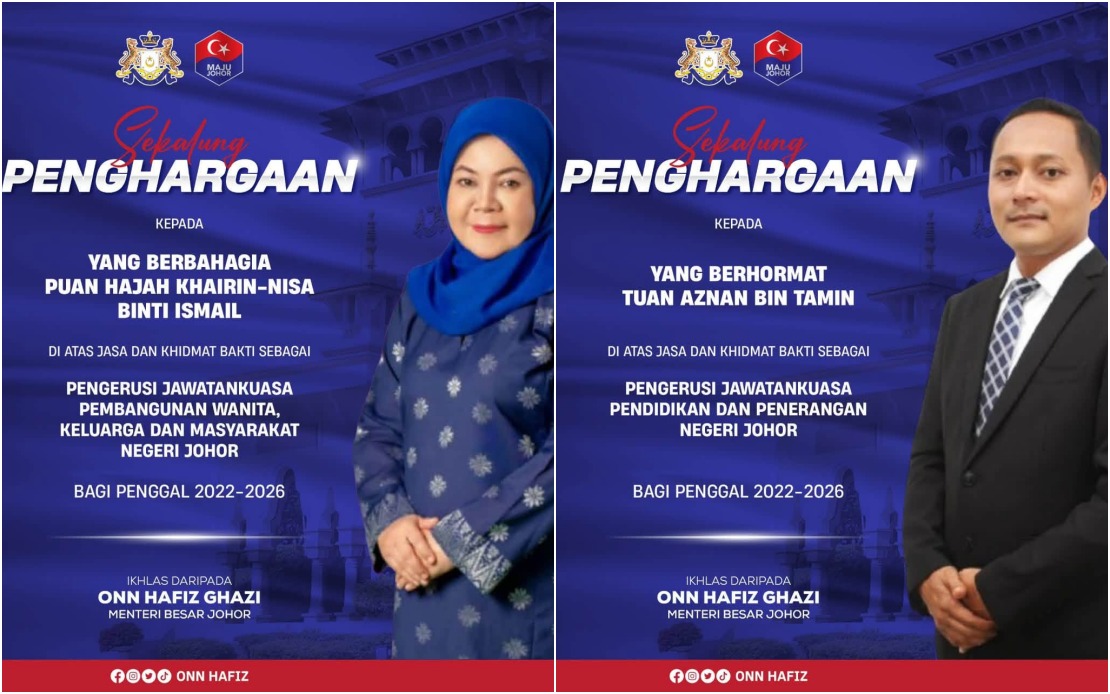
The four exco members departing the 2022-2026 term—Datuk Zahari Sarip, K. Raven Kumar, Aznan Tamin and Khairin-Nisa Ismail—received public recognition from the Menteri Besar for their accumulated contributions to state governance. Onn Hafiz's acknowledgement reflects a political courtesy common across Malaysian administrations, where outgoing officials are typically praised for sacrifice and commitment even when their departure signals strategic repositioning. The gesture also serves a practical purpose: by publicly valuing the departing members' work, the Menteri Besar insulates himself from perceptions of ingratitude that might otherwise circulate within the ruling coalition and wider public discourse.
The incoming executive council composition reveals deliberate choices about representation and portfolio distribution. Six assemblymen retained their positions in the new structure, suggesting continuity in certain policy domains and acknowledgement of proven competence in specific administrative areas. The appointment of four new faces introduces fresh capability into the administration, though the specifics of which portfolios these newcomers assumed remain significant for understanding the state's evolving priorities. In Malaysian state politics, such shifts often signal enhanced emphasis on particular sectors—whether urban development, commerce, social welfare or infrastructure—depending on which portfolios the new exco members inherit.
The formal swearing-in ceremony before Tunku Mahkota Ismail, Johor's Regent, invested the reshuffle with ceremonial weight appropriate to the constitutional role of the state's royal institution. This procedural formality underscores the legality and legitimacy of the transitions, ensuring that all ten exco members begin their tenure with unambiguous constitutional standing. For Malaysian governance, such ceremonies reinforce the institutional frameworks binding executive action to constitutional monarchy, a distinctive feature of the Malaysian political system that differs markedly from Westminster practice.
Onn Hafiz's public statements regarding the reshuffle emphasise a philosophy of inclusive leadership that extends beyond formal office-holding. His assertion that experience, wisdom and passion for service transcend particular positions suggests he intends departing exco members to remain engaged with state governance in secondary capacities—whether within legislative committees, party structures or advisory forums. This reflects pragmatic political management: retaining loyalty and expertise of senior figures even as formal decision-making authority shifts to new hands.
The broader context of Johor state politics situates this reshuffle within wider power consolidation by the Menteri Besar. Onn Hafiz, who assumed office following the 2022 state elections, has progressively shaped his administration according to his preferences and political calculations. The restructuring of the exco represents a maturing of his tenure, moving beyond the transitional accommodations necessarily made during initial administration formation toward a cabinet reflecting his preferred approach to governance priorities.
For Malaysian and Southeast Asian observers, Johor's administrative changes merit attention because the state functions as an economic bellwether for broader Malaysian development trajectories. Johor's role as a manufacturing and logistics hub, its proximity to Singapore as a global financial centre, and its status as a major tourist destination mean that the competence of its state administration carries implications extending beyond regional boundaries. Portfolio allocations within the restructured exco—particularly those responsible for economic development, infrastructure and business-friendly policies—will influence investor confidence and regional economic performance.
The reshuffle also reflects demographic and political evolution within Johor's ruling coalition. The inclusion of new exco members signals openness to emerging political figures and, potentially, broader representation across different demographic segments within the ruling party structure. Such moves, when executed strategically, can rejuvenate governing coalitions by demonstrating meritocratic advancement and preventing the ossification of power within narrow circles—concerns that periodically arise in Malaysian state governments where certain families or factions dominate decision-making over extended periods.
Moving forward, the effectiveness of this administrative restructuring will be measured against tangible outcomes in state-level service delivery, economic management and policy implementation. Johor residents and investors will ultimately assess the new exco configuration through the prism of concrete results: whether infrastructure development accelerates, whether business registrations increase, whether public health and education services improve. The Menteri Besar's public statements positioning the reshuffle as forward-looking renewal carry implicit commitment to delivering improvements that justify the administrative transition.
The transition also carries implications for Johor's relationship with the federal government and other Malaysian states. State-level administrative changes can influence inter-governmental dynamics, particularly regarding allocation of federal resources, infrastructure project approvals, and coordination on policies spanning multiple jurisdictions. A cohesive and capable state exco enhances Johor's bargaining position in national forums, potentially yielding advantages in infrastructure investment and policy support for the state's development agenda.

