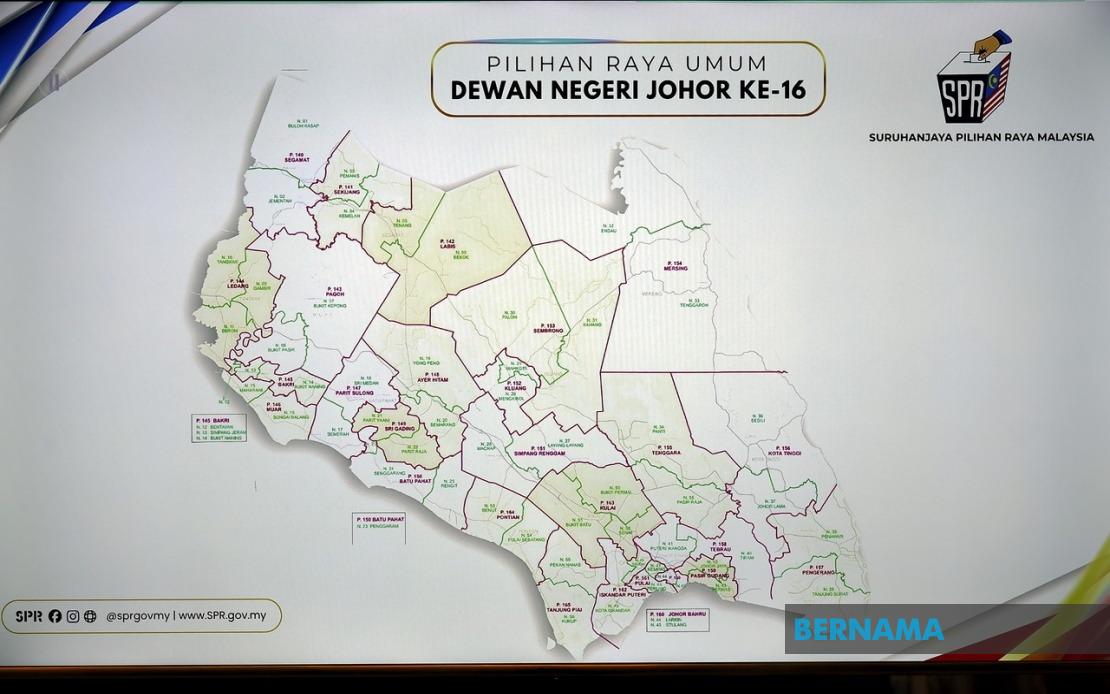
The 16th Johor state election enters its decisive phase tomorrow when nomination day opens the floodgates for what is shaping up to be a fiercely competitive three-way contest across all 56 state assembly seats. The period from 9 am to 10 am will see candidates submitting their nomination papers at designated registration centres throughout the state, after which the Election Commission (EC) will announce the complete roster of contenders following a screening phase. Polling will take place on July 11, with early voting opportunities available on July 7 for eligible voters who cannot make the main voting day.
The electorate for this election is substantial, with the EC confirming that 2,727,926 voters are registered to participate. This figure encompasses more than 2.7 million ordinary voters, alongside 12,041 military personnel and their spouses, as well as 12,710 police officers and their spouses, reflecting the broad representation sought in state electoral contests. The size of the electorate underscores the significance of the election and the logistical complexity involved in administering voting across the state's geography.
With nomination day upon them, Malaysia's major political coalitions have already unveiled their complete candidate lineups, presenting the electorate with a mix of sitting representatives, newcomers, and veterans attempting to reclaim lost seats. Pakatan Harapan (PH) has committed to contesting every available seat, distributing its 56 candidates among three component parties: Parti Keadilan Rakyat (PKR) fields 20 candidates, Amanah contributes 19, and the Democratic Action Party (DAP) deploys 17 contestants. This united front reflects the coalition's determination to challenge the incumbent administration.
Barisan Nasional (BN) has matched this commitment by fielding a complete slate of 56 candidates of its own, drawn primarily from its dominant component, the United Malays National Organisation (UMNO), which has nominated 36 candidates. The Malaysian Chinese Association (MCA) adds 16 candidates to the coalition's campaign, while the Malaysian Indian Congress (MIC) completes the lineup with four representatives. The full participation from BN reflects confidence in the coalition's position following its strong performance in the 2022 election.
Perikatan Nasional (PN), the newer coalition in Malaysian politics, has also entered the fray with candidates across multiple seats, leveraging its component parties. The Pan-Malaysian Islamic Party (PAS) is fielding 11 candidates, Bersatu contributes 16, and the Malaysian Indian People's Party (MIPP) rounds out the coalition's presence with five candidates. This distribution reveals PN's attempt to build a geographically and demographically diverse campaign across the state.
Beyond the established coalitions, several other parties have seized the opportunity to contest. The Malaysian United Democratic Alliance (MUDA), which gained prominence in recent electoral cycles, is targeting four seats, while the Socialist Party of Malaysia (PSM) has nominated a single candidate. Most notably, Parti Bersama Malaysia (Bersama) is making its debut in Johor with candidates across 15 seats, representing a significant new entrant seeking to establish itself within the state's political landscape.
In preparation for the formal commencement, the Election Commission has issued guidance to prospective candidates, urging them to verify their nomination forms in advance at either the Returning Officer's Office or the State Election Office to minimise procedural complications. The commission has also stressed the importance of settling deposit payments well ahead of the submission deadline and retaining receipts as proof of payment when presenting nomination documents. These administrative reminders reflect lessons learned from previous elections and the EC's commitment to ensuring a smooth nomination process.
Anti-corruption oversight represents another critical dimension of the election framework. The Malaysian Anti-Corruption Commission (MACC) has issued explicit warnings to all candidates and political parties, reminding them of their obligations to comply with both the MACC Act 2009 and the Election Offences Act 1954 as amended in 2012. The commission has demonstrated its seriousness by establishing five round-the-clock operations centres strategically located in Tampoi, Batu Pahat, Kluang, Segamat, and Mersing, providing the public with dedicated channels through which to report instances of alleged corruption or abuse of power. This network of monitoring stations will remain active throughout the election period, signalling the authorities' commitment to maintaining electoral integrity.
The dissolution of the Johor State Legislative Assembly on June 1 set in motion the machinery for this contest, which represents a crucial test of voter sentiment in one of Malaysia's economically significant states. The 2022 state election results provide important context for understanding the dynamics at play. Barisan Nasional secured a decisive 40 seats that year, while Pakatan Harapan captured 12 seats, Perikatan Nasional won three seats, and the newly ascendant MUDA claimed one seat. These results saw BN retain control of the state government, though the distribution reflected the competitive nature of modern Malaysian politics.
This electoral rematch carries substantial implications for national politics, as the performance of major coalitions in Johor often signals broader trends affecting federal politics and coalition dynamics. The state's position as an economic powerhouse in Southeast Asia, coupled with its strategic location near Singapore and its historically significant voting blocs, means outcomes here frequently receive attention far beyond Johor's boundaries. The ability of each coalition to mobilise supporters, attract swing voters, and manage internal party dynamics will be tested across the 56 contests.
The participation of new and smaller parties alongside the established coalitions adds layers of unpredictability to the election. Bersama's significant presence with 15 candidates represents a genuine attempt to capture votes from the middle ground, while MUDA's continued participation in selected seats reflects its strategy of focusing on competitive constituencies where it believes it can succeed. These dynamics could fragment votes in certain constituencies, potentially affecting outcomes where margins are traditionally narrow.

