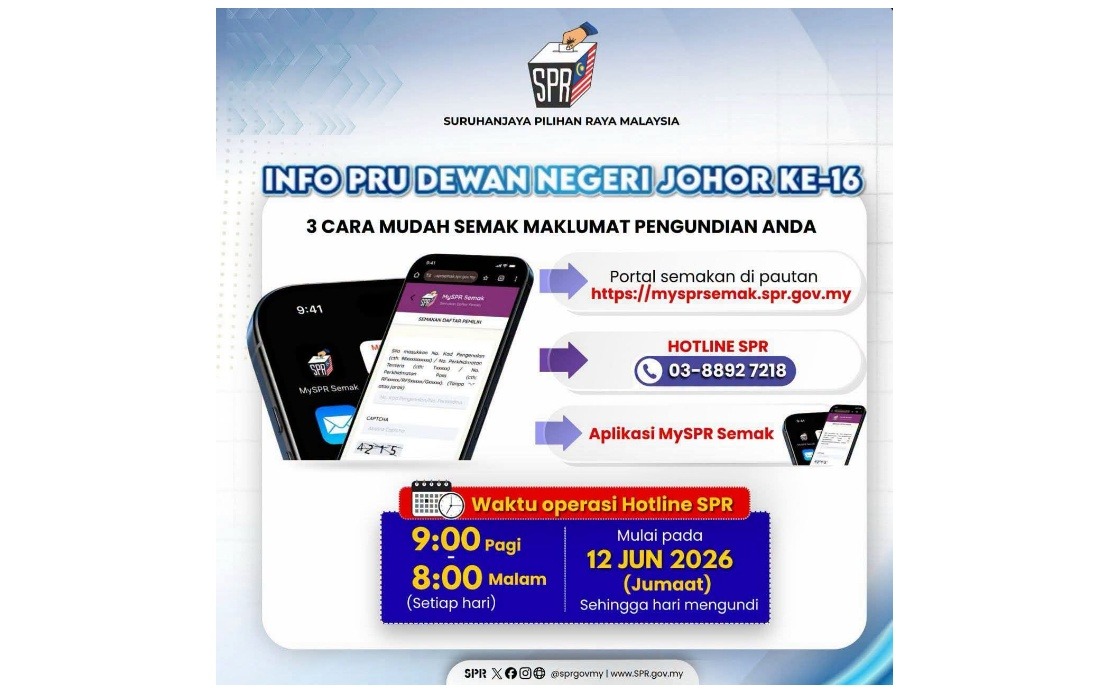
With the 16th Johor state election set for July 11, the Election Commission has issued a timely reminder to the state's registered voters to confirm their assigned polling centres and voting arrangements. The advisory comes as nearly 2.7 million eligible ordinary voters prepare to participate in what represents a significant electoral exercise for the southern state. The EC's guidance underscores the importance of pre-election preparation, particularly given the scale and complexity of managing such a large electorate across multiple constituencies.
Voters can access their polling centre information through two convenient digital channels: the MySPR Semak online portal or the MySPR Semak mobile application. This dual-access approach reflects the Election Commission's commitment to leveraging technology to enhance voter convenience and reduce confusion on polling day itself. By enabling citizens to verify their details ahead of time, the commission aims to streamline the voting process and minimise queues at polling stations on Saturday.
The election will determine which 56 state assembly representatives will lead Johor for the next term, making it a crucial democratic exercise for the state's political direction. The magnitude of this undertaking is reflected in the turnout figures from early voting, which took place last Tuesday. A total of 19,471 early voters participated, comprising 7,960 military personnel and their spouses alongside 11,511 police officers—including General Operations Force members and their families. This early voting segment demonstrates strong participation among uniformed services, who traditionally vote in advance due to their security and operational commitments.
The candidate field for this election reflects the competitive nature of Malaysian politics, with 172 candidates vying for the 56 seats across various political affiliations. The two major coalitions—Pakatan Harapan and Barisan Nasional—each fielded 56 candidates, essentially contesting every single constituency. This comprehensive approach by both blocs indicates the significance both place on Johor's political outcome. Perikatan Nasional, meanwhile, has put forward 33 candidates, representing a substantial third force in the competition.
Beyond the major players, several smaller parties and independent candidates have entered the fray, reflecting the diversity of political representation sought by some voters. Parti Bersama Malaysia fielded 15 candidates, while the Malaysian United Democratic Alliance (MUDA) put up four contenders. Additionally, Parti Orang Asli Malaysia (ASLI) and Parti Sosialis Malaysia (PSM) have candidates in the race, alongside six independent hopefuls who are running without party affiliation. This fragmented field demonstrates how Malaysian politics, particularly at state level, increasingly features multiple political options beyond the traditional two-coalition framework.
For Malaysian voters and observers, the Johor election carries broader implications for the nation's political landscape. As one of Malaysia's most important states economically and politically, Johor's election outcome frequently signals trends that reverberate across the country. The performance of different coalitions here can influence momentum heading into any future federal elections and shape perceptions of government popularity. Analysts typically view Johor results as a barometer of national sentiment, making Saturday's vote particularly significant for all political stakeholders.
The Election Commission's proactive communication strategy in reminding voters to check their details reflects lessons learned from previous electoral exercises. Pre-election confusion about polling locations has historically led to logistical challenges and prevented some eligible voters from participating smoothly. By publicly encouraging verification through the MySPR Semak system, the commission demonstrates its commitment to maximising participation rates and ensuring that voters can exercise their democratic right efficiently. This approach also reduces the administrative burden on poll workers on the actual day of voting.
The technological infrastructure supporting this election—particularly the online portals and mobile applications—represents Malaysia's ongoing digitalisation of electoral processes. These systems allow voters to independently verify their information at their own convenience, at any time before polling day. This self-service approach empowers citizens and reduces dependency on physical visits to electoral offices, particularly beneficial for those in remote areas or with mobility constraints. The availability of both web and mobile options ensures accessibility across different demographic groups and technical comfort levels.
For Johor's electorate, this election represents more than just selecting state representatives; it will influence the state government's composition and policy direction for the next term. The variety of candidates and parties on offer means voters have substantive choices regarding the vision they prefer for Johor's development, particularly concerning economic priorities, infrastructure investment, and social policy. Saturday's result will reflect how Johor residents assess the performance of incumbent leadership and what they anticipate from alternative options.

