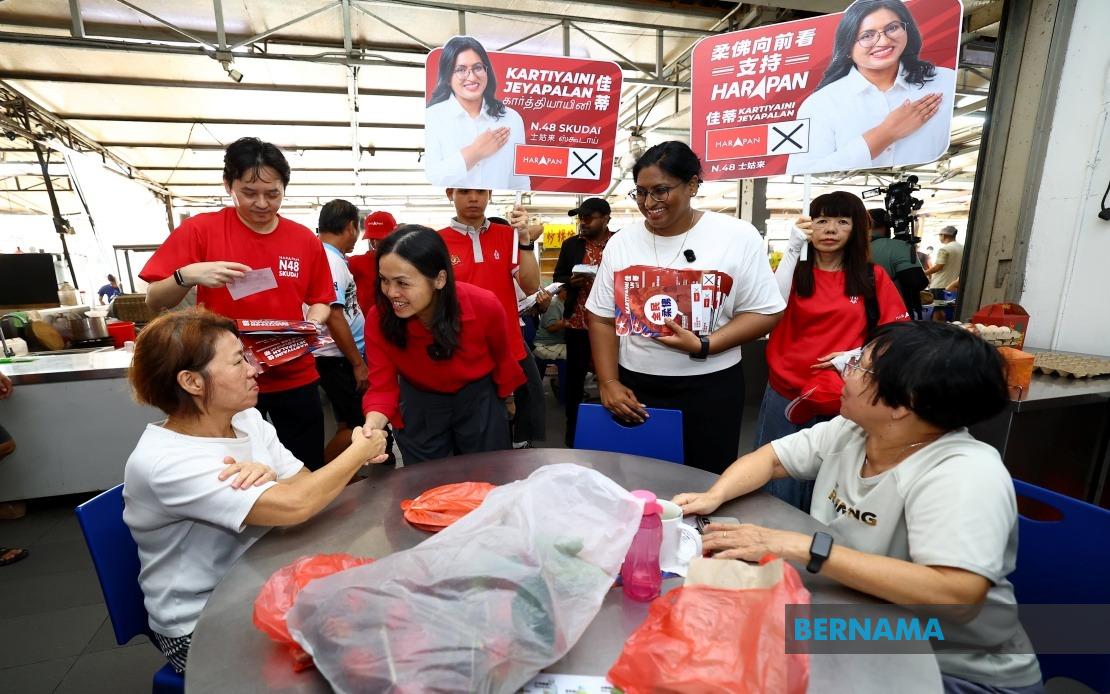
The upcoming Johor state election on Saturday has prompted calls for greater voter participation, particularly from Malaysians living outside the state or abroad. Johor DAP chairman Teo Nie Ching, who serves as Deputy Communications Minister, made an emotional plea to eligible voters to recognise the privilege of casting their ballots, drawing attention to the remarkable efforts undertaken by diaspora communities determined to participate in the democratic process. Speaking after a campaign visit to Kampung Baru Skudai alongside Pakatan Harapan candidate Kartiyaini Jeyapalan, Teo underscored how the sacrifices made by overseas voters should inspire those with easier access to polling stations.
The stories shared by Teo illuminate the lengths to which Malaysians abroad are willing to go to exercise their franchise. A voter based in Queensland, Australia faced delivery uncertainties with postal voting services and personally sought someone to hand-carry the ballot back to Malaysia before the July 11 deadline. In another instance, a postgraduate student pursuing studies in China incurred additional costs exceeding RM1,000 by rescheduling flights to return home specifically for voting day. Meanwhile, a voter in the United States invested considerable effort locating fellow Malaysian citizens to witness the completion of postal voting procedures. These accounts underscore a profound commitment to democratic participation that contrasts sharply with voter apathy in some domestic constituencies.
Teo's remarks carry particular significance for workers employed in neighbouring Singapore and Kuala Lumpur, regions with substantial concentrations of Johor-based employment. She expressed hope that such individuals, facing far lower logistical barriers compared to overseas voters, would similarly prioritise returning home to cast their votes. The Deputy Communications Minister framed voting as an expression of civic ownership, emphasising that each ballot represents an opportunity to influence governmental direction and policy implementation. Her message resonates within Malaysia's broader context, where federal elections typically draw higher participation rates than state contests, suggesting potential voter complacency regarding state-level decisions.
Simultaneously, Teo issued a stark warning regarding the proliferation of deliberately fabricated information designed to distort electoral discourse. She highlighted how coordinated disinformation campaigns, often operating through fake social media accounts, escalate during critical campaign phases when voter attention peaks. The spread of false narratives represents a distinct challenge to electoral integrity, particularly in an environment where digital platforms enable rapid dissemination of unverified claims. Teo advocated for greater digital literacy among the Malaysian public, proposing a cultural shift toward verification before sharing content, essentially asking citizens to act as gatekeepers against false information.
The emphasis on combating misinformation reflects genuine concerns about information ecosystems in Southeast Asia, where fact-checking infrastructure remains underdeveloped compared to Western democracies. Malaysia has experienced repeated episodes of election-related disinformation, from the 2018 general election through subsequent state contests. Social media algorithms, designed to maximise engagement rather than accuracy, often amplify sensational false claims over nuanced factual reporting. Teo's advocacy for adopting a 'verify before you share' ethos addresses a systemic weakness: the speed at which fabricated content spreads frequently outpaces correction efforts. Such advice proves especially critical for older demographics and those less accustomed to digital verification methods.
Kartiyaini, the PH candidate for Skudai state seat, has spearheaded targeted mobilisation efforts directed at cross-border workers. The campaign intensity reflects strategic calculations about marginal constituencies where commuter participation could determine electoral outcomes. She and allied PH activists positioned themselves at the Sultan Iskandar Building Customs, Immigration and Quarantine Complex starting at 5 am to intercept cross-border workers during their transit to Singapore. Additionally, campaign personnel boarded worker transport vehicles to deliver personalised appeals for electoral participation. Kartiyaini reported receiving notably positive responses, suggesting genuine openness among targeted voters, though translating expressed support into actual polling day turnout presents a distinct challenge.
Kartiyaini's campaign messaging extends beyond voter mobilisation to encompass broader advocacy regarding state election significance. She contends that state-level governance exerts profound influence on local development trajectories, infrastructure investment, and service delivery quality. This framing counters a prevalent perception, particularly among younger voters, that state elections constitute lower-priority contests compared to federal elections. She emphasised that effective, proactive state administration directly impacts implementation of policies addressing Johor residents' concrete needs. Such positioning attempts to elevate state election prestige within voters' prioritisation frameworks, potentially affecting turnout calculations among those viewing such contests as secondary.
The 16th Johor state election encompasses 2.7 million registered voters determining representation across 56 state assembly constituencies. This figure indicates substantial electorate size comparable to several Southeast Asian countries' entire voting populations. The scale of participation potential, combined with relatively tight competition in multiple constituencies, renders marginal increases in turnout strategically consequential. Cross-border voter participation becomes mathematically significant in constituencies with narrow previous margins, where even modest changes in commuter engagement could alter seat allocation. This mathematical reality underlies the disproportionate campaign attention directed toward Singapore-based workers and overseas diaspora communities.
The election campaign dynamics reflect evolving challenges confronting electoral systems across the region. Misinformation campaigns increasingly target state elections, recognising that smaller-scale contests attract less media scrutiny and fact-checking attention than federal elections. The diffusion of voters across geographical boundaries, particularly the growing importance of cross-border workers in economically developed states, complicates traditional mobilisation strategies. Meanwhile, generational shifts in information consumption patterns mean that mainstream media outreach proves insufficient for reaching demographics reliant on social media platforms. Teo's warnings and campaign organisers' targeted mobilisation efforts represent adaptive responses to these contemporary electoral complexities.
The intersection of voter participation rhetoric with misinformation warnings illuminates fundamental tensions within modern democratic practice. Mobilising voters presupposes information environment integrity; without reliable information systems, electoral choices become susceptible to manipulation rather than reflecting authentic preferences. Malaysia's experience with previous disinformation campaigns suggests that warnings alone prove inadequate without institutional mechanisms for rapid fact-checking and corrective messaging. The responsibility for combating false narratives extends beyond individual voter digital literacy to encompassing platform accountability, media institutional strength, and regulatory oversight. Teo's dual messaging—emphasising voting importance while cautioning against deception—implicitly acknowledges these structural limitations.
Looking toward polling day, the campaign's success in mobilising marginal voters will reshape Johor's political landscape for the next electoral term. The intensity of efforts targeting cross-border workers and overseas voters signals recognition that traditional bases prove insufficient for securing decisive majorities. This reflects broader patterns within Malaysian politics, where demographic changes, migration patterns, and evolving voter preferences necessitate continuously adapted campaign strategies. The emphasis on information environment protection similarly indicates growing political awareness regarding digital-age electoral vulnerabilities. Whether voters ultimately prioritise their votes as urged, and whether they maintain scepticism toward false narratives, will determine not merely Johor's immediate political configuration but also patterns potentially replicated across subsequent state and federal contests.

