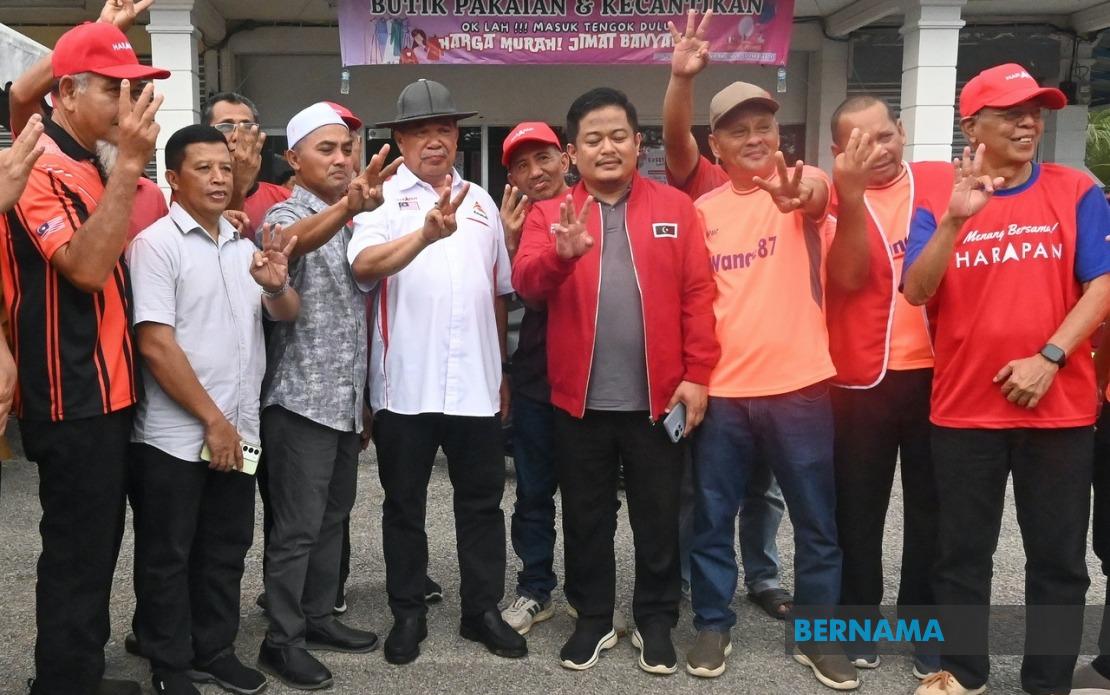
With voting in Johor set for July 11, Pakatan Harapan leadership is making a final push to convince state voters that granting the coalition control of the state government represents the only pathway to meaningful policy implementation. Amanah president Datuk Seri Mohamad Sabu, addressing supporters in Batu Pahat's Rengit area, framed the election as a referendum on whether voters trust PH to execute the detailed policy commitments outlined in its manifesto, released just days before the campaign began.
The thrust of Sabu's message targeted a persistent criticism from the opposition, which has dismissed the PH platform as derivative and lacking originality. Rather than defending the manifesto's intellectual merit, Sabu pivoted the conversation toward the practical question of execution. He acknowledged that writing a manifesto is a straightforward exercise that any political party can undertake, but he positioned implementation—the actual delivery of promised outcomes—as the true measure of a coalition's value to voters. This rhetorical strategy shifts attention away from ideological debate toward tangible results, a calculation that may resonate with an electorate increasingly focused on bread-and-butter issues.
Central to Sabu's argument is the premise that PH cannot deliver on its commitments without winning the state election. This framing carries implicit recognition that electoral defeat would represent not merely a change of government, but the abandonment of an entire policy programme before it begins. For voters considering whether to back the incumbent coalition or switch to alternatives, Sabu's appeal essentially asks them to view the election through the lens of continuation versus discontinuity. The Minister of Agriculture and Food Security projected that if victorious, PH would commence implementing manifesto provisions within days of the July 12 swearing-in ceremony, signalling both urgency and confidence in the coalition's readiness to govern.
Sabu emphasized that the manifesto emerged from an extended period of grassroots consultation throughout Johor. He described a deliberate process of listening to voter concerns in communities across the state, with party officials consciously attempting to translate public grievances into concrete policy proposals. This framing positions the manifesto less as an imposed top-down blueprint and more as a responsive document reflecting genuine community input. For Malaysian voters historically skeptical of political promises, this emphasis on consultation-driven policymaking may carry persuasive weight, particularly in rural constituencies where direct engagement with voters has traditionally been less intensive.
The reception encountered by PH campaigners in rural areas appears to have shifted notably compared to the 2018 general election, according to Sabu's assessment. He noted that a decade ago, Pakatan Harapan was not yet an established political presence in many Johor villages and markets. The coalition operated at a significant disadvantage in these communities due to unfamiliarity and lack of organizational infrastructure. Today, Sabu observed that the political landscape has fundamentally transformed, with voters actively approaching PH candidates and leaders, seeking photographs and expressing visible enthusiasm. This grassroots momentum, if accurately reflected in Sabu's account, suggests that the coalition has succeeded in building recognition and credibility in constituencies that once represented difficult terrain for the opposition.
This shift in rural perception holds particular significance for a state election outcome. Rural constituencies have traditionally been strongholds for established parties with deep community roots and organizational networks. Johor's rural areas are no exception, making PH's reported improvements in reception and engagement potentially consequential for seat allocation. The movement from obscurity to visible public warmth does not guarantee electoral success, but it indicates that voters are at least considering PH candidates as viable alternatives rather than dismissing them outright. In a competitive three-way or four-way contest, such perceptual changes can prove decisive.
Sabu's emphasis on the manifesto's people-centric origins represents an attempt to preempt opposition characterizations of PH as disconnected from voter concerns or driven by narrow factional interests. By repeatedly stressing that the manifesto emerged from extensive field consultation, Sabu seeks to establish that PH has invested significant effort in understanding what matters to Johor residents. This narrative becomes particularly important in a context where political trust remains fragile and voters frequently encounter conflicting claims about parties' genuine commitment to public welfare versus personal political advancement.
The timing of Sabu's campaign remarks merits consideration alongside the electoral calendar. With security force personnel voting on July 10 and the general electorate voting July 11, these final campaign appeals constitute the coalition's concluding effort to persuade undecided voters. Early voting participation patterns among police and military personnel often signal broader electoral trends, and opposition parties would presumably be monitoring these early results for indications about the state's direction. Sabu's public confidence in imminent implementation, conditional on electoral victory, represents both a commitment to voters and a signal of internal PH confidence regarding competitive positioning.
The broader Southeast Asian context adds another dimension to the Johor election's significance. Malaysia's coalition government has been working to consolidate its position following the 2022 general election, which produced a fractured parliament and prolonged post-election uncertainty. State elections therefore assume heightened importance as both legitimacy-building exercises and demonstrations of the coalition's continued electoral viability. Success in Johor, Malaysia's second-largest state by population, would strengthen the government's political standing heading into potential future federal electoral contests. Conversely, losses would reinforce narratives about the coalition's declining appeal and potentially trigger internal realignments within the opposition.
For voters weighing their choices, Sabu's message ultimately reduces to a straightforward proposition: PH's ability to fulfill its promises depends entirely on acquiring governmental power through the ballot box. This creates a direct equivalence between electoral support and policy delivery, leaving little room for voters to support the coalition while harboring doubts about implementation capacity. The message carries implicit confidence that PH possesses both the organizational capability and the political consensus required to act decisively once empowered, though voters must ultimately judge whether such confidence proves justified.

