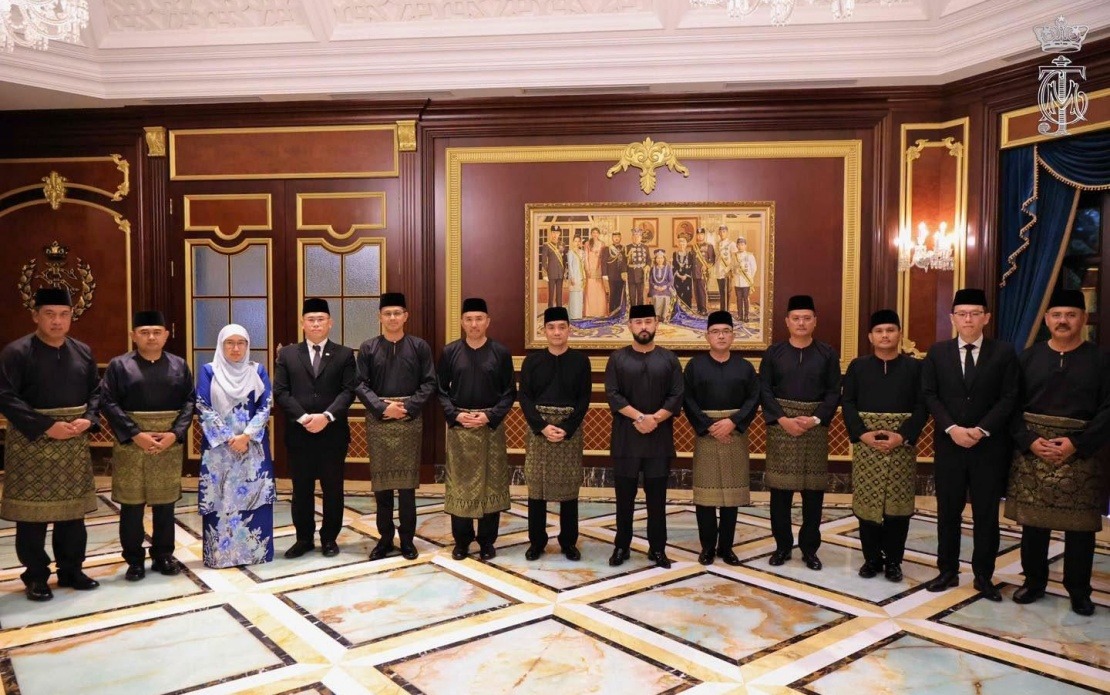
Ten newly appointed members of the Johor State Executive Council (Exco) took their oaths of office on July 18 in a formal ceremony held at Istana Bukit Serene before Tunku Mahkota Ismail, the Regent of Johor. The swearing-in represents the beginning of a restructured state administration following Barisan Nasional's resounding triumph in the 16th Johor state election, which delivered the coalition a supermajority that will shape governance in the southern state for the coming years.
The freshly constituted Exco comprises a mix of seasoned legislators and first-time executive members, reflecting efforts to balance experience with new perspectives. Among those taking office are Mohd Hairi Mad Shah representing Larkin, Datuk Mohd Jafni Md Shukor from Bukit Permai, Mohd Fared Mohd Khalid from Semerah, Ling Tian Soon from Yong Peng, Lee Ting Han from Paloh, and Mohamad Fazli Mohamad Salleh from Bukit Pasir. These individuals bring varying tenures of service within the state assembly and represent constituencies spanning urban and semi-urban areas across Johor.
Four members represent entirely new entries into the Exco tier, marking the first occasion they have assumed executive responsibilities at the state level. Md Israk Abdullah from Kukup, P. Pannir Selvam from Perling, Hasrunizah Hassan from Pulai Sebatang, and Muhammad Naqib Md Ghazali from Panti join the council at a time when the state administration enjoys substantial parliamentary support and resources to pursue its legislative agenda. The inclusion of these debutants suggests a deliberate strategy to refresh the executive apparatus and introduce fresh ideas into state-level decision-making processes.
The ceremony was witnessed by significant figures in the Johor administration and royal apparatus. Menteri Besar Datuk Onn Hafiz Ghazi, whose leadership will guide the new Exco in implementing state policy and managing day-to-day governance, presided over the occasion. Also present were Datuk Dr Abdul Rahim Ramli, the Yang Dipertua of the Royal Court Council, and Datuk Mohammed Ridha Abd Kadir, the State Secretary—individuals whose roles involve advising on matters of constitutional procedure and ensuring administrative continuity.
Onn Hafiz's own recent elevation to a second consecutive term as Menteri Besar occurred just days before the Exco swearing-in. The Machap assemblyman was formally sworn in following BN's triumph at the ballot box, underscoring the electorate's continued confidence in his stewardship of the state. His reappointment had been widely anticipated given the coalition's performance, but the formal ratification of his position marked a critical juncture in Johor's political trajectory.
The electoral foundation underpinning this new administration proves exceptionally solid. Barisan Nasional captured 48 of the 56 contested state assembly seats, delivering the coalition a commanding majority that exceeds the 29 seats required for a simple majority. This result represents a decisive validation of BN's platform and governance record in Johor, providing the administration with substantial political capital to advance its agenda without parliamentary uncertainty. The magnitude of the victory distinguishes Johor's electoral outcome within Malaysia's current political landscape, where multi-party competition has increasingly fractionalised voting patterns.
Onn Hafiz's personal performance in the Machap constituency reflects the broader strength of the BN campaign. He retained his seat with a majority of 15,375 votes—a commanding figure that positions him as a strong mandate-holder within his own constituency base. Such personal electoral strength often translates into enhanced credibility when negotiating with federal counterparts and pursuing state-level development allocations, resources that prove essential for fulfilling campaign promises and advancing infrastructure projects.
For Malaysian political observers, Johor's outcome carries significance beyond the state level. The state represents the third-largest economy in Malaysia and serves as a crucial component of BN's national coalition strategy. Johor's decisive outcome provides momentum to the federal government, offering an electoral success story that can be deployed in forthcoming national discourse. Conversely, opposition coalitions confront the challenge of articulating alternative visions in a state where BN's institutional advantages and electoral machinery have proven formidable.
The composition of the new Exco—with its balance of continuity and renewal—suggests administrative thinking aimed at sustaining momentum while preventing institutional sclerosis. The inclusion of multiple new members creates opportunities for younger or differently-experienced voices within cabinet-level deliberations, potentially addressing public sector innovation and contemporary governance challenges. Whether this translates into substantive policy shifts or represents primarily symbolic renewal will become apparent as the administration implements its development roadmap.
For Johor residents and business interests, the political transition offers relative stability and clarity regarding governance direction. The substantial parliamentary majority minimizes legislative obstruction scenarios and permits sustained focus on executing development plans. The broad electoral mandate enables Onn Hafiz and his Exco to pursue infrastructure projects, economic diversification initiatives, and social programmes without the political fragility that constrains single-digit majorities elsewhere in Malaysia.
The swearing-in ceremony also carries symbolic weight for state-level institutional processes. The involvement of the Regent in formally witnessing the oath-taking reaffirms the constitutional role of the Johor monarchy in state governance structures, reinforcing the ceremonial and political importance attached to the sultanate within the state administrative framework. This institutional ceremony signals continuity with Johor's constitutional traditions even as the personnel and some policy directions shift.

