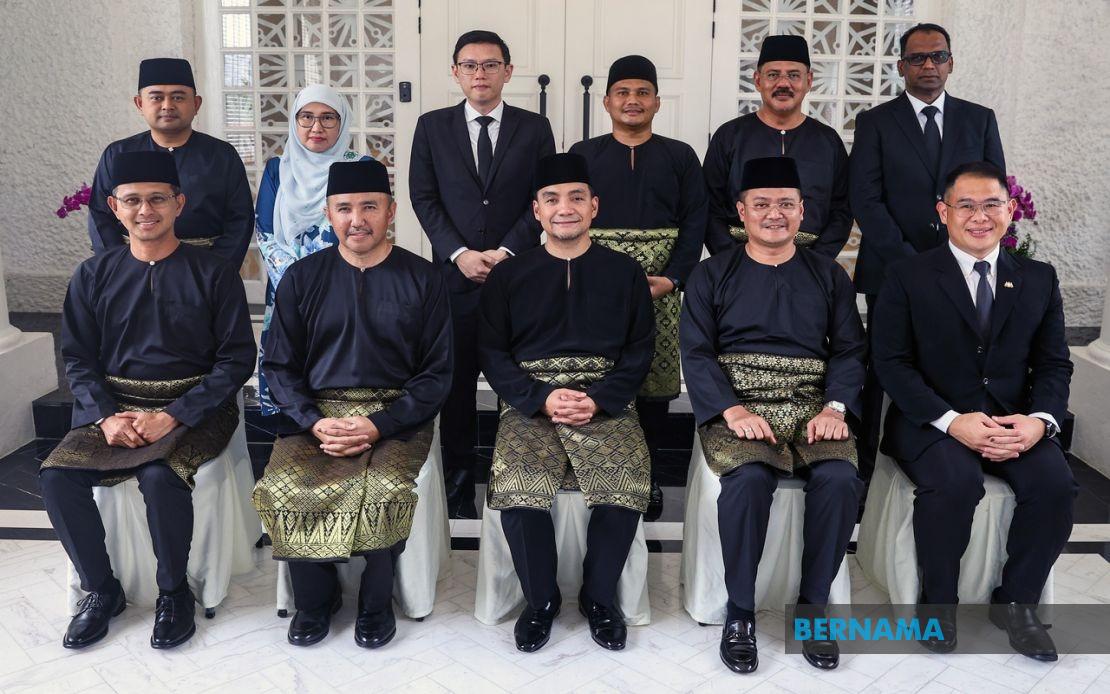
Johor's newly constituted State Executive Council took its oath of office on July 18 in a formal ceremony at Istana Bukit Serene, with all ten members receiving their appointment letters from the Regent of Johor, Tunku Mahkota Ismail. The swearing-in ceremony marked an important milestone in establishing the administrative framework for the state government's fresh mandate, following the Barisan Nasional coalition's commanding performance in the recent state election.
Four members bring fresh perspectives to the exco, bringing the composition to a blend of continuity and renewal. Md Israk Abdullah, representing the Kukup constituency, will chair the Agriculture, Agro-Based Industry and Rural Development Committee, positioning him to oversee the state's crucial agricultural sector and rural initiatives. P. Pannir Selvam, the Perling assemblyman, takes charge of the Unity, Heritage and Culture Committee, a portfolio reflecting the importance placed on social cohesion and cultural preservation in Johor. Hasrunizah Hassan from Pulai Sebatang leads the Women, Family and Community Development Committee, while Dr Muhammad Naqib Md Ghazali assumes responsibility for the Education and Information Committee, bringing what appears to be academic credentials to educational policy matters.
The retention of six experienced exco members provides institutional continuity and preserves institutional knowledge within the state administration. Datuk Mohd Jafni Md Shukor continues overseeing housing and local government affairs from his Bukit Permai seat, a portfolio central to Johor's urban development agenda. Mohd Hairi Mad Shah maintains his oversight of youth, sports, entrepreneurship and cooperative development, sectors vital for engaging younger demographics and fostering economic participation. Ling Tian Soon persists in leading health and environmental matters from Yong Peng, addressing public health concerns and sustainability issues that resonate across Malaysia. Lee Ting Han continues managing investment, trade, consumer affairs and human resources, critical portfolios for attracting business and protecting consumer interests. Mohamad Fazli Mohamad Salleh remains responsible for public works, transport, infrastructure and communications—arguably the most visible portfolio affecting daily citizen experiences. Mohd Fared Mohd Khalid continues his management of Islamic religious affairs, reflecting the state's commitment to religious governance structures.
This exco configuration emerges from Barisan Nasional's dominant performance in the sixteenth Johor State Election, where the coalition secured 48 of 56 state assembly seats. This substantial majority provides the government considerable legislative capacity to advance its agenda without significant obstruction. Menteri Besar Onn Hafiz, who represents the Machap constituency, secured his position for a consecutive second term after winning his own seat with a commanding 15,375-vote majority, underlining his personal electoral strength within the state political landscape.
The composition of the exco reflects deliberate attention to portfolio distribution across demographic and sectoral interests. The prominence given to agriculture and rural development acknowledges Johor's significant agricultural heritage and the importance of rural constituencies within the state's electoral map. The dedication of distinct portfolios to women's affairs, education, and community development signals responsiveness to social policy expectations, while the separate religious affairs committee recognises Islam's institutional importance within Malaysian governance frameworks. The investment and trade committee speaks to Johor's aspirations as an economic hub, particularly given its proximity to Singapore and its role as a gateway for cross-border commerce.
For Malaysian observers, this reshuffle offers insights into how state governments operationalise coalition victories at the federal level. Johor's governance structure—with its committee-based portfolio allocation—represents one model for balancing executive authority with distributed responsibility. The integration of four newcomers suggests either recognition of emerging talent within the Barisan Nasional coalition structure in the state, or perhaps strategic reward for constituencies and demographic groups whose support proved decisive in the election outcome. The four new faces include representation from different assembly seats scattered across the state, suggesting geographic balancing rather than concentration of power.
The timing of this exco establishment, completed within weeks of the election result, reflects operational efficiency in transition management. Unlike federal governments where exco formations can stretch over months amid complex coalition negotiations, Johor's process moved relatively swiftly, suggesting either pre-election planning or the absence of contentious internal disagreements over portfolio allocation—a notable contrast to some federal transitions. This efficiency matters for investor confidence and bureaucratic continuity, as businesses and civil services require clarity on decision-making structures.
For Southeast Asian context, Johor's political stability and clear governance structures contribute to the broader regional narrative around Malaysia's democratic functioning. As one of Malaysia's most economically significant states and a direct neighbour to Singapore, Johor's administrative coherence affects not only its 4.2 million residents but also the broader regional economy. Foreign investors and regional partners closely monitor how Malaysian states manage their governance transitions, viewing them as indicators of institutional health and predictability.
The exco members' backgrounds and constituencies offer clues to the government's policy priorities moving forward. The prominence of committees addressing agriculture, education, health, and women's affairs suggests the government anticipates these sectors as crucial battlegrounds in the next electoral cycle. The balance between retaining experienced hands and introducing new faces represents a calculated bet that the electorate values both continuity and fresh thinking—a political philosophy that may prove instructive as Malaysia navigates broader democratic cycles at state and federal levels.

