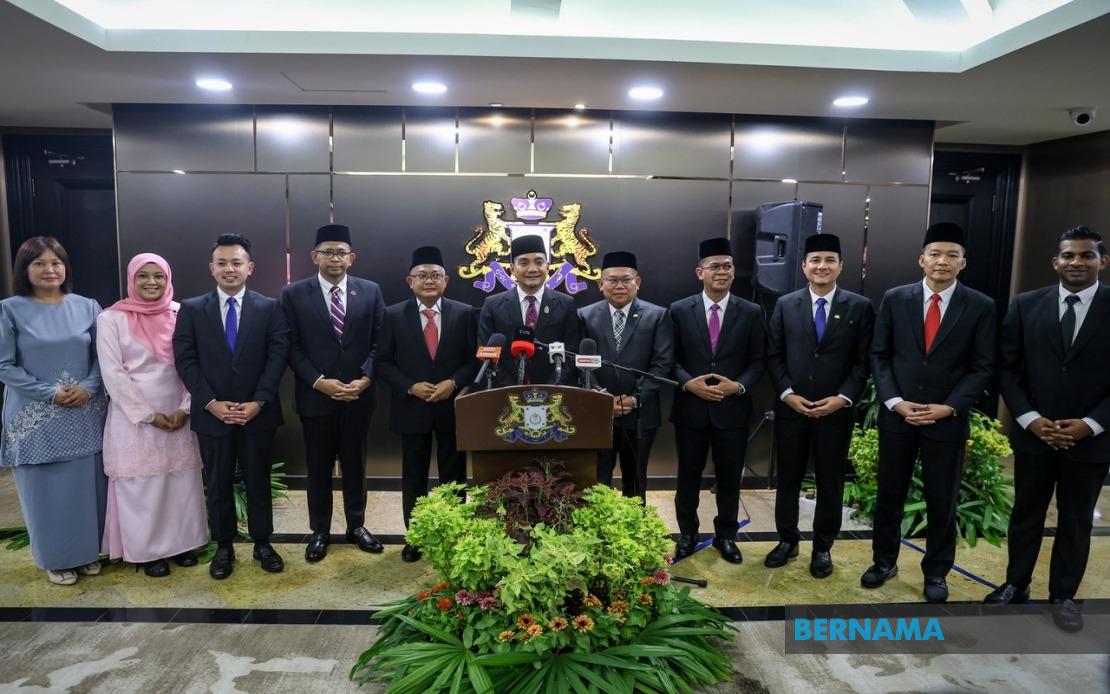
Johor has taken significant structural steps to enhance its government machinery by appointing 10 deputy chairmen to the State Executive Council's key committees. The move, announced by Menteri Besar Datuk Onn Hafiz Ghazi in Iskandar Puteri, reflects the state government's recognition that effective administration requires expanded leadership capacity as development initiatives accelerate across multiple sectors and districts.
The Regent of Johor, Tunku Mahkota Ismail, has formally consented to these appointments, lending institutional weight to what Onn Hafiz characterised as positions of significant trust and responsibility. This dual endorsement—from the elected leadership and the constitutional monarchy—signals consensus within Johor's governance structure regarding the need for administrative restructuring.
The appointment framework sits squarely within Johor's broader development vision. The state government is actively pursuing ambitious targets under two key strategic blueprints: the Maju Johor 2030 framework, which aims to elevate the state to developed status within the decade, and the Johor Economic Transformation Plan (JETP), which targets economic growth and structural advancement. Both initiatives require coordinated implementation across multiple government bodies, complex stakeholder engagement, and sustained project management at the district level.
Onn Hafiz articulated the strategic reasoning behind the restructuring during his press conference at Kota Iskandar. As development agendas mature and become more intricate, governments must proportionately increase administrative resources dedicated to execution. The challenge facing Johor is not merely formulating policy but ensuring that these policies translate into tangible benefits across all districts—a task requiring more hands-on oversight and coordination than existing structures provided.
The deputy chairmen's role extends beyond ceremonial participation. They are tasked with working closely alongside the primary committee chairmen, creating a two-tier leadership structure within each committee. This arrangement theoretically allows for better division of labour: while chairmen set strategic direction and represent committees at the highest levels, deputies can focus on implementation oversight, problem-solving, and grassroots coordination. Critically, these positions require sustained engagement with field operations and project sites.
Government service delivery in Malaysia has long been a point of public concern, particularly regarding response times and inter-agency coordination. By creating additional senior positions focused on these coordination mechanisms, Johor is explicitly attempting to reduce bureaucratic friction. The deputy chairmen are expected to bridge gaps between departmental silos, accelerate issue resolution, and ensure that initiatives designed at state level actually reach communities in rural and urban districts alike.
For Malaysian observers, this restructuring exemplifies a broader trend in state governance: recognising that good policies alone are insufficient without adequate implementation capacity. Johor's approach differs from simply adding administrative layers that could further slow decision-making; instead, it distributes responsibility in ways intended to strengthen both strategic oversight and tactical execution. This dual focus—maintaining vision while improving on-ground delivery—is particularly relevant for large states managing multiple concurrent development projects.
The economic implications are worth considering. Johor is competing not only with other Malaysian states but with regional neighbours for investment and talent. The perception of effective, responsive governance attracts both domestic and foreign investors seeking predictability and efficient permit processes. By demonstrating commitment to administrative capacity, Johor signals to the investment community that it takes implementation seriously—not merely as a policy objective but as an operational reality requiring dedicated human resources.
The appointment of these 10 positions also reflects demographic and developmental realities. Johor encompasses diverse geographic zones, from the developed Iskandar Puteri and Johor Bahru corridors to more rural interior districts. A single committee chairman, no matter how capable, struggles to maintain meaningful oversight across such variance. Deputy chairmen can be strategically deployed or focused on specific thematic areas or geographic zones, creating more granular accountability structures.
This administrative restructuring carries implications beyond Johor's borders. Southeast Asian economies increasingly recognise that infrastructure and policy excellence depend on governance quality. Should Johor's deputy chair model prove effective—measurable through faster project timelines, improved public satisfaction metrics, and more equitable distribution of development benefits—other Malaysian states or regional governments might adopt similar approaches. The experiment potentially becomes a template for institutional adaptation in fast-developing regions.
However, success depends entirely on appointment quality and institutional culture. Creating new positions without ensuring capable individuals occupy them, or without building coordination mechanisms that prevent turf conflicts between chairs and deputies, would merely duplicate existing problems at higher cost. The real test lies not in the announcement but in whether these 10 individuals can genuinely accelerate implementation and improve service delivery across Johor's administration.
Onn Hafiz's emphasis on teamwork and collaborative effort suggests awareness of potential pitfalls. By framing the appointments as requiring close working relationships among deputies, chairmen, and external agencies, he is signalling that siloed operations will undermine the restructuring's purpose. Whether this cultural message translates into changed behaviour across Johor's bureaucracy will determine whether the appointment strategy succeeds or merely adds administrative overhead without corresponding benefits for the state's development trajectory.

