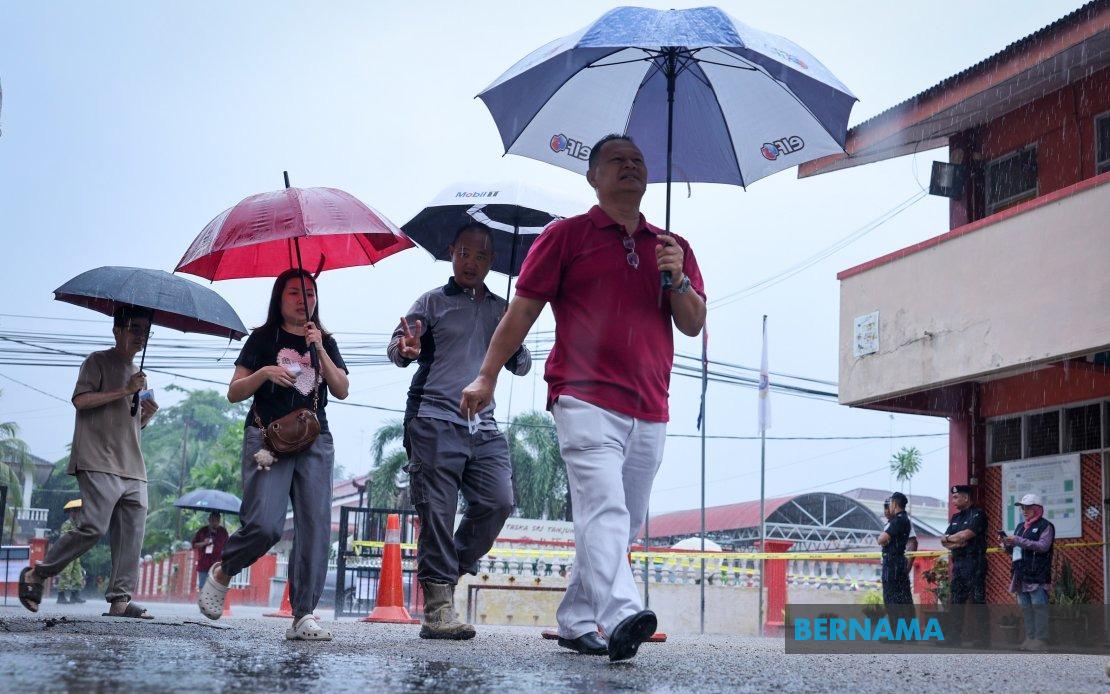
The 16th Johor State Election unfolded under predominantly pleasant weather conditions on July 11, with clear skies dominating most of the state's polling districts. However, the Muar area presented a notably different scenario, as residents contended with persistent heavy rainfall from the early morning hours. Despite the meteorological variations across the state, voter participation remained robust, demonstrating the electorate's commitment to the democratic process regardless of weather challenges.
Election Commission personnel, security forces, and journalists established their presence at polling stations well before the official 8am commencement, with officers conducting final preparations at venues such as Sekolah Kebangsaan Seri Pantai in Mersing by 7am. This early arrival ensured smooth operations and enabled polling authorities to accommodate early voters efficiently. The comprehensive deployment of election personnel across the state reflected the logistical scale of managing a state-level electoral exercise involving multiple administrative divisions and demographic communities.
In areas blessed with clear weather, voter turnout patterns proceeded without interruption. At Dewan Raya Taman Ungku Tun Aminah in Johor Bahru's urban centre, residents encountered pleasant conditions as they queued to cast their ballots. Similarly, rural and sub-urban polling stations including SMK Senggarang in Batu Pahat and SJKC Kulai recorded comparable atmospheric conditions, allowing voters to approach polling stations without weather-related obstacles. These venues witnessed diverse voter demographics, including persons with disabilities and elderly citizens, who were among the earliest arrivals to exercise their voting rights.
The meteorological challenges in Muar presented a different narrative, yet failed to suppress voter enthusiasm. Residents navigating through sustained heavy downpours still made their way to designated polling centres including SJKC Limbong and Sekolah Kebangsaan Ismail 1. This demonstrated that weather adversity, even of significant magnitude, did not constitute a barrier to electoral participation in the affected district. The determination displayed by Muar voters underscored the importance Johor residents placed on the electoral process, transcending practical inconveniences.
This election represented a significant democratic engagement, with the electorate comprising more than 2.7 million registered voters across the state. The scale of participation required an extensive infrastructure of 1,076 polling centres strategically distributed to serve the diverse geography and population distribution of Johor. A total of 172 candidates representing various political formations contested for representation across the 56 state assembly seats, offering voters a substantial range of choices reflecting the state's varied political landscape.
The pre-election configuration of the state assembly provided important context for understanding the electoral dynamics. Barisan Nasional maintained significant dominance with 40 seats prior to the legislative dissolution on June 1, establishing it as the incumbent coalition with the largest parliamentary representation. Pakatan Harapan, the primary opposition coalition, held 12 seats, indicating a substantial but substantially smaller footprint in the assembly. Perikatan Nasional retained three seats, while MUDA, the newer political entrant focusing on generational politics, held a single seat. This distribution illustrated the competitive landscape within which the election contest unfolded.
The electoral mechanics proceeded according to the Election Commission's established protocols, with voting commencing at 8am at all polling locations. Recognising operational complexities arising from the state's geographic expanse and varying population densities, the Commission staggered polling station closing times according to locally determined schedules. This flexible approach acknowledged that different districts possessed varying voter densities and operational requirements, necessitating tailored timing arrangements rather than uniform closure across all venues.
Immediate vote counting commenced upon the closure of polling stations in their respective areas, ensuring that results could be compiled and reported with minimal delay. This expedited tabulation process reflected contemporary electoral best practices, where transparency and rapid result compilation serve to strengthen public confidence in the integrity of the democratic process. The counting operations occurred simultaneously across multiple venues, requiring substantial logistical coordination and trained personnel deployed throughout the state.
For Malaysian observers and regional analysts, the Johor election held considerable significance beyond the state's boundaries. Johor's electoral performance traditionally influenced national political dynamics and coalition arrangements at the federal level, given the state's economic prominence, substantial parliamentary representation, and demographic diversity. The outcome would potentially reshape coalition configurations and provide signals regarding voter sentiment towards existing governance arrangements, offering insights into broader political trajectories affecting Malaysia's future political landscape and the stability of the current federal administration.

