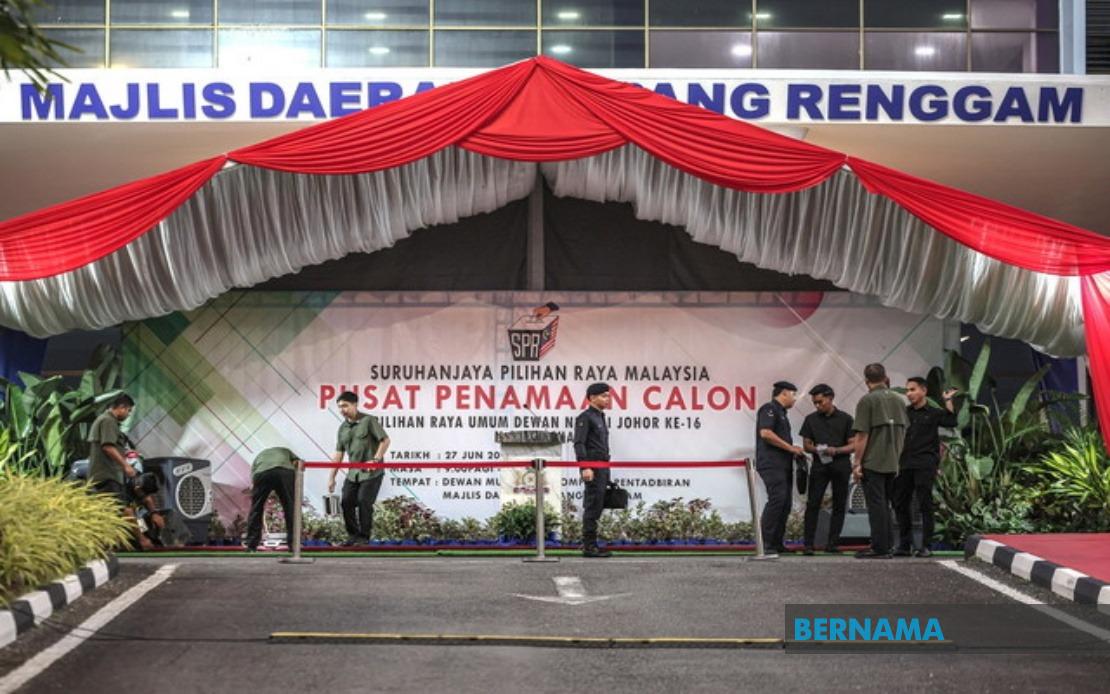
The 16th Johor State Election officially commenced this morning as all 56 nomination centres across the state unlocked their doors simultaneously at 9am, marking the formal beginning of what promises to be a closely watched contest in Malaysia's second-largest state. Party supporters began assembling outside voting centres well before dawn, with crowds gathering from 6.30am onwards to demonstrate backing for their preferred candidates, signalling the intensity of political engagement expected throughout the electoral campaign.
Candidates faced a strict one-hour window, closing at 10am, to lodge their nomination documentation with the returning officer at their designated centre. The submission process permits flexibility in presentation—candidates may hand over papers personally alongside their proposer and seconder, or either representative may file on their behalf. This procedural streamlining aims to prevent bottlenecks while maintaining electoral integrity as the state prepares for what analysts anticipate will be a decisive moment in Johor's political trajectory.
The Election Commission has orchestrated a carefully timed electoral calendar designed to balance administrative efficiency with democratic principles. Following today's nominations and subsequent verification procedures, a 14-day campaign period officially commences, extending through 11.59pm on July 10. This compressed timeframe means political parties must rapidly mobilise ground operations, coordinate messaging across constituencies, and persuade voters in an environment where regional and national political currents intersect with local concerns affecting Johor's predominantly urban and suburban populations.
Weather conditions presented an unpredictable element for organisers and supporters gathering throughout the morning. The Malaysian Meteorological Department forecast scattered rainfall across Johor Bahru, Muar, Batu Pahat, Kota Tinggi, Pontian, Tangkak and Kulai, while other districts including Segamat, Kluang and Mersing were expected to remain dry. Afternoon thunderstorms were predicted across multiple districts including Johor Bahru, Segamat, Kluang and Kota Tinggi, potentially affecting both campaign activities and crowd gatherings as the day progressed.
Security arrangements reflected the sensitive nature of electoral proceedings in a state where political competition has intensified in recent years. Police personnel working alongside volunteers from the People's Volunteer Corps maintained vigilant oversight around nomination centres, implementing traffic management protocols and preventing potential disruptions. This coordinated approach underscores official commitment to ensuring orderly proceedings and safeguarding the democratic process from any incidents that might undermine public confidence in electoral integrity.
The electoral landscape encompasses a remarkably large voting population that will determine the composition of Johor's state assembly. According to Election Commission data, approximately 2.73 million registered voters are entitled to participate, comprising 2.7 million ordinary voters alongside 12,041 military personnel and their spouses and 12,710 police personnel and their spouses. This substantial electorate reflects Johor's demographic weight within Malaysia and underscores why outcomes here frequently signal broader political trends affecting the peninsula.
For Malaysian and regional observers, Johor elections carry outsized significance beyond state boundaries. The state has historically served as a political barometer, with results often foreshadowing shifts in national sentiment or indicating the relative strength of competing political coalitions. The election schedule, featuring early voting on July 7 and main polling day on July 11, provides a compressed but intensive engagement period during which ground operations will intensify dramatically across constituencies ranging from urban Johor Bahru to rural and semi-urban areas in the interior.
The nomination process completing today represents merely the initial procedural step in a broader democratic exercise. Candidates formally enter the contest only after verification processes confirm their eligibility and nomination documentation compliance with electoral regulations. Once verified, the campaign period transforms constituencies into spaces of intensive political communication where parties deploy volunteers, conduct rallies, organise door-to-door canvassing, and utilise digital platforms to reach voters.
For opposition parties seeking to make electoral inroads in Johor, this election represents a critical opportunity to demonstrate viability and build momentum heading toward a potential federal election. For the incumbent coalition, defending ground becomes paramount, particularly in constituencies where margins are narrow or demographic shifts have altered traditional voting patterns. The stakes extend beyond parliamentary representation to questions about which political constellation can most credibly address cost-of-living pressures, employment opportunities, and infrastructure development—issues resonating across Johor's economically diverse communities.
As the campaign unfolds over coming weeks, political narratives will sharpen, local issues will receive amplified attention, and the competing visions for Johor's future will become increasingly defined. The electoral process unfolding today across 56 nomination centres represents the formal commencement of this democratic exercise, setting in motion dynamics that will culminate in votes cast on July 11 and results that likely possess ramifications extending well beyond state boundaries.

