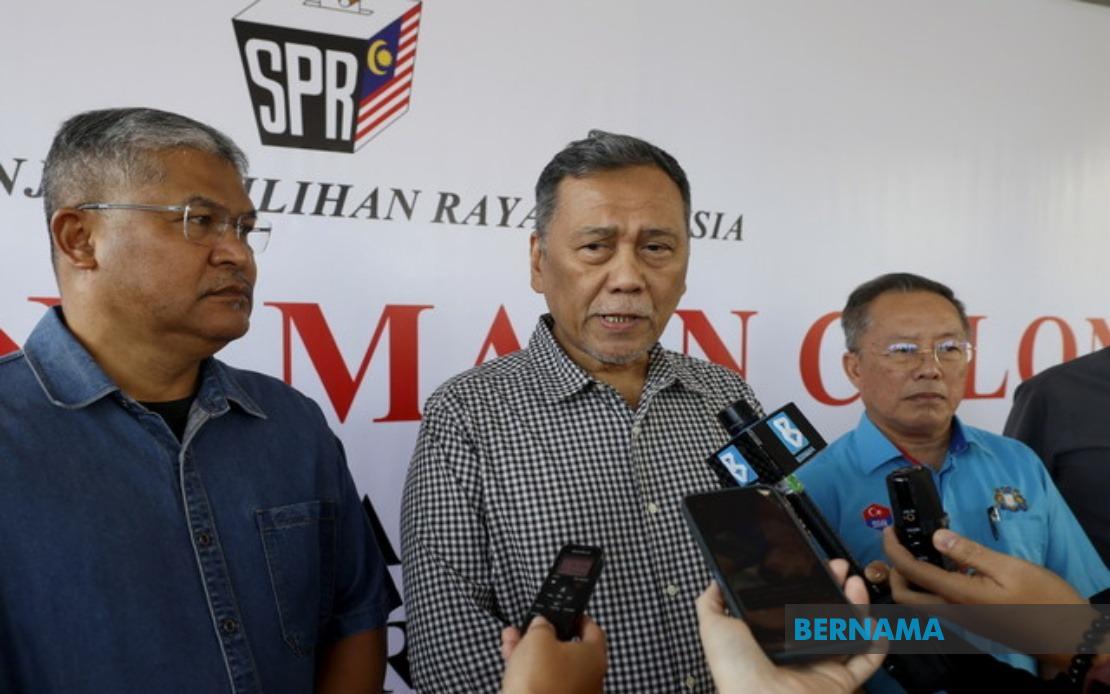
The Malaysian Election Commission has confirmed that 593 nomination forms for the upcoming Johor state election have been distributed, though only 133 prospective candidates have formally committed to contesting by paying their required deposits ahead of today's nomination deadline. Election Commission chairman Datuk Seri Ramlan Harun indicated that final participation numbers remain fluid, with candidates still able to complete registration procedures as the nomination process commences this morning across the state's 56 designated centres.
Ramlan's remarks underscore the typically dynamic nature of nomination periods in Malaysian state elections, where interest from would-be contenders often crystallises in the final hours before formal registration. The timing of deposit payments has long served as a reliable indicator of genuine candidacy versus exploratory interest, distinguishing serious aspirants from those merely testing the political waters. The gap between forms sold and deposits paid—a difference of 460 forms—suggests either substantial undecided candidates or a notably large pool of interested parties who may not ultimately proceed to formal nomination.
The Election Commission has assured stakeholders of comprehensive readiness across all nomination centres, having conducted consecutive trial runs to stress-test logistical arrangements and procedural compliance. Zainal Eran, the returning officer for the Maharani constituency, outlined detailed security protocols designed to accommodate the expected influx of candidates, party officials, and supporters while maintaining orderly processing. The framework restricts access to nomination centres themselves to only the candidate, their proposer, and a single supporter, a measure intended to reduce congestion and potential friction during what historically can become tense procedural moments.
Outside the nomination centres, party supporters will occupy designated segregated areas demarcated by physical barriers, a precaution reflecting lessons learned from previous Malaysian elections where competing party bases in close proximity have occasionally resulted in heated confrontations. These spatial separations represent a deliberate administrative strategy to channel political enthusiasm into designated zones whilst preventing spontaneous encounters that might escalate beyond rhetoric. The Election Commission has explicitly reminded all political participants—parties, candidates, and their supporters alike—to scrupulously observe existing regulations and refrain from provocative conduct that might jeopardise the peaceful progression of nomination proceedings.
The broader political landscape for the 16th Johor state election reflects Malaysia's established three-bloc competition structure. Pakatan Harapan, fielding candidates in all 56 seats, has allocated representation across its three constituent parties: PKR claiming 20 seats, Amanah 19, and DAP 17. This configuration mirrors the coalition's typical seat-sharing arrangements and reflects the respective organisational strengths of member parties within Johor's political context. Barisan Nasional's allocation similarly distributes all 56 seats among its three components, with UMNO contesting 36 seats, MCA 16, and MIC four—a distribution reflecting demographic realities and historical voting patterns across the state's diverse constituencies.
Perikatan Nasional's approach to candidate deployment reveals a notably more fragmented arrangement, with PAS contesting 11 seats, Bersatu 16, the Malaysian Indian People's Party five, and Pejuang one seat. This distribution suggests ongoing internal negotiations within the coalition regarding respective territorial claims and electoral viability assessments, demonstrating how Perikatan's constituent parties continue balancing mutual accommodation against individual organisational ambitions. The Malaysian United Democratic Alliance's decision to field candidates in only four seats indicates either selective targeting of winnable constituencies or modest organisational capacity within Johor specifically.
Peculiar to this election cycle is Parti Bersama Malaysia's electoral debut, the party contesting 15 state seats—a substantial commitment reflecting either confidence in its mobilisation capacity or strategic positioning within Malaysia's evolving political marketplace. The party's decision to contest at this magnitude suggests serious intent to establish electoral legitimacy and test its appeal among Johor voters, potentially serving as a longer-term foundation for future contests. Parti Sosialis Malaysia's single-seat candidacy reflects that party's characteristic modest electoral engagement, typically contesting strategically selected constituencies rather than pursuing comprehensive state coverage.
The election timeline established by the Election Commission provides candidates and parties narrow windows for campaigning and organisation. With nomination day occurring today, early voting scheduled for July 7, and polling day set for July 11, the compressed election period compresses the traditional campaigning interval available to candidates. This compressed schedule, commonly employed in Malaysian state elections, tests parties' capacities to mobilise voters rapidly whilst limiting time for extended public consultation or grassroots engagement. The tight timeline particularly challenges newer or smaller parties attempting to build voter awareness and preference within condensed timeframes.
The dissolution of the Johor State Legislative Assembly on June 1 initiated the constitutional countdown toward the current election, with the Election Commission's scheduling reflecting constitutional requirements and practical logistical considerations. Johor's significance within Malaysia's broader political calculus—as home to the second-largest state population and historically contested terrain between Barisan Nasional and opposition coalitions—ensures this election receives substantially magnified national attention. Electoral outcomes here frequently signal broader directional trends within Malaysian politics, making the 16th Johor state election consequential far beyond the state's boundaries.
For Southeast Asian observers, the Johor election exemplifies Malaysia's established democratic procedures and institutional consistency, demonstrating how Malaysia's Election Commission manages logistically complex state contests involving dozens of constituencies and multiple competing coalitions across geographically dispersed polling locations. The commission's emphasis on procedural transparency, security coordination, and advance preparation reflects institutional maturation within Malaysia's electoral management apparatus. However, the substantial gap between nomination forms distributed and candidate deposits paid warrants monitoring as an indicator of genuine competitive participation versus formal political positioning without serious electoral commitment.
The coming weeks will reveal whether the expected increase in candidate confirmations materialises and how competitive dynamics ultimately shape polling outcomes. The presence of multiple viable coalition alternatives, combined with strong constituent party organisation within each bloc, suggests Johor voters will genuinely choose between distinctly different governing alternatives rather than facing inevitable outcomes. The state election will provide valuable indicators of urban-rural support patterns, ethnic community voting preferences, and coalition momentum heading toward potential federal electoral contests, making this election analytically significant for Malaysian political analysis and regional observers tracking Southeast Asian democratic developments.

