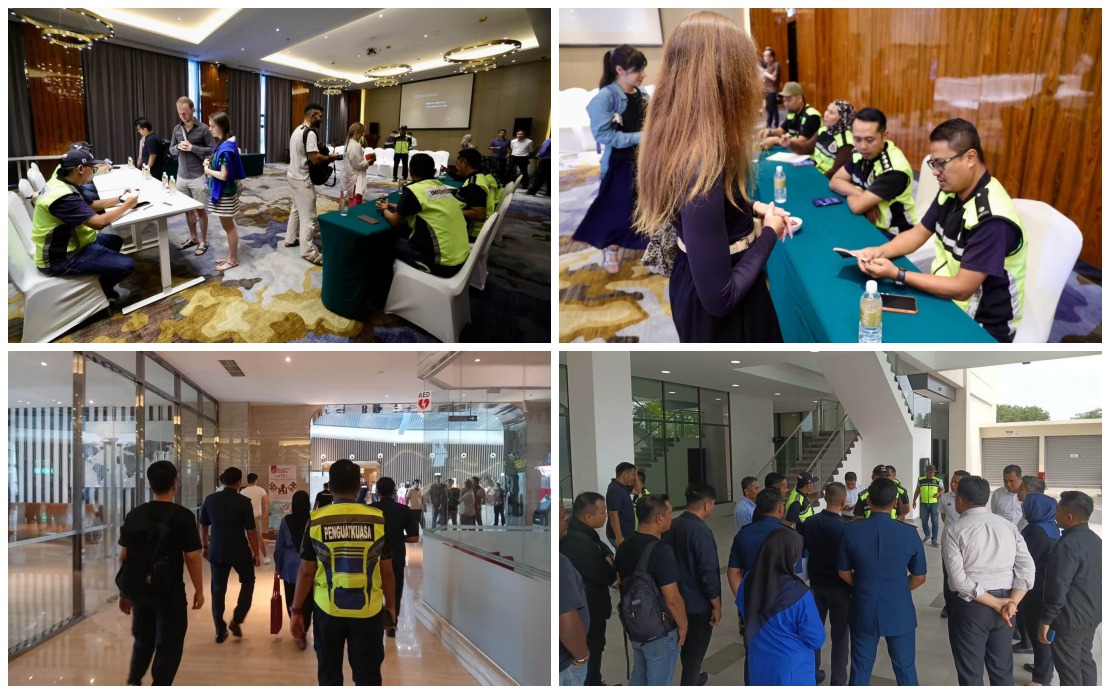
Johor's local authority has moved decisively against Network School operations in Forest City, issuing a formal Stop-Business Notice after uncovering multiple licensing violations and unauthorised use of commercial premises. The Iskandar Puteri City Council (MBIP) enforcement action marks an escalation in regulatory oversight of the educational facility, which had generated significant public concern following viral social media allegations questioning its legitimacy and associations.
Menteri Besar Datuk Onn Hafiz Ghazi disclosed that systematic inspections revealed the organisation operated from two separate locations within Forest City, creating a fragmented operational structure that circumvented standard licensing requirements. One facility maintained valid office business documentation, but investigators found that the second location functioned entirely without appropriate MBIP authorisation, despite being registered to a Malaysian national. This dual-premise arrangement appears designed to distribute operations in ways that might evade centralised regulatory scrutiny.
The core violation centred on categorical misuse of licensed space. Premises registered solely for general office business purposes were repurposed to accommodate classroom instruction, student activities, and commercial promotional material—functions requiring distinct educational facility classification and approval pathways. The company neither sought nor obtained formal consent from MBIP to modify the permitted business category, representing a deliberate departure from approved operating parameters.
Officially designated Stop-Business Notice IP012N260714001 now prohibits continued operations at the unlicensed premises effective immediately. Beyond this primary enforcement instrument, MBIP simultaneously issued an Advertisement Licence Notice under Section 107(2) of the Local Government Act 1976, specifically targeting signboards and promotional materials that violated both licensing conditions and permit specifications. This dual approach demonstrates comprehensive regulatory intervention targeting operational infrastructure and public-facing communications simultaneously.
Onn Hafiz articulated the Johor state administration's commitment to rigorous compliance enforcement, positioning these actions within a broader framework of municipal accountability. The statement emphasised that MBIP remains actively engaged in investigating additional regulatory dimensions potentially relevant to the case, with particular attention to identifying any further breaches across licensing conditions and applicable statutory frameworks. Authorities indicated that supplementary enforcement measures would follow if investigations uncover additional violations warranting legal action.
The matter touches upon broader jurisdictional boundaries within Malaysia's federal structure. While MBIP maintains clear authority over local business licensing, premises compliance, and municipal regulations, questions surrounding the immigration status and nationality of individuals associated with Network School operations fall squarely within Home Ministry purview. Onn Hafiz emphasised the state government's expectation that federal authorities will expedite final determinations regarding foreign national status and whether Network School's operational model aligns with permissible activities under Malaysia's immigration and educational frameworks.
Social media discourse preceded official enforcement, with unverified claims circulating allegations that Network School connections extended toward Israeli interests and that the facility functioned as infrastructure for international currency investment schemes. These allegations remained largely unsubstantiated through official channels, though they clearly catalysed heightened public scrutiny and potentially accelerated regulatory investigation timelines. The rapid MBIP response suggests that administrative concerns regarding licensing legitimacy existed independently of social media conjecture, though public pressure undoubtedly intensified official attention.
For Malaysian readers, this enforcement action illustrates how local authorities address unlicensed educational operations within premium developments like Forest City. The case demonstrates that international investors or education providers cannot simply repurpose commercial office space for classroom instruction without formal regulatory approval and appropriate licence categories. The regulatory framework protecting premises integrity and business category compliance applies uniformly regardless of organisational size, funding sources, or institutional prominence.
The implications extend beyond this singular institution. Forest City, as a major integrated development attracting international residents and investment, represents a regulatory environment where diverse business models encounter established Malaysian municipal governance structures. This enforcement action signals that MBIP maintains active oversight capacity and willingness to deploy administrative measures against non-compliant operators, regardless of whether they operate educational, commercial, or service-oriented functions.
For institutions considering educational operations within Johor's jurisdictions, the precedent emphasises procedural compliance as foundational. Securing appropriate business classifications, obtaining proper premises usage authorisation, maintaining current licensing documentation, and submitting formal applications before modifying operational scope constitute non-negotiable administrative prerequisites. Educational providers cannot assume that commercial office licences provide sufficient legal cover for classroom activities.
The unresolved immigration dimension remains consequential. Until the Home Ministry addresses the nationality status of individuals steering Network School's operations and determines whether their activities fall within permissible visa categories, uncertainty regarding the institution's future persists. This administrative gap may eventually prove more determinative than municipal licensing issues, depending upon what federal authorities establish regarding work permit compliance and educational sector eligibility.
Moving forward, the case will likely inform how MBIP evaluates premises conversion applications from international education providers and similar service-oriented enterprises. Enhanced documentation requirements, more rigorous inspection protocols, and potentially closer inter-agency coordination between municipal authorities and federal immigration enforcement may result from this episode. Malaysian stakeholders should anticipate more granular oversight of unlicensed educational operations within premium developments as local authorities strengthen compliance verification mechanisms.

