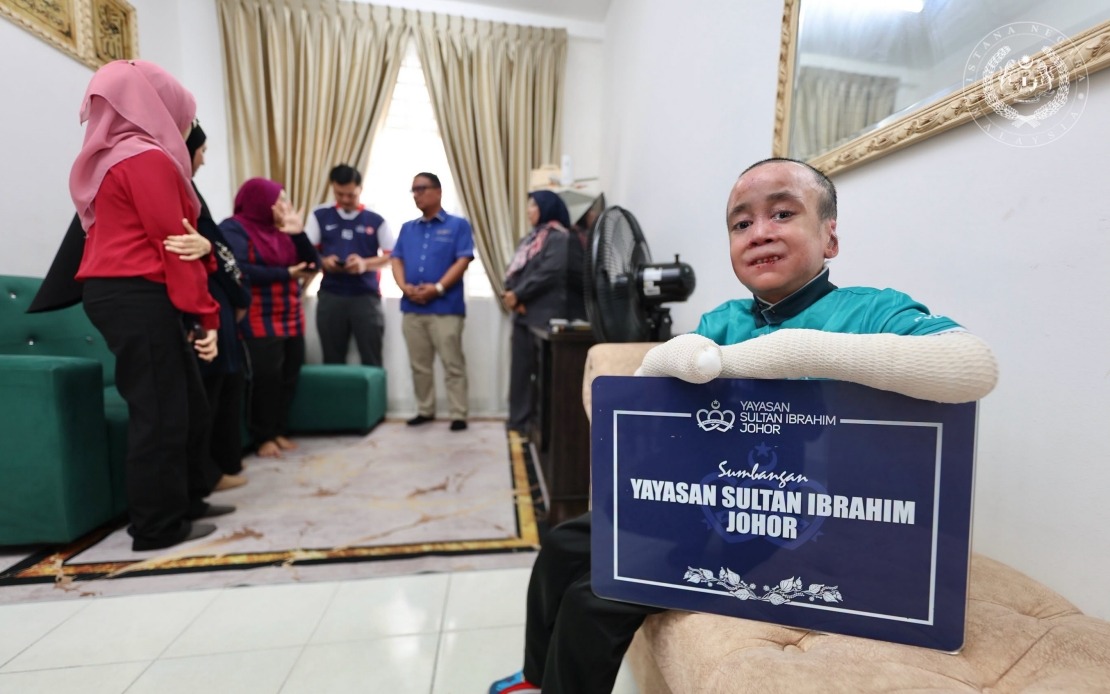
The Yayasan Sultan Ibrahim Johor (YSIJ) has extended financial support to assist Muhammad Hazreel Mikhail Hizar, 15, and his family navigate the considerable expenses associated with managing epidermolysis bullosa, a debilitating genetic disorder characterised by skin fragility and recurrent blistering. The grant was delivered on August 18 to Hazreel's residence at the Sungai Tiram People's Housing Project in Johor Bahru through the foundation's Ziarah Kasih initiative, which focuses on providing direct aid to individuals and families facing severe hardship.
Epidermolysis bullosa represents one of several rare inherited conditions that profoundly affect quality of life and impose substantial financial burdens on affected families. In Hazreel's case, the condition has persisted since birth, requiring meticulous daily medical management to prevent complications including infection and tissue damage. The nature of the disorder necessitates a carefully controlled living environment maintained at consistently cool temperatures, making the provision of reliable air-conditioning not a luxury but a medical necessity.
Hazreel's mother, Noor Halimaton Hashim, shoulders the responsibility of caring for three children as a single parent, a circumstance that has forced her to abandon full-time employment in favour of providing round-the-clock care for her son. Her daily routine encompasses wound cleaning protocols and vigilant monitoring to mitigate infection risks, tasks that demand both medical knowledge and constant attention. The cumulative effect of these caregiving demands has created a precarious economic situation for the household, where medical expenses compete with fundamental living costs.
According to a statement released through Sultan Ibrahim Sultan Iskandar's official social media channels, the foundation's intervention recognises the intersection of medical need and financial constraint that characterises many families managing chronic illnesses in Malaysia. Epidermolysis bullosa, though rare, typically requires consistent access to specialised wound care supplies, pharmaceutical interventions, and environmental modifications that collectively drain household resources. The YSIJ's decision to provide assistance acknowledges that conventional income support mechanisms often fail to address the specific vulnerabilities of families managing such conditions.
Noor Halimaton expressed profound gratitude for the foundation's support, describing the timing as particularly crucial for her family's stability. In her statement to the Royal Press Office, she emphasised how the assistance arrives at a moment when household finances have become increasingly strained, allowing her to redirect limited resources toward Hazreel's essential care requirements. Her testimony underscores the gap between the theoretical availability of social support systems and the practical reality facing families in vulnerable socioeconomic circumstances.
The Ziarah Kasih programme represents a targeted approach to identifying and assisting individuals whose circumstances fall outside the scope of broader government welfare schemes. By conducting direct home visits, the foundation gains firsthand understanding of specific needs and living conditions, enabling more responsive and appropriately scaled interventions. This methodology contrasts with centralised application-based systems that often fail to reach those lacking awareness of available programmes or facing documentation barriers.
For Malaysian families managing rare genetic or chronic conditions, the YSIJ's intervention illustrates how royal patronage and philanthropic mechanisms continue to address gaps in the social safety net. While government health services provide medical care, the ancillary expenses—specialised equipment, environmental modifications, lost wages from caregiving responsibilities—frequently remain uncompensated. Epidermolysis bullosa patients and families require sustained support extending far beyond clinical interventions, encompassing housing stability, nutritional security, and economic viability.
Hazreel's case also highlights the particular vulnerability of single-parent households managing childhood chronic illness. The concentration of caregiving responsibilities within a single adult, combined with economic necessity, creates compound stressors that affect parental health and family stability. Research consistently demonstrates that such situations increase risks of parental burnout and secondary health complications within affected households, yet remain underaddressed in policy discussions surrounding childhood chronic illness.
The foundation's initiative, publicised through official channels, also serves a broader awareness function within Malaysian society. Public visibility of royal foundation engagement with rare disease communities helps legitimise these conditions as worthy of social attention and resource allocation. For other families managing epidermolysis bullosa or similar disorders, awareness of such programmes may prompt engagement with charitable mechanisms previously unknown to them, expanding the reach of community-based support beyond traditional welfare bureaucracies.
Moving forward, cases such as Hazreel's underscore the necessity for integrated approaches to managing childhood chronic illness within developing economies. Comprehensive support frameworks must address not only medical needs but also caregiver sustainability, economic security, and housing stability. The YSIJ's Ziarah Kasih programme demonstrates that targeted, need-responsive interventions remain viable mechanisms for addressing gaps in conventional social provision, particularly where rare or complex conditions exceed standard welfare categorisations.

