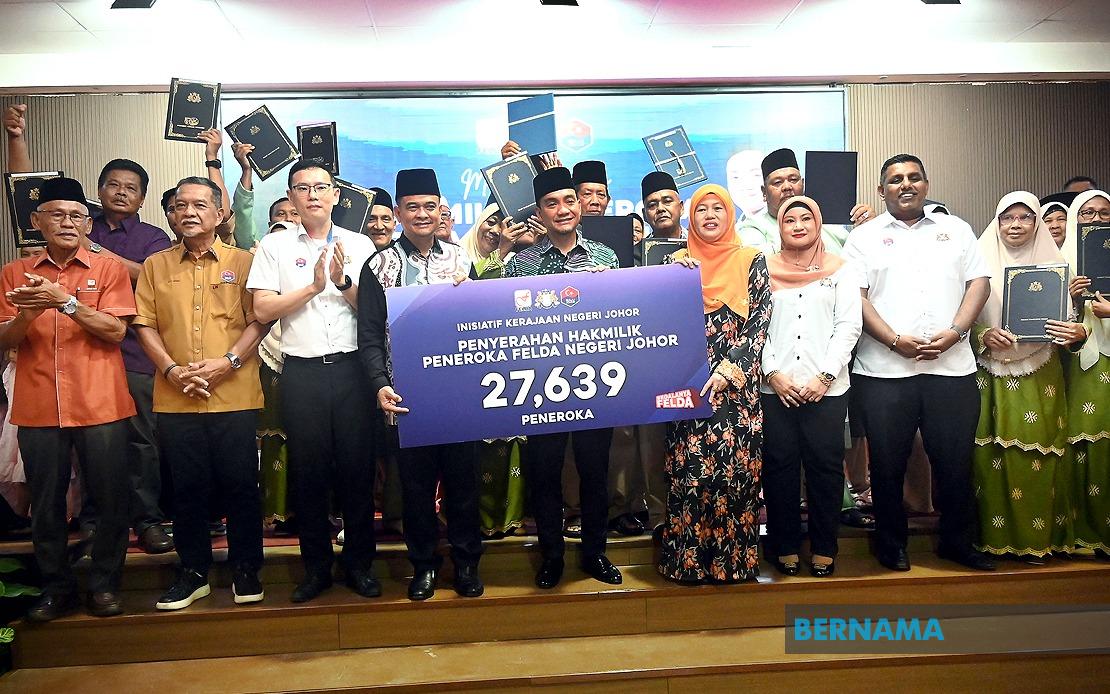
The Johor state government has achieved near-complete resolution of a protracted land title dispute that has vexed Federal Land Development Authority (FELDA) settlers for decades, with 27,639 out of 27,642 applications now settled. The breakthrough, announced at a ceremony in Kluang on June 23, represents a turning point for one of Malaysia's most vulnerable rural constituencies, whose members have struggled for years to obtain official documentation for their homes and agricultural plots. Menteri Besar Datuk Onn Hafiz Ghazi characterised the achievement as reflecting the state administration's unwavering dedication to resolving ownership issues that have long caused distress within FELDA communities across the state.
The land title crisis has been a defining challenge for FELDA settlers in Johor. Many inhabitants of these agricultural schemes have occupied and worked their plots for decades without formal legal documentation, a situation that left them exposed to disputes, unable to access credit facilities, and vulnerable to eviction. The absence of clear titles created cascading problems: settlers could not secure bank loans for improvements or expansion, faced difficulties passing properties to heirs, and lacked leverage in disputes with authorities. For a demographic already marginalised within Malaysia's economic hierarchy, this bureaucratic limbo compounded other structural disadvantages and rendered their most significant asset—the land itself—effectively unusable as collateral or a reliable inheritance.
During the ceremony, 210 settlers from Kluang, Kota Tinggi and Mersing received formal land title documents for their plantations and residential plots, providing tangible evidence of the resolution process now substantially complete across the state. The distribution of titles represents not merely paperwork but a restoration of economic dignity and security to families who have invested generations into their holdings. For these recipients, the certificates open pathways to agricultural financing, property transactions, and the ability to plan long-term investments with legal certainty. The geographic spread across three districts signals that the resolution has been coordinated across multiple FELDA schemes, suggesting a systematic state-level approach rather than ad-hoc settlement of isolated cases.
The resolution of this issue carries broader implications for rural Malaysia's governance landscape. FELDA, established in 1956 as a mechanism for resettling landless farmers and developing agricultural regions, has historically operated with varying degrees of administrative efficiency across different states. Johor's success in clearing nearly all disputed applications demonstrates that coordinated state action, combined with political will from elected representatives, can successfully untangle longstanding bureaucratic knots. This achievement may provide a template for other states where FELDA settlers continue to face title complications, particularly in Pahang, Perak, and Sabah where similar disputes have simmered for years.
Menteri Besar Onn Hafiz Ghazi framed the land title resolution as integral to Johor's broader rural development agenda, positioning it within a wider strategy to enhance living standards and economic opportunity in countryside communities. This framing suggests that the state government recognises land security as foundational to rural prosperity—without it, agricultural modernisation, value-added processing, and market integration become difficult for smallholders. By treating FELDA settlements as a priority area, the Johor administration has signalled that no rural community will be left behind in the state's development trajectory, a message potentially resonant with voters in predominantly agricultural constituencies ahead of future electoral cycles.
The involvement of Johor Agriculture, Agro-based Industry and Rural Development Committee chairman Datuk Zahari Sarip at the ceremony underscores that this resolution was not incidental but rather a deliberate policy initiative spanning multiple government portfolios. The intersection of agriculture, agro-business and rural development portfolios suggests that authorities recognised land title resolution as essential infrastructure for promoting agricultural productivity and rural enterprise. When smallholders possess secure tenure, they are more likely to invest in soil improvement, adopt better farming techniques, and participate in cooperative marketing arrangements—investments they would otherwise be reluctant to make without certainty of ownership.
The 99.99 per cent resolution rate, while extraordinary, still leaves three applications unresolved. These remaining cases likely involve complex disputes—competing claims, inheritance tangles, or administrative irregularities that cannot be expedited without potentially creating new injustices. The state government's acknowledgment that a tiny fraction remains suggests pragmatic realism rather than hollow triumphalism. It also implies that mechanisms exist for addressing the remaining disputed applications, even if they require additional time or specialised legal attention. For the broader settler population, however, the overwhelming resolution rate provides confidence that their own title disputes, if any, will eventually reach satisfactory conclusion through available administrative channels.
From the perspective of Malaysian federalism, the Johor government's successful resolution of this issue demonstrates the capacity of state-level administrations to tackle rural welfare challenges when they prioritise such work. Given that land is a state matter under the Malaysian Constitution, states bear primary responsibility for land administration, titling and dispute resolution. Johor's achievement illustrates how state governments can leverage their constitutional competencies to address citizen grievances, potentially reducing the pressure on federal institutions and validating devolved governance arrangements. Other state administrations facing similar backlogs might benefit from studying Johor's approach, whether through streamlined application procedures, dedicated FELDA title units, or coordination between state and federal land authorities.
The political dimensions of this resolution deserve consideration. For Johor's ruling coalition, successfully clearing a decades-old grievance affecting tens of thousands of voters provides tangible evidence of good governance and responsiveness to vulnerable constituencies. FELDA settlers, while economically marginalised, represent a concentrated voting bloc within specific constituencies, and their satisfaction with land title resolution could influence electoral behaviour in future state or federal elections. The announcement of this achievement in a formal ceremony, rather than through routine administrative channels, reflects an understanding that public recognition of such progress strengthens the government's legitimacy and demonstrates commitment to rural constituencies often overlooked in discussions of Malaysia's economic modernisation.
Looking forward, the near-completion of Johor's land title resolution opens possibilities for more ambitious rural development initiatives. With the foundational issue of land security addressed, FELDA schemes can now transition toward productivity enhancements, cooperative strengthening, and market linkage programmes. Settlers with secure titles become eligible for agricultural financing programmes, insurance schemes, and technology adoption initiatives that have historically been restricted to those with documented ownership. The resolution also removes a persistent source of grievance and distrust between FELDA communities and government authorities, potentially enhancing cooperation on future rural policy initiatives and community development projects.