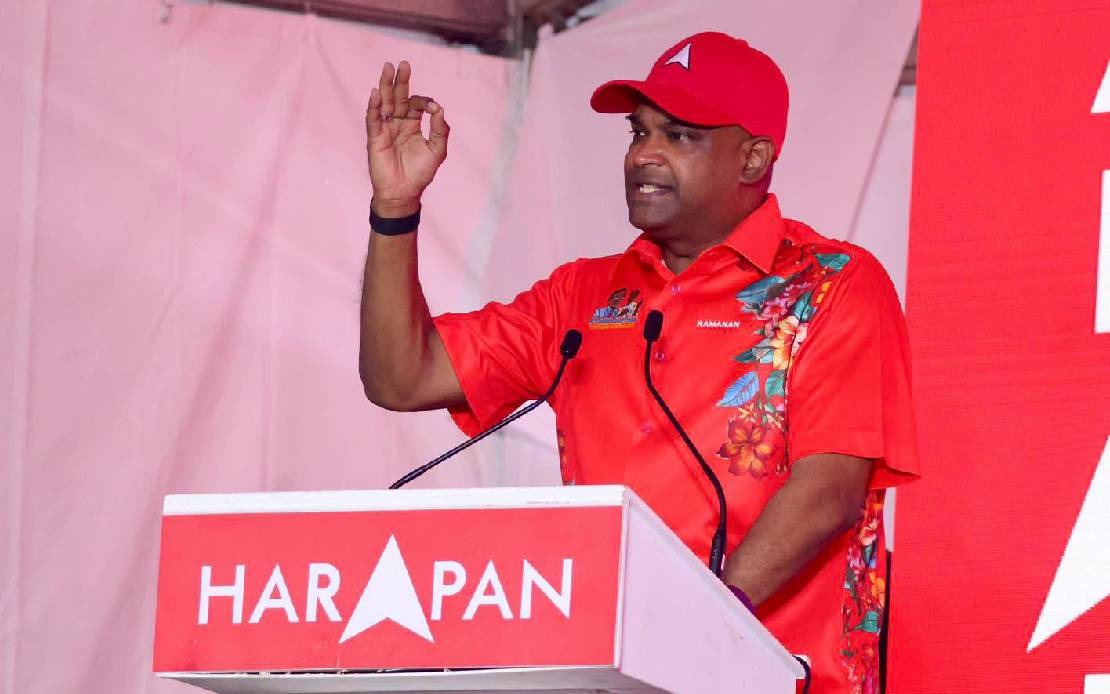
The Federal Government remains steadfast in treating Johor as a cornerstone of its national development agenda, according to PKR Vice-President Datuk Seri R Ramanan, who outlined the administration's track record of investment and public welfare programmes during a campaign stop in the state. Speaking at the Johor Ke Depan, Undi Harapan roadshow in Simpang Renggam on July 3, Ramanan presented the government's approach to economic growth and social development as fundamentally tied to ensuring equitable distribution of national benefits across Johor's diverse communities.
Ramanan's remarks underscore a broader political strategy by the Pakatan Harapan coalition to consolidate support ahead of the scheduled state election on July 11. The PKR leader emphasised that the commitment to Johor extends beyond rhetoric, citing concrete examples of major capital projects and assistance schemes already operational or in development across the state. This framing reflects a deliberate effort to translate federal-level policy into tangible outcomes that voters can recognise and assess in their own communities.
The scope of federal involvement in Johor encompasses multiple dimensions of governance and economic activity. Infrastructure development forms a significant component, with the government championing large-scale projects designed to improve connectivity, transportation networks, and industrial capacity. These investments are positioned not merely as engineering feats but as enablers of broader prosperity, creating employment opportunities and facilitating trade. For a state like Johor that serves as Malaysia's industrial and logistical gateway to the wider region, such infrastructure decisions carry particular weight in determining economic trajectory.
Beyond infrastructure, assistance programmes targeting Johor residents represent the government's commitment to direct welfare support. These schemes span education subsidies, healthcare access, housing support, and income assistance for vulnerable groups. The federal approach reflects recognition that development cannot be measured solely through GDP figures or physical projects; it must also encompass improvements in living standards, healthcare outcomes, and educational attainment. Such programmes carry specific relevance for Malaysian voters, whose household budgets face ongoing pressures from inflation and cost of living increases.
Ramanan's emphasis on administrative alignment between state and federal governments highlights a structural argument for voting Pakatan Harapan in the Johor election. When the same coalition controls both levels of government, the theory goes, policy implementation becomes smoother and more efficient. Bureaucratic friction diminishes, and development plans can proceed without the complications that arise when different political coalitions govern state and federal levels. This argument has particular resonance in Malaysia's context, where federal-state relations have historically been a source of both productive collaboration and significant friction.
The campaign event brought together multiple layers of Pakatan Harapan's leadership structure, reflecting the coalition's commitment to presenting a united front in Johor. Amanah Secretary-General Faiz Fadzil's presence alongside PKR representatives signals multi-party coordination in pursuit of state-level gains. The inclusion of candidates for specific state seats—including PH candidates for Machap, Benut, and Layang-Layang—reinforced the ground-level dimension of the campaign, bridging national messaging with local constituency interests.
Johor's political significance in Malaysia extends beyond its size and population. As a state with substantial industrial capacity, a major port in Port Klang's vicinity, and significant agricultural and manufacturing sectors, Johor's trajectory influences broader national economic performance. How effectively the state government can coordinate with federal authorities on regulatory frameworks, skill development, and infrastructure investment shapes the state's competitive positioning relative to other regions in Malaysia and Southeast Asia. Ramanan's emphasis on federal priorities reflects understanding that Johor's development serves national economic interests.
The July 11 state election unfolds against a backdrop of intense political competition, with 172 candidates contesting seats across multiple constituencies. The election timeline, which includes early voting on July 7, follows standard electoral procedures but also reflects urgency in the coalition's efforts to secure a clear mandate. For Pakatan Harapan, success in Johor would represent consolidation of control across Malaysia's most economically significant states and demonstrate continued electoral viability after the 2022 general election.
From a Malaysian voter perspective, Ramanan's claims about federal commitment merit assessment against verifiable outcomes. Infrastructure projects can be tracked through completion timelines and functionality assessments. Assistance programmes can be evaluated through beneficiary numbers and financial allocation levels. The alignment of federal and state governance can be judged by examining policy coordination, regulatory harmonisation, and project implementation efficiency. These concrete metrics ultimately matter more to constituents than political rhetoric, though both elements influence electoral decision-making.
The broader context includes Malaysia's ongoing economic challenges and regional competition for investment and skilled labour. States that effectively leverage federal support while maintaining competitive governance standards position themselves advantageously. Johor's historical status as a manufacturing and logistics hub means it attracts particular federal attention and resources. How these investments are deployed—whether toward emerging sectors like renewable energy and digital technology or concentrated in traditional industries—carries implications for long-term economic sustainability and job creation quality.
Looking forward, the coalition's framing of federal-state coordination as a development enabler will face scrutiny as voters assess their actual experiences with government services, infrastructure quality, and economic opportunity. The campaign period through July 11 will likely feature competing narratives about which political forces genuinely prioritise Johor's interests and which possess the capacity and will to translate priorities into sustained, measurable improvements in residents' quality of life.

