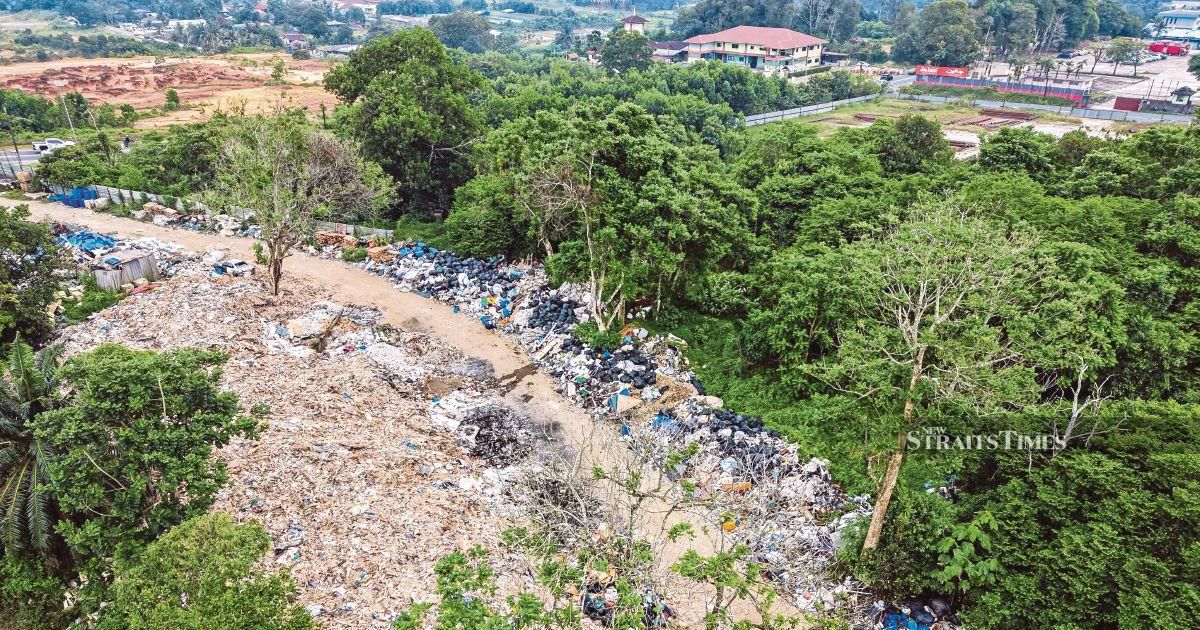
The Johor state government has responded decisively to mounting concerns about illegal waste dumping in Pontian by establishing a multi-agency task force that will conduct a thorough investigation into allegations that construction debris originating from Singapore has been deposited at multiple locations within the district. The initiative represents a significant step in addressing what environmental observers suggest could be a systematic breach of transboundary waste management protocols in the Johor Strait region.
Pontian, situated along Johor's southwestern coast directly across from Singapore, has long occupied a strategic position in regional commerce and logistics. This geographic proximity, while economically advantageous, has inadvertently positioned the district as a potential receptacle for illegally exported waste. The alleged dumping of construction materials—including concrete, timber, metal, and other demolition debris—at undisclosed locations raises serious questions about enforcement mechanisms at both the state and national level.
The establishment of the task force signals recognition among Johor's administrative hierarchy that environmental violations of this magnitude require coordinated action rather than isolated agency responses. Construction waste management is fundamentally a shared responsibility involving Solid Waste and Public Cleansing Corporation (SWCorp), local municipal authorities, the Department of Environment Malaysia, customs and border agencies, and Johor's environmental enforcement division. By consolidating these functions under a unified investigation framework, authorities aim to develop a comprehensive understanding of how materials crossed into Malaysian territory and where they were deposited.
Environmental dumping, particularly across state and international boundaries, presents distinctive enforcement challenges. Construction waste represents a significant proportion of total waste streams in developed economies like Singapore, where stringent environmental regulations and high domestic disposal costs create perverse incentives for illegal export. The relative weakness of monitoring infrastructure at informal dumping sites in Malaysian border regions can make cross-border waste trafficking economically attractive to unscrupulous operators seeking to avoid proper disposal expenses.
The implications extend beyond Pontian's immediate environment. Uncontrolled construction waste deposits can leach hazardous substances into groundwater, disrupt local ecosystems, and degrade agricultural land values in surrounding communities. The district's proximity to the Johor Strait—a vital shipping corridor and fishing ground—means environmental contamination risks extend to marine resources that support livelihoods across the region.
For Malaysia's waste management sector and its environmental governance architecture, this investigation carries symbolic weight. The country has sought to position itself as an environmentally responsible nation committed to circular economy principles and sustainable development. Illegal dumping by neighbouring countries directly contradicts this narrative and tests the resilience of bilateral environmental cooperation mechanisms. The Association of Southeast Asian Nations has increasingly emphasised transboundary environmental accountability, making this a matter with regional policy implications.
The timing of the investigation reflects growing public awareness of environmental violations, likely amplified through social media documentation and community reporting. Residents of Pontian may have observed suspicious dumping activities or noticed environmental degradation at particular sites. Public mobilisation around environmental concerns has historically proven instrumental in prompting official action in Malaysia, particularly when local communities feel their environmental security is threatened.
The task force's investigative scope will likely encompass identifying the specific dumping locations, determining the composition and volume of deposited materials, tracing the origin and transport route of the waste, and identifying the individuals and entities responsible for the illegal activity. This may involve coordinating with Singapore's authorities through existing environmental and law enforcement channels. Such international cooperation, while complex, remains essential for establishing accountability and preventing future incidents.
Legal accountability represents another crucial dimension. Malaysia's Environmental Quality Act 1974 and related legislation impose penalties for illegal waste disposal and trafficking. Those found culpable could face substantial fines, imprisonment, or both, depending on the severity of violations. The investigation may also reveal regulatory gaps or enforcement deficiencies that inform future policy adjustments.
From a comparative regional perspective, this situation reflects broader Southeast Asian challenges with transboundary waste management. As Indonesia, Vietnam, and other nations have demonstrated, developing countries often absorb waste exports from wealthier neighbours, externalising environmental costs onto communities with less political influence. Malaysia's investigation serves as a potential precedent for how regional nations can assert their environmental sovereignty and demand accountability from wealthier partners.
The resolution of this investigation will likely influence public confidence in environmental governance and cross-border cooperation mechanisms. If the task force successfully identifies perpetrators and recovers or properly manages the deposited waste, it would demonstrate state capacity to manage complex environmental violations. Conversely, if the investigation stalls or produces limited accountability, it may reinforce perceptions that illegal dumping carries minimal risk of consequences.
Moving forward, the multi-agency approach may establish institutional frameworks for ongoing monitoring of potential dumping activities in Pontian and other border areas. Enhanced inter-agency coordination could yield dividends beyond this specific case, creating more robust mechanisms for detecting and preventing environmental violations generally.

