The Johor government has committed RM50 million towards a comprehensive repainting initiative targeting low-cost flats, privately owned low-medium-cost flats, and public housing units throughout the state. The programme represents a significant investment in housing stock maintenance and reflects the state administration's focus on upgrading living conditions for lower-income households across its urban and suburban communities.
The initiative encompasses an ambitious scope, with repainting work scheduled for 170 housing blocks containing 11,693 residential units positioned at 26 strategic locations throughout Johor. According to Datuk Mohd Jafni Md Shukor, chairman of the State Housing and Local Government Committee, the project is projected to provide direct benefits to nearly 46,772 residents who call these housing complexes home. This scale of intervention demonstrates the state government's commitment to addressing maintenance backlogs that have accumulated in public housing estates.
While repainting might appear to be superficial cosmetic work, state officials have articulated a broader vision for the programme's impact on community welfare. The initiative extends beyond aesthetic improvement to encompass environmental and psychological dimensions that influence residents' daily lives. A freshly painted, clean residential environment contributes to enhanced comfort levels, fosters stronger bonds within communities, and communicates to residents that their wellbeing remains central to state government priorities. This messaging is particularly important in lower-income housing estates where residents may otherwise feel neglected by local authorities.
Implementation of the project will be coordinated by multiple state agencies working in tandem to ensure consistency and efficiency. The Johor State Housing Development Corporation (PKPJ) and the Local Government Division of the Johor State Secretary's Office will lead coordination efforts, supported by several city and municipal councils including the Johor Bahru City Council (MBJB), Iskandar Puteri City Council (MBIP), Pasir Gudang City Council (MBPG), and the Kulai Municipal Council (MPKu). This multi-agency approach distributes responsibility across administrative boundaries and leverages existing local government infrastructure.
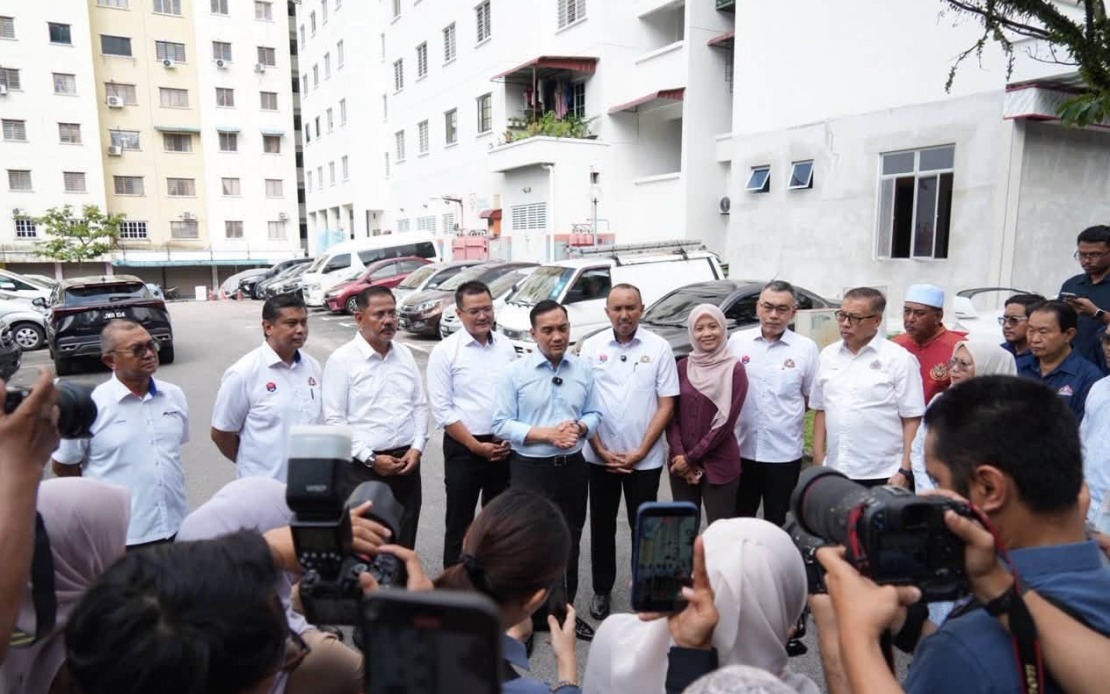
Datuk Mohd Jafni conducted an inspection of repainting works at the Desa Muafakat Apartments alongside Johor Menteri Besar Datuk Onn Hafiz Ghazi, underscoring the project's importance within the state's broader housing policy agenda. The visit allowed state officials to assess on-site progress and address emerging maintenance issues beyond the scope of the repainting programme. During the inspection, officials were briefed on slope subsidence concerns near apartment parking facilities and damage to internal road infrastructure within the housing complex. These secondary issues highlight the interconnected nature of housing maintenance, where cosmetic improvements must be coordinated with structural repairs to deliver meaningful outcomes.
The visit also included a tour of a Tabika KEMAS Bangsa Johor construction site situated within Desa Muafakat Apartments, indicating the state government's layered approach to improving amenities and services in lower-income housing communities. By combining housing maintenance initiatives with childcare facility development, the administration seeks to address multiple dimensions of resident welfare simultaneously. This integrated approach reflects contemporary thinking about holistic community development in urban settings.
State officials have emphasised stringent quality control measures to ensure the repainting project delivers lasting benefits rather than short-term cosmetic fixes. Datuk Mohd Jafni stressed that both implementing agencies and appointed contractors have been explicitly instructed to maintain the highest standards of workmanship, safety, and cleanliness throughout project execution. This emphasis responds to past experiences where hastily completed public works projects have deteriorated rapidly or inadvertently created new complications for residents. The state government has signalled that work must proceed according to predetermined schedules, detailed specifications, and established quality standards without compromise.
The initiative carries particular relevance for Southeast Asian regional contexts where public housing stock maintenance represents an ongoing challenge for urban administrations. Many housing blocks constructed decades ago require substantial intervention to maintain habitability standards, and available budgets often prove insufficient for comprehensive renovation. By dedicating RM50 million specifically to painting programmes, Johor acknowledges that deferred maintenance can undermine resident satisfaction and community cohesion even when structural integrity remains intact. The project demonstrates one state's prioritisation of incremental improvements that complement longer-term housing policy objectives.
For Malaysian property markets and housing policy observers, this initiative signals the state government's recognition that public housing deserves sustained maintenance investment. As Malaysia continues urbanising, the condition of existing public housing estates influences broader perceptions of urban governance effectiveness and social equity. Well-maintained public housing reflects government responsiveness to lower-income constituents' needs and supports social stability. The RM50 million commitment, while substantial, represents a proportionate response to the accumulated maintenance backlog across Johor's diverse housing portfolio spanning multiple municipalities and urban jurisdictions.

