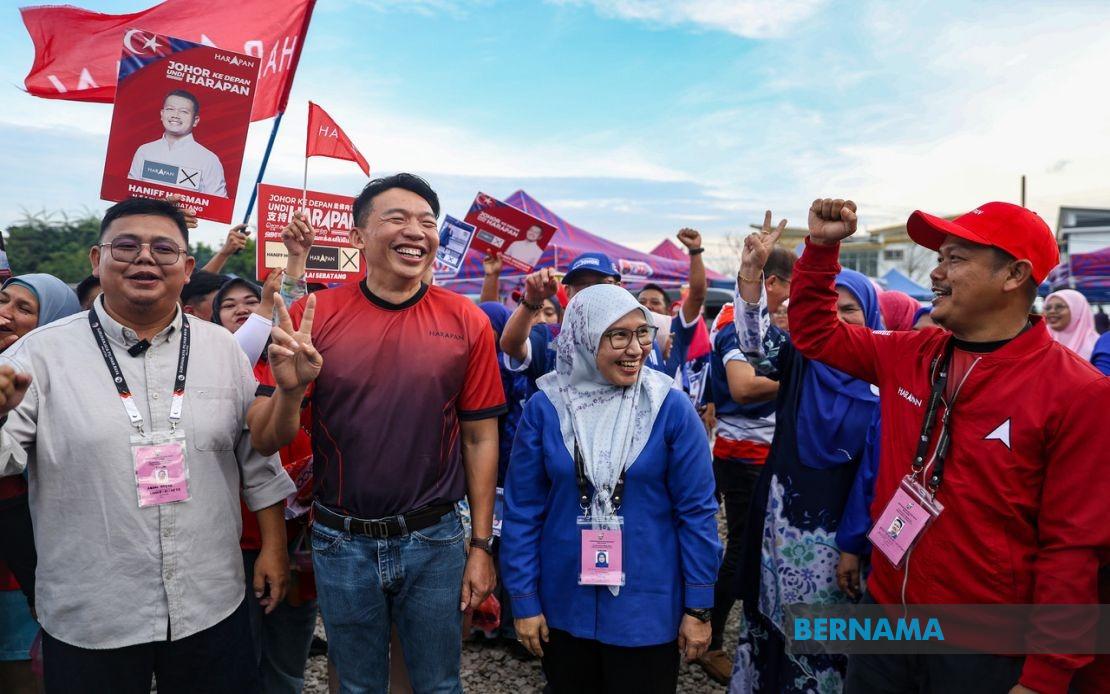
The Johor state election campaign took a notably courteous turn in Pontian on June 29 when rival candidates from competing political coalitions encountered each other while campaigning at the Taman Megah night market. The unscripted meeting between Pakatan Harapan representatives and their Barisan Nasional counterpart became a brief moment of democratic theatre, drawing the curiosity of passing voters who witnessed the interchange before the candidates resumed their respective campaign activities.
The three Pakatan Harapan candidates—Haniff @ Ghazali Hosman of Pulai Sebatang, Abd Razak Ismail of Benut, and Cheah Chee Hong of Kukup—were conducting a joint campaign walkabout when they encountered Hasrunizah Hassan, the Pulai Sebatang candidate fielded by Barisan Nasional. What could have been an awkward collision between rival campaign teams brandishing red and blue flags instead transformed into a genial exchange, with the candidates acknowledging one another as the watching crowd paused to observe the interaction.
The incident reflects a broader pattern in Malaysian electoral politics where personal civility often coexists with robust political competition. For voters witnessing such encounters, the sight of opposing candidates treating each other with respect carries symbolic weight, suggesting that electoral contests need not devolve into personal animosity or confrontation. In Johor's campaign environment, where multiple constituencies across three constituencies were simultaneously in play, such moments provided reassurance to the electorate that political differences could be negotiated within a framework of mutual courtesy.
When addressing media representatives at the location, Haniff characterised the meeting as emblematic of a mature democratic process in motion. He emphasised that the Pontian campaign had proceeded without acrimony or disturbances, with candidates from opposing sides demonstrating the capacity to compete peacefully. His commentary positioned the interaction as evidence that robust electoral competition and personal civility were not mutually exclusive propositions, a perspective that carries particular relevance in Malaysian politics where concerns about campaign civility periodically surface.
Cheah, representing Pakatan Harapan in the Kukup seat, used the platform to appeal directly to voters across all three constituencies contested by his coalition. His remarks underscored the strategic unity of the Pakatan Harapan campaign in the region while acknowledging the significance of the cordial encounter. By framing the meeting positively rather than defensively, Cheah contributed to a narrative of confident, secure candidacies unbothered by the proximity of political opponents.
From Barisan Nasional's perspective, Hasrunizah similarly characterised such encounters as unremarkable expressions of democratic maturity. Her statement that inter-party meetings during campaigns reflected the health of Johor's electoral culture positioned the incident within a broader context of institutional stability. She noted that despite the intensifying campaign period, the overall situation in the state remained orderly and incident-free, an observation that holds significance for voters evaluating not just candidates but the tenor of the electoral process itself.
Hasrunizah's additional remarks about channelling the encounter's positive energy toward energising the Barisan Nasional and Maju Johor campaigns suggested that even seemingly neutral moments could be instrumentalised within broader campaign narratives. The comment reflected strategic discipline in ensuring that no aspect of the campaign—even chance meetings—escaped incorporation into the larger messaging framework.
The Johor state election context lending significance to these exchanges extends across multiple dimensions. With polling scheduled for July 11 and early voting on July 7, the campaign period represented a concentrated window of intensive candidate visibility and voter engagement. The Pontian night market, as a venue frequented by diverse constituencies of voters, provided an organic setting where candidates could encounter both constituents and competitors simultaneously. Such venues carry particular weight in Malaysian campaigns, where community spaces often serve as sites of authentic political engagement beyond staged rallies.
The broader implications of this encounter merit consideration within Johor's recent political trajectory. The state has experienced significant coalitional shifts and realignments in recent election cycles, making displays of civil political competition potentially reassuring to voters fatigued by more acrimonious campaigns. When candidates from opposing sides demonstrate personal respect, it can subtly communicate that political differences represent honest disagreements rather than existential threats, an important messaging in a state where electoral volatility has characterised recent patterns.
For Malaysian political observers more broadly, such moments provide counternarrative to concerns about campaign deterioration or increasing polarisation in electoral contests. While individual instances of civility do not guarantee systemic transformation, they contribute to a cultural reservoir of democratic precedent suggesting that competition need not require cordiality's abandonment. The Pontian incident, captured and reported within media cycles, thus extends beyond its immediate geographical context to reinforce nationally circulating images of Malaysian democracy functioning within established norms of conduct.
The scheduling of early voting on July 7 followed by general voting on July 11 means that such campaign moments occur within an increasingly compressed timeframe as polling day approaches. Encounters occurring in the final stretch of campaigns often carry heightened symbolic weight, as candidates and voters alike become increasingly focused on electoral outcomes. Against this backdrop, the friendly exchange in Pontian represented a reassuring punctuation mark in the campaign narrative.
The incident also illustrates how campaign dynamics extend beyond formal mechanisms to encompass spontaneous, unscripted interactions that voters directly witness. While both campaign messaging and organisational structures matter significantly in electoral outcomes, the personal conduct of candidates in unplanned moments often registers deeply with voters who observe them. In this sense, the Pontian night market encounter functioned as a form of implicit campaign communication, demonstrating through action rather than rhetoric the kind of electoral culture the candidates wished to embody.

