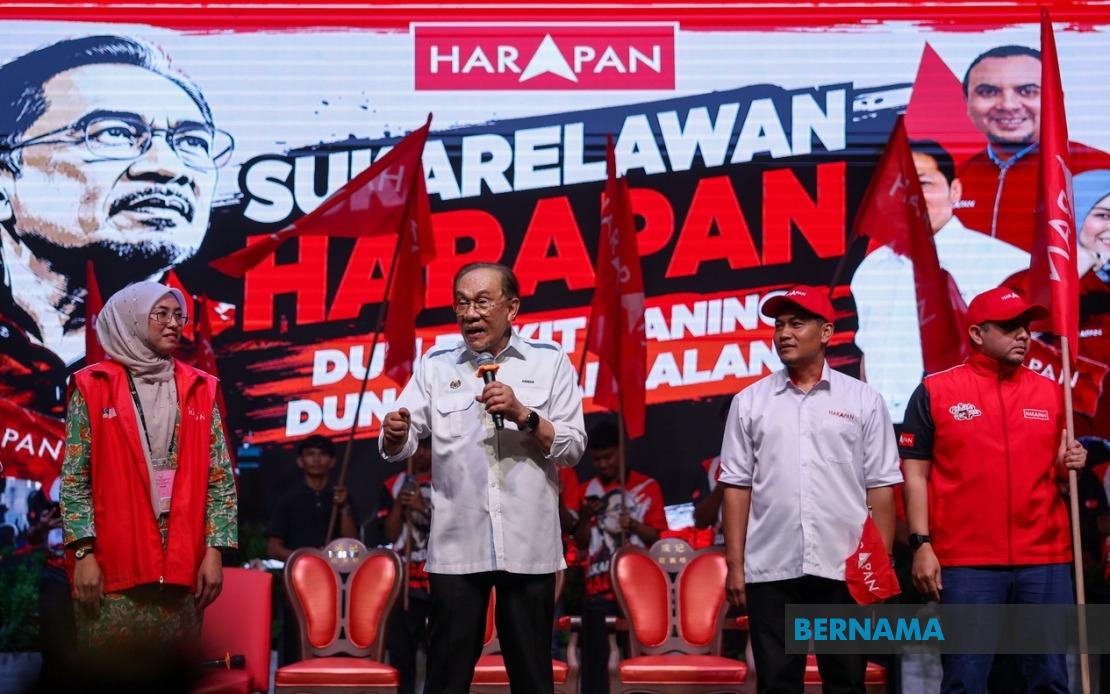
Prime Minister Datuk Seri Anwar Ibrahim has made a direct appeal to Johor's younger electorate to abandon divisive identity politics, framing the state election scheduled for July 11 as a defining moment for the generation tasked with determining the nation's trajectory. Speaking at the launch of the Bukit Naning state constituency volunteer programme in Muar, Anwar emphasised that voters should assess candidates based on their capacity to resolve tangible challenges affecting daily life—particularly education quality, job creation, and regional economic progress—rather than allowing themselves to be manipulated by appeals to racial grievance.
The Prime Minister, who also chairs Pakatan Harapan, articulated a fundamental critique of what he characterised as a moribund political approach that deliberately manufactures fear and resentment across Malaysia's multicommunal society. He referenced deliberate efforts to cultivate suspicion of Chinese Malaysians, animosity toward Indian Malaysians, and discord between Malay and Chinese communities, questioning the utility of such strategies when ordinary citizens suffer while political elites engage in wealth accumulation. This messaging reflects an ongoing tension within Malaysian politics between traditional communal mobilisation tactics and appeals for cross-ethnic consensus.
Addressing the assembled youth directly, Anwar articulated a call to action that transcended passive participation in electoral processes. He urged young Malays, Chinese, and Indian voters to recognise their collective agency and responsibility in dismantling what he termed Malaysia's "rotten political system." The framing positioned youth not merely as voters but as architects of systemic change, tasked with rejecting inherited patterns of political behaviour that have characterised post-independence Malaysian democracy. This generational framing carries particular resonance given demographic shifts that have expanded the youth voting population in recent electoral cycles.
The Prime Minister's remarks came amid notable enthusiasm from younger participants at the event, which Anwar characterised as extraordinary compared to his campaigning experience spanning more than a decade. He interpreted this youth engagement as indicative of heightened political consciousness and determination to catalyse genuine transformation. The narrative of historic youth mobilisation serves dual purposes: legitimising Pakatan Harapan's electoral positioning while simultaneously pressuring younger voters to view participation as part of a transformative national project rather than routine electoral exercise.
Context surrounding the Johor state election underscores the competitive nature of the contest. The election will see 172 candidates contesting 56 state seats, with early voting occurring on July 7 and main polling on July 11. Alongside Anwar, Pakatan Harapan candidates including Nazri Abd Rahman (Simpang Jeram) and Md Ysahrudin Kusni (Bukit Naning) were present, reflecting the coalition's focus on youth engagement as electoral strategy. The timing and composition of these events suggest deliberate efforts to cultivate generational advantage.
Anwar's condemnation of racial narratives as fundamentally poisonous and incompatible with contemporary independent Malaysia represents a deliberate ideological positioning. He characterised attempts to incite communal hatred as forms of sabotage against national unity that has historically undergirded Malaysian stability. By framing such politics as "outdated narratives peddled by the old guard," Anwar situated divisive approaches as temporally superseded rather than merely morally objectionable. This rhetorical strategy attempts to render racial mobilisation not simply wrong but anachronistic.
The Prime Minister grounded his pluralist vision in pragmatic observations about Malaysia's lived reality. He noted that Malays, Chinese, Indians, and Orang Asli inhabit shared national space and possess capacity for coexistence grounded in mutual respect and reciprocal care. Anwar's framing positioned intercommunal harmony not as idealistic aspiration but as achievable outcome dependent on political choices and generational commitment. He expressed particular optimism regarding youth prospects, suggesting that younger Malaysians represent the demographic most capable of transcending inherited communal frameworks.
Central to Anwar's messaging was a critique of passive citizenship. He rejected the notion that younger Malaysians should assume positions of detached spectatorship regarding national direction. Instead, he demanded that youth embrace active responsibility for constructing more inclusive futures. This rhetorical move transforms electoral participation from procedural obligation into moral imperative rooted in generational stewardship. The implications extend beyond immediate electoral calculations to fundamental questions about political culture and citizenship expectations.
For Malaysian readers and broader Southeast Asian observers, Anwar's positioning reflects contemporary tensions within plural democracies navigating competing pressures toward both communal mobilisation and inclusive governance frameworks. The emphasis on youth and generational change speaks to broader regional patterns wherein younger voters increasingly reject traditional identity-based political alignments. Johor, as Malaysia's second-largest state by population and economically significant region, represents a crucial testing ground for whether such messaging can translate into substantive electoral shifts.
The election also illustrates ongoing competition within Malaysian politics regarding which coalition can credibly claim commitment to multiethnic governance. Pakatan Harapan's emphasis on policy-based rather than identity-based politics positions the coalition differently from competitors, though such positioning requires consistent demonstration through policy implementation and candidate selection. The presence and prominence of younger candidates alongside Prime Ministerial endorsement suggests deliberate efforts to match rhetorical commitments with generational representation.
Regionally, the Johor contest offers insights into how Southeast Asian democracies balance demographic change, youth political preferences, and traditional communal structures. Malaysia's management of these tensions—whether through transcendence or repackaging of communal politics—carries implications for neighbouring democracies managing similar tensions. The outcome and trajectory of youth political mobilisation in Johor may signal broader patterns regarding generational political preferences across the region.
Anwar's intervention demonstrates recognition that electoral outcomes increasingly depend on youth participation and preferences. Whether his messaging successfully mobilises young voters around policy and developmental concerns rather than identity markers will provide important data regarding the sustainability of pluralist political coalitions in Malaysia. The July 11 election represents not merely a state-level contest but a referendum on whether generational change can reshape the nation's political foundation.

