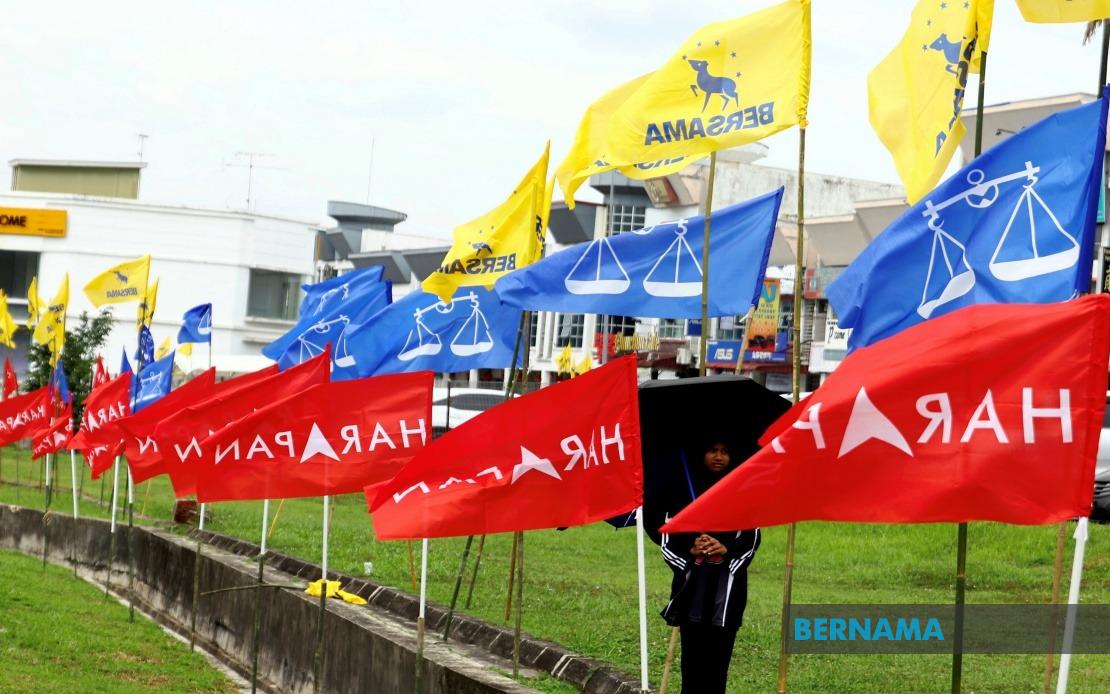
Johor's electoral campaign enters its final hours tonight as the two-week political marathon draws to a close at 11.59 pm, silencing all ground and digital canvassing operations. From tomorrow morning, attention shifts entirely to the ballot box as the state's 2.7 million registered voters make their way to 1,076 polling centres to determine which of 172 candidates will claim the 56 available state assembly seats. The Election Commission anticipates preliminary results by 10 pm, setting the stage for what analysts describe as a pivotal moment in Johor's political trajectory.
This election has unfolded against a backdrop of sustained economic and social concerns that shaped the campaign's thematic core. Since campaigning commenced on June 27, political parties from the major coalitions through to independent contenders have positioned their visions around pressing bread-and-butter issues—the escalating cost of living, employment opportunities, economic revitalisation, and welfare provisions. Unlike the previous election cycle, the candidate field has contracted, with 172 individuals standing this time compared to 239 in 2018, suggesting a consolidation within party structures and possibly clearer ideological positioning.
The closing moments of campaigning witnessed appearances by national heavyweights underscoring the contest's significance beyond state boundaries. Prime Minister Datuk Seri Anwar Ibrahim, who chairs Pakatan Harapan, and Deputy Prime Minister Datuk Seri Dr Ahmad Zahid Hamidi, heading Barisan Nasional, both mobilised their constituencies in final rallies, demonstrating that Johor's outcome carries implications for the federal Unity Government arrangement and the broader BN-PH power dynamic.
Electoral mechanics have already begun their course through early voting, completed last Tuesday, which involved 20,607 members from the Malaysian Armed Forces, Royal Malaysia Police, General Operations Force and their families. This mechanism, designed to accommodate security personnel's operational commitments, typically produces lower overall ballot numbers but signals the calibre of preparation across administrative apparatus.
Dr Nazreena Mohammed Yasin from Universiti Tun Hussein Onn Malaysia identifies voter turnout as the linchpin determining whether campaign momentum translates into actual electoral support. However, she cautions against treating turnout as a monolithic indicator, emphasising that its political significance varies substantially across constituencies and demographic groupings. In certain areas, elevated turnout may decisively benefit particular parties, whilst in others it registers minimal strategic consequence. For marginal seats—those decided by narrow margins—turnout patterns prove especially consequential, potentially swinging outcomes for undecided voters mobilised in final hours.
The previous Johor election in 2022 recorded a 54.92 per cent overall turnout figure, establishing a baseline against which tomorrow's participation may be assessed. Beyond raw numbers, the quality of party machinery becomes decisive, particularly in tightly contested divisions where organisational efficiency in mobilising supporters and managing polling day logistics separates victory from defeat. Candidates themselves carry considerable weight, with electoral outcomes reflecting voter confidence in individual representatives' credibility and track records.
Dr Mazlan Ali of Universiti Teknologi Malaysia observes that this campaign has been fundamentally shaped by competing narratives around political stability, with both BN and PH leveraging their respective federal and state governance records as central campaign pillars. The dominance of these two coalitions reflects not merely their numerical strength but the narrative space they occupy—framed through the lens of institutional performance and demonstrated delivery on previous electoral pledges. Smaller parties, including Perikatan Nasional's 33 candidates, Parti Bersama Malaysia's 15 hopefuls, and scattered independent and specialist party representatives, find themselves articulating alternative visions within a contest weighted toward larger player legitimacy.
The broader electoral arithmetic reveals the landscape's complexity. BN currently occupies 40 of the 56 seats vacated following the assembly's dissolution on June 1, with PH holding 12, Perikatan Nasional three, and MUDA one. These holdings represent institutional advantage for the incumbent BN, yet PH's coalition positioning within the federal Unity Government provides compensatory political capital. The question becomes whether voters reward incumbency or use this election to rebalance the state-federal relationship, a consideration particularly acute given the interplay between Malaysia's federal framework and state-level mandates.
Analysts expect heightened public interest this cycle to drive elevated turnout, amplifying each vote's significance in shaping the next five-year administration. The focus on economic management and cost-of-living pressures resonates particularly in Johor, where manufacturing, logistics, and commerce constitute economic foundations vulnerable to broader regional economic fluctuations. Candidates' credibility on these specifics—demonstrated through concrete policy proposals rather than abstract promises—appears to influence fence-sitters whose last-moment decisions can prove decisive in closely fought contests.
Victory margin shifts will communicate much beyond simple seat counts. Changes in winning margins reveal whether political support has consolidated, fractured, or migrated between cycles. A party increasing its previous winning margins signals strengthened voter confidence; narrowed margins suggest eroding support or tightening competition. For Johor specifically, these patterns illuminate whether the state's electorate views governance through a federal or local lens, whether economic messaging penetrated effectively, and whether the Unity Government concept itself has shifted public calculus.
As the campaign formally concludes this evening, the accumulated weight of two weeks' political activity rests with voters. The 1,076 polling centres opening tomorrow morning will process millions of individual decisions that collectively determine Johor's governance architecture, its policy direction on cost-of-living interventions, job creation and economic diversification, and its role within Malaysia's federal political balance. Whatever emerges from tomorrow's count will reverberate through Southeast Asia's most strategically positioned state and inform calculations at federal level regarding the stability and durability of current coalition arrangements.

