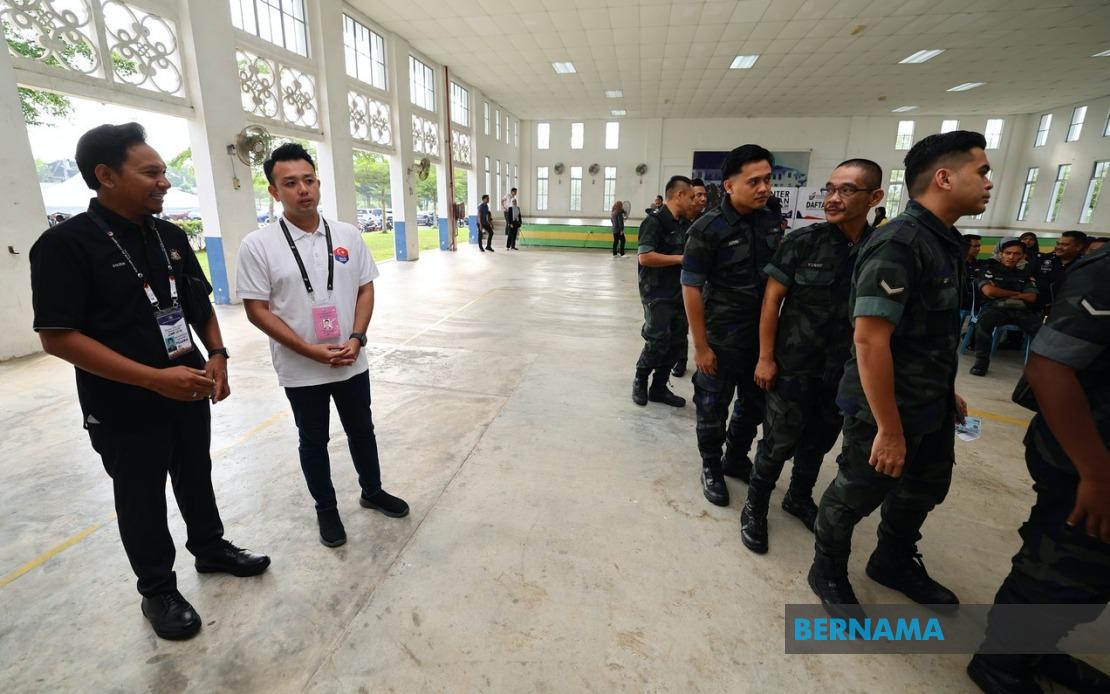
As the Johor state election approaches its climax with polling day scheduled for Saturday, candidates competing across the state's 56 legislative seats made a concerted effort to witness the early voting procedures unfolding for the security forces. The decision to attend these centres provided the candidates with direct visibility into the electoral mechanics that would determine representation in the Johor State Legislative Assembly, where 172 hopefuls are contesting the available positions.
The Layang-Layang seat witnessed the convergence of all three coalition representatives at the 5th Battalion General Operations Force Camp in Simpang Renggam. Guna Balakrishnan, representing the Pakatan Harapan alliance, joined rivals Chua Jian Boon from Barisan Nasional and Abd Mutalip Abd Rahim of Perikatan Nasional in observing how military personnel and their spouses exercised their franchise. This tripartite presence underscored the competitive nature of the contest, with each coalition keen to ensure transparency during the voting process for a constituency that could prove significant in determining the final composition of the state legislature.
Similarly, the Tenggaroh seat drew attention from its three competing candidates, who converged at the Iskandar Camp early voting centre in Mersing. Muhamad Amerul Muhamad from Perikatan Nasional, Mohd Youzaimi Yusof representing Barisan Nasional, and Md Yusof Dawam of Pakatan Harapan observed proceedings as police personnel and military families cast their ballots. The coordinated presence of opposing candidates reflected a broader commitment across the political spectrum to maintaining confidence in the electoral process, particularly among security sector voters whose participation carries symbolic weight in ensuring democratic legitimacy.
Prominent candidates from other constituencies also made appearances throughout the morning and afternoon. Lim Chin Eng, the oldest competitor in the entire Johor election, attended proceedings at the Johor Contingent Police Headquarters, demonstrating that engagement with the early voting process transcended age or tenure in politics. Muhammad Faezuddin Mohd Puad of Pakatan Harapan positioned himself at the Kempas Police Station, while Barisan Nasional's Datuk Jafni Md Shukor observed the process at Kulai District Police Headquarters, each candidate ensuring their presence during this preliminary phase of the election cycle.
The attendance of senior military and security leadership added an additional layer of official oversight to the proceedings. Army Chief General Tan Sri Azhan Md Othman, accompanied by 21st Special Service Group commander Major General Datuk Ahmad Shuhaimi Mat Wajab, visited the Iskandar Camp facility in Mersing to monitor the orderly conduct of voting among uniformed personnel. Johor police chief Datuk Ab Rahaman Arsad also participated in the democratic process, casting his own ballot at Dewan Dato Onn within the Johor police headquarters complex, signalling the commitment of security apparatus to the electoral framework.
Despite logistical challenges posed by brief rainfall across several voting locations, the early voting process proceeded with remarkable efficiency. Reporters observing the centres confirmed that security personnel arrived in organised stages beginning from 8 am, adhering strictly to procedures established by Election Commission officials without disruption or significant delays. The rain, which fell intermittently at multiple sites, failed to impede the systematic movement of voters through registration and balloting stations, demonstrating the preparedness of electoral administrators for weather contingencies.
The scale of early voting participation reflected the substantial security sector presence in the state's electoral calculus. A combined total of 20,607 voters comprising military personnel and police officers, along with their eligible spouses, had registered for advance balloting. This cohort included 8,544 members of the Malaysian Armed Forces and their spouses, while 12,063 police personnel and their spouses completed the registered early voter roster. The magnitude of this security-affiliated electorate underscores the administrative complexity of conducting early voting while maintaining operational readiness across the state's law enforcement and defence establishments.
The logistical infrastructure deployed to accommodate early voting proved substantial in scope and distribution. A total of 64 early voting centres operated across Johor, opening uniformly at 8 am but closing on a staggered basis between noon and 6 pm depending on local voter concentration and specific site circumstances. This distributed approach reflected Election Commission efforts to prevent bottlenecks while respecting the deployment requirements of military and police units, which necessitated flexibility in return times to operational duties. The phased closing arrangement allowed the Commission to manage voter throughput efficiently while maintaining security protocols.
From a Malaysian electoral perspective, the participation of candidates and officials in observing early voting carried broader significance beyond mere procedural oversight. In Southeast Asian contexts where election integrity occasionally faces scrutiny, the transparent monitoring by competing political representatives serves as a confidence-building mechanism for democratic processes. The presence of candidates from Pakatan Harapan, Barisan Nasional, and Perikatan Nasional at multiple centres demonstrated that despite fierce political competition, consensus existed regarding the legitimacy of early voting protocols for essential public service workers.
The Johor election itself represents an important barometer for Malaysian politics, testing the relative strength of the three major political coalitions in one of the country's economically significant and geographically strategic states. With 172 candidates competing for 56 seats, the election anticipated considerable fragmentation and close contests in numerous constituencies. The early voting process for security personnel, while administratively routine, carried political weight as a genuine rehearsal of the democratic machinery that would operate at full scale when general polling day arrived on Saturday.
The professional conduct observed by reporters at early voting centres also reflected the maturation of Malaysia's electoral administration since the transformative 2018 general election. Election Commission officers maintained discipline over procedures while accommodating the unique requirements of military and police voters whose operational schedules demanded inflexibility. The absence of reported irregularities or complaints from any of the observing candidates suggested that technical and administrative standards had been maintained throughout the morning and afternoon sessions across all 64 designated facilities.
Looking forward to Saturday's main polling day, the successful completion of early voting for security personnel provided an encouraging indicator regarding the Election Commission's preparedness to manage the far larger civilian voter population anticipated across the state's regular polling stations. The discipline, efficiency, and transparency demonstrated during the security forces' early voting window suggested that the electoral infrastructure could accommodate the anticipated turnout when the broader Johor electorate exercised its franchise in what many observers regard as a consequential test of political preferences in a crucial Malaysian state.

