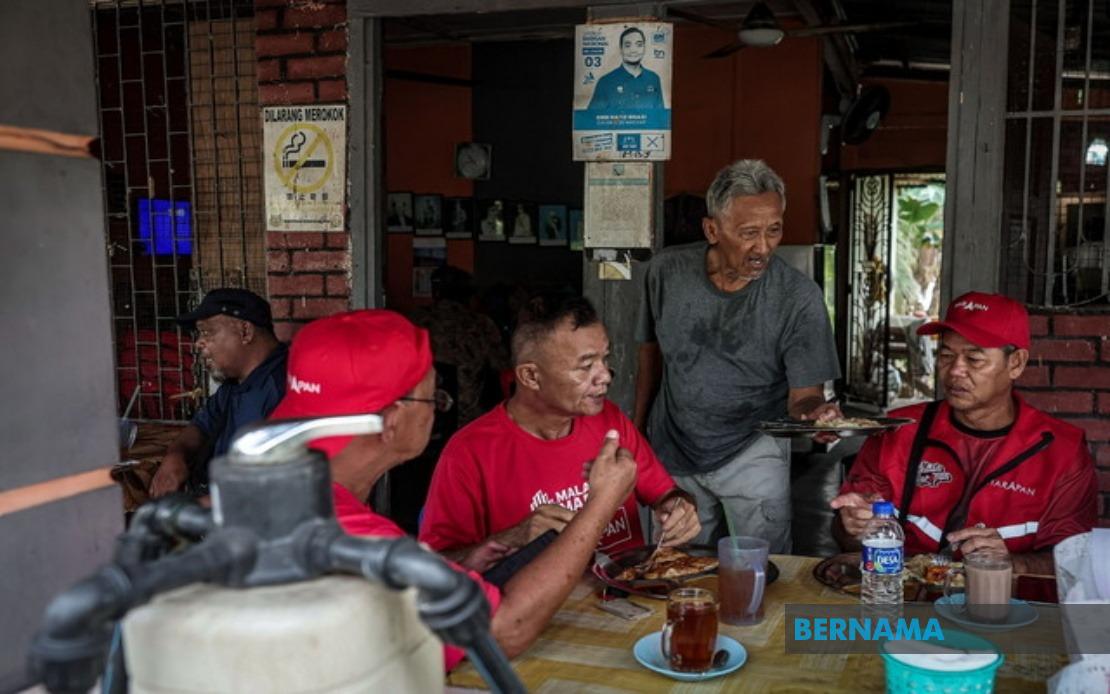
Beyond the rhetorical exchanges and campaign rallies characterising Johor's state election, an unmistakable economic undercurrent is reshaping the fortunes of street-level merchants across contested constituencies. In the weeks leading up to polling on July 11, petty traders and food vendors in areas such as Layang-Layang and Simpang Renggam have witnessed a tangible uptick in business activity, transforming what is ordinarily the quieter season into an unexpectedly profitable period. This phenomenon illustrates how electoral cycles, whilst primarily vehicles for democratic participation, cascade into real economic consequences for informal sector workers whose livelihoods depend on daily foot traffic and opportunistic sales.
For Noorma Zafmeeden, a 70-year-old stall operator working out of the Felda Layang-Layang settlement, the contrast between ordinary trading days and the election period has become stark. Her warung, which specialises in roti canai and nasi lemak, typically generates less than RM400 during morning hours on regular days. Since the campaign intensified, however, her revenue patterns have shifted noticeably upward, with customer volumes climbing substantially. This is no marginal improvement—the difference represents the kind of income variance that determines whether a small operator can comfortably meet monthly obligations or faces financial strain.
Noorma and her husband Bahari Madiran, 76, have operated their food establishment since settling in Felda Layang-Layang in 1987. Their daily rhythm remains unchanged: they begin preparation work before dawn, serving breakfast staples through the morning, then pivoting to fried dishes as evening approaches. What has altered is the clientele. Bahari observes that their warung has evolved into an informal civic gathering space, a modest but meaningful indicator of how election periods disrupt ordinary social patterns. The diverse composition of customers—spanning multiple ethnic and religious backgrounds—converges within the intimate space of a food stall, creating moments of everyday multiculturalism that reflect Malaysia's social texture.
Bahari's satisfaction with the influx extends beyond purely financial calculation. He values the opportunity to encounter campaign workers and political operatives from different regions, seeing in these encounters a form of national connection that transcends the immediate economic transaction. For aging traders in rural settlements, such interactions represent a tangible link to the broader national conversation, breaking the monotony of routine. This psychological dividend complements the material gain, suggesting that election-driven business booms offer traders something beyond monetary accumulation—a sense of relevance and inclusion in processes that might otherwise feel distant.
The pattern observed in Layang-Layang repeats itself across nearby Simpang Renggam, where nasi campur trader Ahmad Ridzuan Awang, 45, reports that his sales have doubled during the campaign window. His experience provides quantifiable evidence of the surge: dishes that ordinarily clear only as evening approaches now sell out by early afternoon, with bulk orders from various political factions accounting for the acceleration. By 1:30 pm, his preparation trays stand empty—a dramatic compression of his selling window that nonetheless reflects a proportional increase in total revenue. Ahmad Ridzuan's observation highlights the operational strain that election periods impose alongside their financial benefits; the compressed timeframe demands more intensive labour and rapid turnover.
What Ahmad Ridzuan terms "political tourists"—campaign workers, candidates, volunteers, and supporters descending on constituencies from across the country—constitute the engine driving this economic activity. These temporary migrants bring not only direct purchasing power to food vendors but generate indirect benefits throughout the local supply chain. Suppliers of raw ingredients experience increased demand, transport operators move greater volumes, and the general commercial atmosphere becomes more animated. This multiplier effect, though temporary, illustrates how election cycles can catalyse dormant economic potential in peripheral areas that might otherwise struggle to attract outside spending.
The current Johor state election, the 16th since the state's administrative establishment, encompasses 172 candidates competing across 56 seats, with early voting scheduled for July 7. This relatively large field of candidates and substantial geographic spread means that campaign activity is geographically dispersed, touching numerous settlements and market areas across the state. The distributed nature of the campaign ensures that the economic windfall is not concentrated in a single urban centre but disperses across multiple small towns and rural market zones, benefiting traders in locations that typically experience weaker consumer demand.
Yet the sustainability question lingers beneath this temporary prosperity. Once polling concludes and candidates return to their home constituencies, campaign workers disperse, and the political focus shifts away from Johor, these traders will inevitably revert to their baseline transaction levels. The sharp income fluctuation creates a dynamic where traders become accustomed to the exceptional earnings of campaign periods, only to experience a steep contraction afterwards. For operators like Noorma and Ahmad Ridzuan, whose economic margins are typically tight, the psychological adjustment from abundance to scarcity presents its own challenges alongside the financial reality.
The election-driven boost also underscores the vulnerability of informal sector traders to external shocks and irregular demand patterns. Unlike formal businesses with diverse revenue streams or established customer bases, hawkers and stall operators depend heavily on foot traffic and spontaneous purchasing decisions. Campaign periods artificially inflate this traffic, creating an anomalous window of opportunity. This dependency reveals the precarious nature of livelihoods in Malaysia's informal economy and suggests that policymakers might consider whether more systematic support mechanisms could stabilise the earnings of such traders beyond election cycles.
Moreover, the commercial activation of smaller towns during election campaigns represents a phenomenon that warrants scholarly and policy attention. These periods provide empirical evidence that demand exists in peripheral areas when sufficient spending power concentrates locally—a counterargument to narratives of inevitable rural economic decline. Election campaigns, whatever their political implications, function as periodic demand aggregators, channelling resources into areas that might otherwise remain economically marginal. Understanding this pattern could inform broader strategies for regional economic development and the revitalisation of smaller market centres that feel increasingly bypassed by national economic growth.
For traders like Noorma, Bahari, and Ahmad Ridzuan, the immediate reality is straightforward: the election campaign has created a temporary but meaningful improvement in their circumstances. They experience firsthand how political processes at the state level translate into concrete changes in their daily economic reality. This ground-level perspective often remains absent from electoral discourse, which focuses predominantly on policy platforms, candidate credentials, and voting mathematics. Yet from the standpoint of a 70-year-old vendor hoping to generate sufficient income to cover her family's needs, the election campaign's economic consequences are at least as consequential as its political outcomes.

