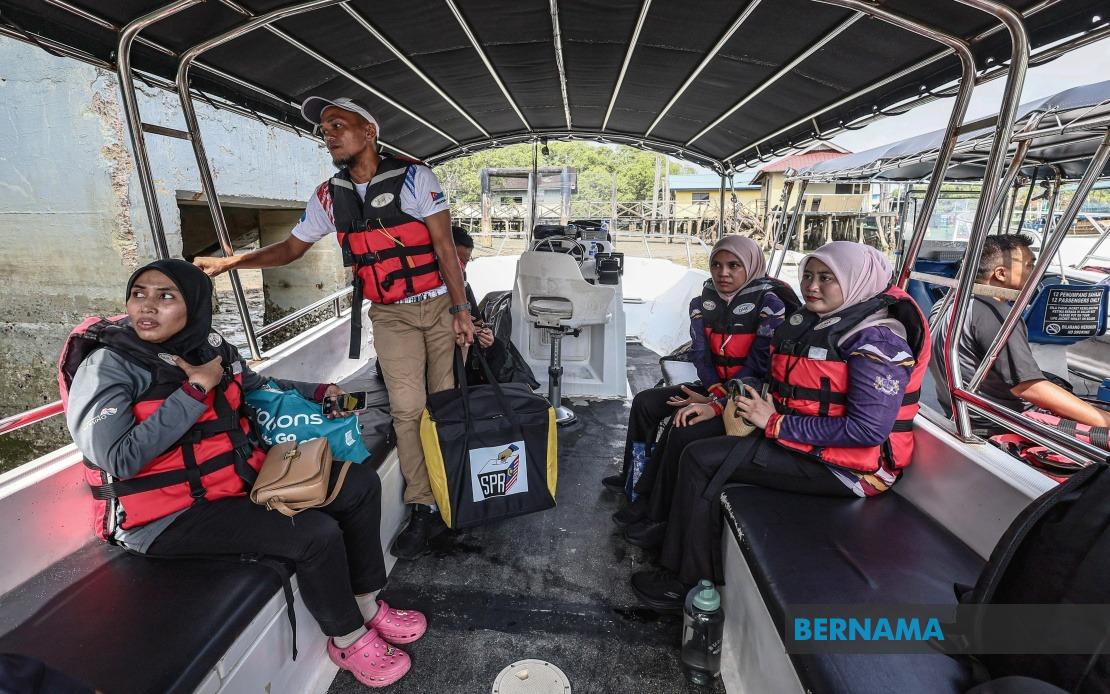
The 16th Johor State Election on July 11 has generated tangible economic benefits beyond the political arena, with small-scale business owners from the marine transport and food service sectors experiencing a noticeable uptick in earnings. The election cycle, which mobilised more than 2.6 million registered voters across the state, created legitimate commercial opportunities for entrepreneurs operating in logistical and hospitality spaces who found themselves integral to the mechanics of the democratic process.
Mustakim Shafie, who operates Island Eagle Boat Services & Island Hopping at the age of 35, witnessed a remarkable surge in demand for his maritime transport offerings. Beyond his regular contract to ferry Election Commission personnel and associated materials, his enterprise received bookings from approximately 50 voters requiring passage to offshore islands in order to participate in the election. The dual-stream revenue proved transformative, with bookings reaching double the volume of a typical working day. Operating a fleet of six speedboats, Mustakim's standard pricing structure reflects the operational complexity of maritime tourism: charter packages spanning three days and two nights command fees between RM4,000 and RM4,500, while single-journey transport for up to 18 passengers costs roughly RM2,500.
The maritime transport sector's reliance on unpredictable environmental variables presents considerable operational risk during election cycles. Weather patterns and sea conditions create inherent uncertainties that boat operators must navigate whilst maintaining both passenger safety and reliable schedules. This vulnerability underscores why experienced maritime professionals command premium positioning in the electoral logistics ecosystem. Hasrul Azmin Jumaat, a 39-year-old veteran skipper with more than two decades of hands-on navigation experience, exemplifies this expertise. His operational repertoire includes the technically demanding 76-kilometre, two-hour-plus passage to Pulau Aur, a journey requiring precise seamanship and weather forecasting acumen that only accumulated experience can provide.
The food service sector similarly benefited from the electoral calendar. Ismail Mad Hasim and his wife Faradila Fairuz Mohd Affandi, a husband-and-wife entrepreneurial partnership aged 55 and 45 respectively, operated a food stall positioned beside Sekolah Kebangsaan Taman Sutera and discovered election day transformed their ordinary commercial operation into a high-volume retail point. Customer traffic commenced early in the morning as voters who had completed their balloting sought refreshments, generating sales momentum that substantially exceeded normal commercial performance. The couple possessed previous electoral experience, having operated an identical stall during the earlier General Election, lending them operational knowledge about voter movement patterns and purchasing behaviour during polling days.
Despite the commercial advantages that polling day presented, the husband-and-wife team maintained their commitment to civic participation. Even whilst managing brisk customer demand and operational demands that resulted in selling out their entire stock, they reserved time within their schedule to personally cast their votes at the same polling centre where they conducted their business. This simultaneous engagement in both commercial activity and democratic participation illustrates the layered roles that small business proprietors navigate during election cycles.
For Malaysia's broader entrepreneurial ecosystem, particularly among small and medium enterprises concentrated in service delivery, election cycles represent periodic but genuine revenue opportunities. The electoral calendar creates temporal windows during which specific sectors—transport, catering, accommodation, retail—experience demand surges driven by logistical requirements and voter movement. For boat operators and food vendors in Johor, the 16th state election demonstrated this principle concretely. The influx of commission personnel, security staff, election observers, and voters themselves circulating through the state generated secondary economic activity that rippled through businesses positioned to service this temporary but intensive demand.
The scale of Johor's electorate—exceeding 2.6 million registered voters—amplifies these economic impacts. When distributed across polling centres, the voter population creates discrete but measurable commercial opportunities for vendors and service providers operating within geographic proximity. The election's continuation through the evening hours, with polling scheduled until 6 pm, extended the revenue window for merchants and operators, allowing them to service voters across multiple temporal windows rather than concentrating activity during peak morning hours.
For policymakers and economic development agencies monitoring grassroots entrepreneurship in Malaysia, the Johor election experience illustrates how political processes intersect with commercial activity at the community level. Small businesses demonstrate adaptive capacity, mobilising existing assets—boats, food preparation facilities, personnel—to serve election-related demands whilst maintaining core operations. This flexibility and responsiveness to temporary market conditions reflects the operational agility that characterises Malaysia's informal and semi-formal enterprise sector.
The election cycle also highlights the interdependencies within local economies. Boat operators, food vendors, transport providers, and accommodation proprietors collectively constitute a service ecosystem that activates during high-traffic periods. Their combined activities generate employment, distribute earnings across multiple business households, and sustain ancillary sectors supplying inputs to these primary service providers. From this perspective, even politically-driven commercial activity contributes to economic circulation and livelihood sustainability at the grassroots level, particularly in regions where traditional tourism and transport demand fluctuates seasonally.

