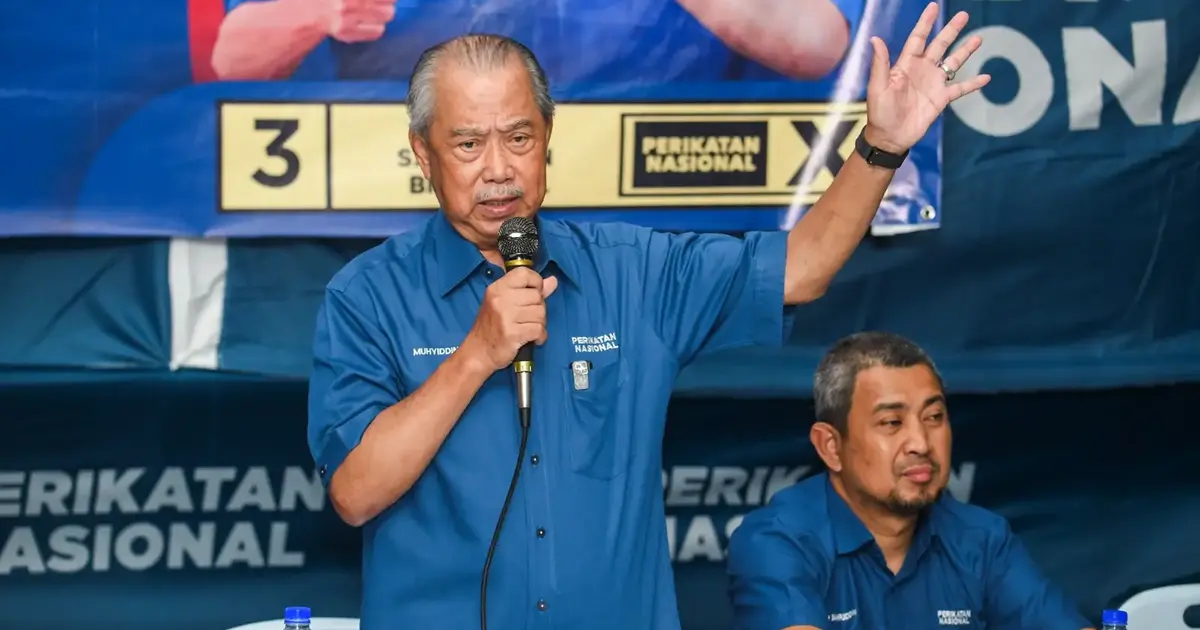
Bersatu president Muhyiddin Yassin has suggested that developments surrounding Johor's political landscape may be intertwined with discussions about the possible release of former Prime Minister Najib Razak, adding that Najib's legal status as a convicted person cannot be overlooked in such considerations.
Muhyiddin's remarks highlight the intricate relationship between state-level electoral dynamics and high-profile national political figures. The Johor state election, a significant political event in Malaysia's most developed state, appears to have become a focal point in broader political calculations affecting the trajectory of major political personalities and their circumstances.
The former Prime Minister Najib Razak was convicted in a court of law, and this foundational legal fact remains central to any discussion about his current situation and future. Despite any public discourse surrounding potential clemency or release, his conviction stands as an established legal outcome that shapes the parameters of what is administratively possible. This distinction is important in Malaysian political discourse, where the rule of law and respect for judicial decisions carry significant constitutional weight.
The intersection of state elections and national political figures reflects how Malaysian politics operates across multiple simultaneous levels. Electoral contests in individual states often serve as barometers for national political moods and alliances, while simultaneously testing coalition stability and reshaping political calculations at the federal level. Johor, as the nation's economic powerhouse and a strategically important state, commands particular attention from all major political parties and their leadership.
Muhyiddin's linking of these issues suggests that the political fortunes of various groups and individuals are interconnected through sophisticated networks of support, bargaining, and mutual interest. Politicians across Malaysia's spectrum recognise that state-level victories or defeats can have ripple effects on national positioning, resource allocation, and the viability of different policy directions or personnel decisions at higher levels of government.
The question of Najib's potential release or clemency has remained a subject of speculation and political discussion since his conviction. However, Muhyiddin's positioning emphasises that such matters cannot be divorced from Malaysia's constitutional and legal frameworks, nor from the broader political environment in which they occur. Any formal process regarding his status would need to navigate existing legal structures and institutional procedures.
For Malaysian voters and observers, understanding these connections illuminates how political power actually operates in practice. Electoral campaigns often operate simultaneously at multiple levels—voters may be making decisions about state representatives while being influenced by narratives about national figures and their circumstances. The Johor election therefore becomes not merely a contest over state administration, but a moment when various political actors reveal their priorities and their relationships with one another.
The timing of such statements also matters considerably in Malaysia's political calendar. Election periods tend to intensify scrutiny of political leadership and their decision-making, bringing both recent history and potential future scenarios into sharper focus for the voting public. When senior political figures make public statements about connections between different political matters, they are invariably communicating to multiple audiences—their own supporters, rival coalitions, and the broader electorate.
Muhyiddin's emphasis that Najib remains a convicted individual serves as an important reminder that legal outcomes cannot simply be erased through political processes, even as political configurations change. Malaysia's constitutional framework provides mechanisms for clemency or other forms of executive action regarding convicted persons, but these exist within defined legal boundaries and cannot override judicial determinations of guilt.
For Southeast Asia more broadly, Malaysia's handling of high-profile corruption cases and the subsequent political complications they generate has become a significant issue. Other nations in the region observe closely how Malaysia manages the intersection of legal accountability and political pragmatism, particularly when convicted figures remain politically significant or connected to powerful interests.
The coming weeks and months will likely see continued statements from various political actors regarding the Johor election and its implications for national politics. Muhyiddin's recent remarks suggest that conversations about multiple political matters—state elections, convicted former leaders, and coalition arrangements—are occurring simultaneously in Malaysia's political backrooms and public forums. Understanding these connections provides voters with a more complete picture of how their choices in upcoming elections might influence political outcomes affecting the entire nation.

