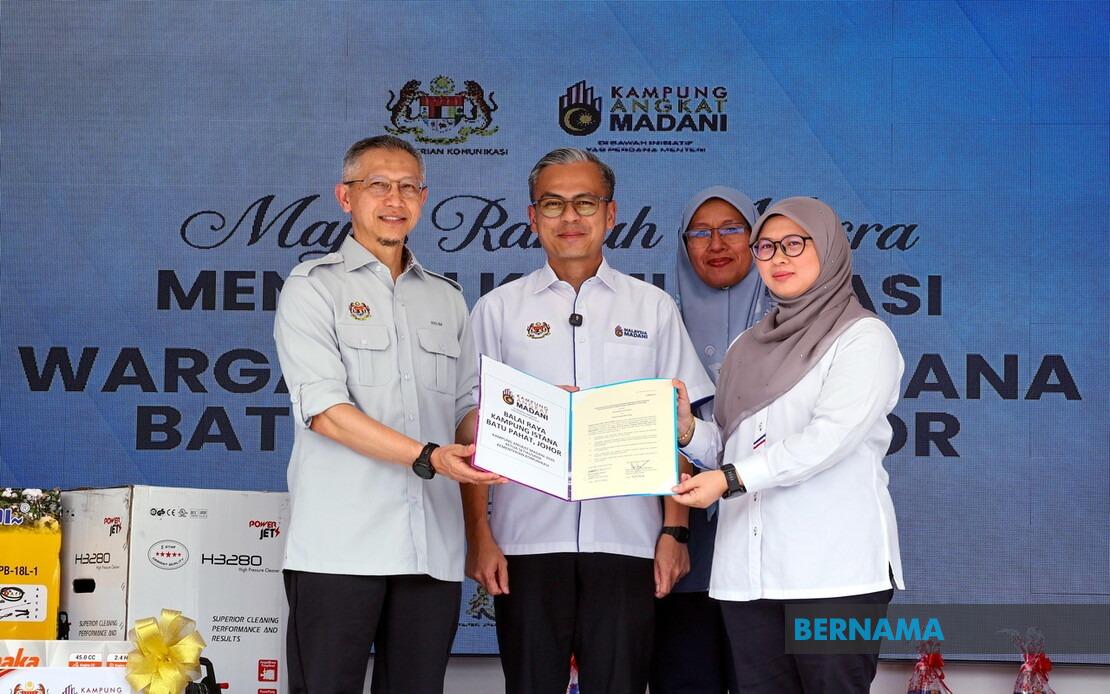
The 16th Johor State Election must be understood as a choice about the state's direction and development prospects, not as a personal endorsement of any political figure, according to Pakatan Harapan Communications Director Datuk Fahmi Fadzil. Speaking in Batu Pahat during a community engagement session, Fahmi distanced the upcoming poll from individual personalities, emphasizing that voters should evaluate candidates and coalitions based on their capacity to govern effectively and improve living standards across Johor.
Fahmi's remarks came in response to claims made by Datuk Nazifuddin Mohd Najib, who suggested that a Barisan Nasional victory would demonstrate public backing for a pardon for his father, Datuk Seri Najib Razak. The PH communications chief expressed concern at such framing, viewing it as misrepresentative of what should fundamentally be a policy-driven electoral contest. He argued that linking state-level electoral outcomes to individual figures fundamentally misunderstands the democratic process and voter intentions.
The Malaysian political landscape has long grappled with personality-centric campaigns that sometimes overshadow substantive policy discussions. Fahmi's intervention reflects a broader PH strategy to refocus the Johor narrative away from legacy issues and towards forward-looking governance questions. For Malaysian voters, this distinction carries significant weight, particularly given the region's experiences with leadership transitions and the importance of institutional accountability in democratic systems.
A critical element of Fahmi's message concerned the nature of voter loyalty and political support in contemporary Malaysia. He cautioned against any political party—regardless of affiliation—treating electoral support as permanent or automatically granted. This observation challenges the longstanding concept of "fixed deposits," traditional voting blocs assumed to provide reliable support to particular coalitions. The PH official suggested that Malaysian voters increasingly evaluate each election independently, weighing current circumstances and candidate quality rather than perpetuating inherited political allegiances.
The question of non-Malay voter behaviour particularly featured in Fahmi's analysis, as he addressed perceptions that DAP's support base among these communities was no longer assured. He argued persuasively that sustaining voter confidence requires continuous engagement, responsiveness to community concerns, and demonstrated commitment to promised outcomes. This reflects a maturation in Malaysian electoral dynamics, where demographic groups increasingly act as discerning participants rather than predictable voting blocs. The implications extend beyond Johor, potentially reshaping how all political entities approach coalition-building and voter outreach across Malaysia.
Fahmi highlighted recent defections and crossover support as evidence of PH's expanding appeal in Johor. The decision by former Rengit assemblyman Datuk Dr Mohd Puad Zarkashi to publicly endorse Pakatan Harapan candidates signals meaningful fractures in UMNO's traditional strongholds within the state. Historically, Johor served as a particularly secure base for UMNO within the BN framework, its political stability underwriting the broader coalition's electoral mathematics. The erosion of this certainty represents a significant structural shift in Malaysian politics, suggesting that even traditionally strong BN territories cannot assume continued dominance.
Additional cross-party support has emerged from unexpected quarters, with Bersatu members endorsing the PH candidate in Sri Medan, further illustrating fragmentation within the opposition-turned-government coalition. These developments suggest that the political realignment initiated during the 2018 general election continues to generate secondary shifts in voter and activist allegiances. For Malaysian observers, such movements indicate that the post-2018 political settlement remains unsettled, with constituencies and leaders still evaluating their optimal positioning within Malaysia's evolving partisan landscape.
The underlying argument advanced by Fahmi posits that Prime Minister Anwar Ibrahim's leadership and economic stewardship have created conditions conducive to broader political realignment. He specifically referenced confidence in the government's economic recovery efforts and their benefits for Johor residents, connecting national-level governance performance to state-level electoral calculus. This linkage between federal stability and local outcomes represents a critical variable in the Johor equation, as voters simultaneously evaluate both tiers of government and their interdependencies.
The mechanics of the 16th Johor State Election establish the practical context for these broader political dynamics. With 172 candidates contending for 56 seats, the contest features sufficient complexity to prevent simple binary outcomes. Polling day is scheduled for 11 July, with early voting permitted from 7 July, providing multiple opportunities for voter participation across different demographic and occupational circumstances. The scale and structure of the election require sustained campaigning efforts from all major political entities, extending beyond Johor's borders as national political figures contribute to local contests.
For Malaysia and Southeast Asia more broadly, the Johor election carries implications extending well beyond state-level governance. The state represents Malaysia's industrial and commercial heartland, with economic significance disproportionate to its political weight. Electoral outcomes here influence investor confidence, labour market dynamics, and regional economic trajectories across the southern Peninsular region. Political instability or perceived governance weaknesses in Johor create ripples affecting the broader regional economy and Malaysia's international positioning.
The mobilisation of cross-party support for PH candidates also reflects generational and ideological shifts within Malaysian politics. Younger voters and urban constituencies increasingly evaluate parties based on contemporary performance metrics rather than historical positioning, while traditional voter segments demonstrate greater flexibility in their electoral choices. This heterogenization of the electorate presents both opportunities and challenges for established political entities accustomed to more predictable electoral environments.
Fahmi's emphasis on voters making independent, future-focused decisions rather than endorsing individual personalities represents a normative claim about how democratic elections should function. Whether Malaysian voters ultimately embrace this framework remains to be determined through their actual voting behaviour on 11 July. The gap between politician rhetoric about voter sophistication and demonstrated voter behaviour frequently reveals interesting contradictions in democratic societies, and Johor may similarly display such tensions between aspirational messaging and underlying electoral motivations.

