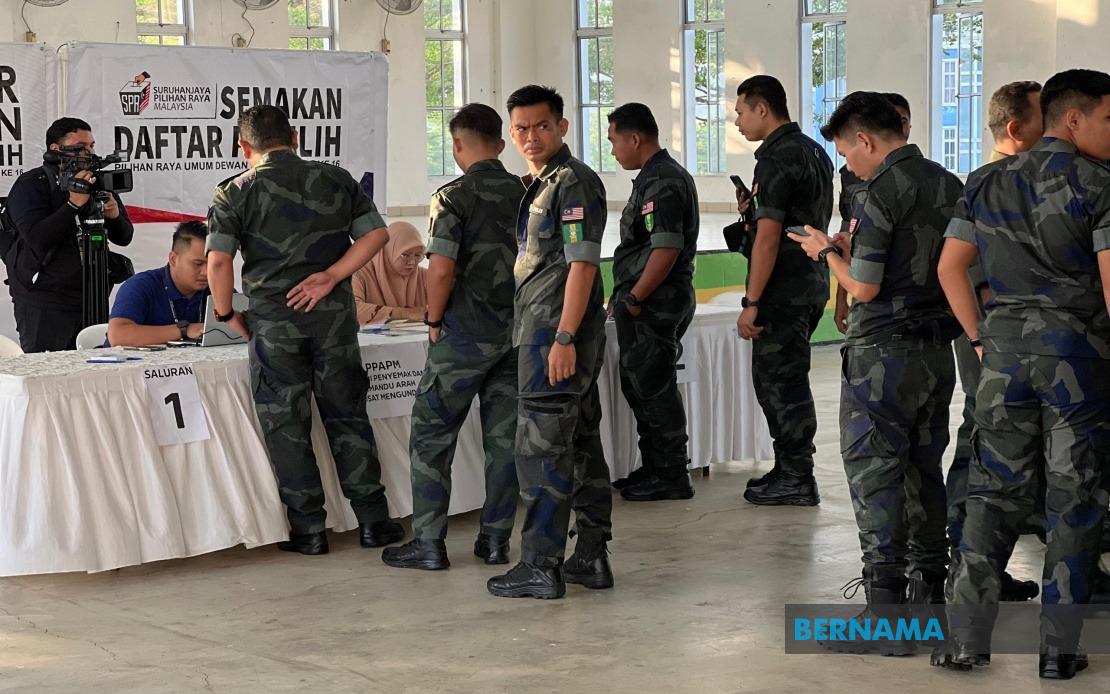
Preparations for the 16th Johor state election accelerated on July 7 as the Election Commission activated 64 early voting centres across the state, giving security personnel priority access to fulfil their electoral duties before ordinary voters head to the polls. The staggered voting arrangement reflects the logistical complexity of managing elections across a large state while accommodating the scheduling constraints of military and police personnel who may be posted away from their constituencies or on operational duty.
The Election Commission facilitated voting for 24,751 members of the security forces and their spouses through this dedicated early voting process. This figure underscores the significant contribution of Malaysia's armed and uniformed services to the electoral process, with their participation treated as a distinct administrative category requiring separate polling infrastructure. The scale of early voting centres—64 in total—demonstrates the geographical spread of security personnel stationed across Johor's various districts and the commission's commitment to ensuring universal suffrage regardless of professional circumstances.
The Malaysian Armed Forces contingent represented the larger portion of early voters, with 12,041 personnel from the MAF and their spouses assigned to cast ballots at 11 designated polling centres. This allocation suggests concentrated military installations or barracks in specific locations, allowing the Election Commission to streamline operations by consolidating MAF voters into fewer, centralized venues. The decision to separate armed forces voters from other security personnel reflects distinct command structures and operational considerations that necessitate different logistical approaches.
The Royal Malaysia Police and General Operations Force personnel presented a different distribution challenge. A combined 12,710 voters from these organizations and their families were distributed across 53 polling centres, indicating a more dispersed deployment pattern compared to military units. This wider geographic spread likely reflects the nature of police and GOF operations, which typically involve presence throughout urban and rural communities rather than concentration in major bases. The significantly higher number of polling centres for this group suggests the Election Commission prioritized accessibility and reduced congestion at individual voting locations.
Voting operations proceeded on a staged schedule, with centres closing progressively between noon and 6 pm according to Election Commission protocols. This phased closure system prevents bottlenecks at individual venues and allows poll workers to process ballots in manageable batches rather than managing a simultaneous nationwide closure. The extended voting window—from the opening at 8 am through the final closures at 6 pm—provides flexibility for security personnel whose duties may not permit simultaneous availability during traditional polling hours.
Weather conditions across several districts appeared favorable for the early voting process. Reports from Batu Pahat, Muar, Pontian and Tangkak indicated sunny skies, reducing the likelihood of weather-related disruptions to voting operations or voter turnout. Stable weather conditions are particularly important for security personnel who may travel distances to reach designated polling centres, as inclement weather could complicate their schedules or create transportation challenges.
The early voting mechanism underscores Malaysia's electoral framework, which recognizes that not all citizens can vote on the designated polling day due to occupational obligations. Security forces, in particular, operate under national requirements that may prevent their presence in home constituencies during scheduled elections. By institutionalizing early voting for these groups, the Election Commission ensures that service members do not face the choice between career obligations and civic participation—a principle fundamental to inclusive democratic systems.
The substantial number of early voters—nearly 25,000—represents a notable portion of Johor's electorate, though the state's overall voter registration indicates this is a carefully managed subset rather than a mass early voting exercise. This measured approach differs from some international models where early voting or mail-in systems are available to all voters, reflecting Malaysia's specific constitutional and administrative framework that reserves special provisions for security personnel.
The 16th Johor state election was scheduled to proceed on Saturday with approximately 2.7 million ordinary voters participating across 56 state seats. The completion of security forces voting on July 7 thus enabled the main election day to proceed without requiring military or police presence at polling centres in their individual capacities, allowing these personnel to focus on election security, public order management, and other operational responsibilities. This separation of voting and operational duties is administratively cleaner and reduces potential complications regarding the neutrality of armed and security forces during elections.
The logistics of conducting early voting for security personnel requires coordination between the Election Commission, Ministry of Defence, and police command structures. This interagency cooperation ensures that voting schedules align with military and police deployment rosters, that eligible personnel receive proper notification and documentation, and that the process maintains the same security standards applied to ordinary voting. The successful activation of 64 centres across Johor demonstrated the institutional capacity to execute these complex administrative arrangements.
For Malaysian voters and observers, the security forces early voting represented the formal commencement of the 16th Johor state election cycle, setting the rhythm for the main polling day that would follow. The professional execution of early voting procedures would shape public perception of the overall election administration, with smooth operations in security force voting potentially building confidence in the broader election process. Any inefficiencies or complaints from early voters could signal broader administrative challenges heading into the main election day.
The early voting process also reflected Malaysia's evolution in election management practices, incorporating administrative innovations that balance accessibility with security and integrity. While early voting remains limited to specific populations rather than universally available, its existence acknowledges that rigid single-day polling can create inequities for citizens whose employment circumstances differ fundamentally from the general population. This targeted approach represents a pragmatic compromise between traditional fixed-date elections and more flexible voting systems.

