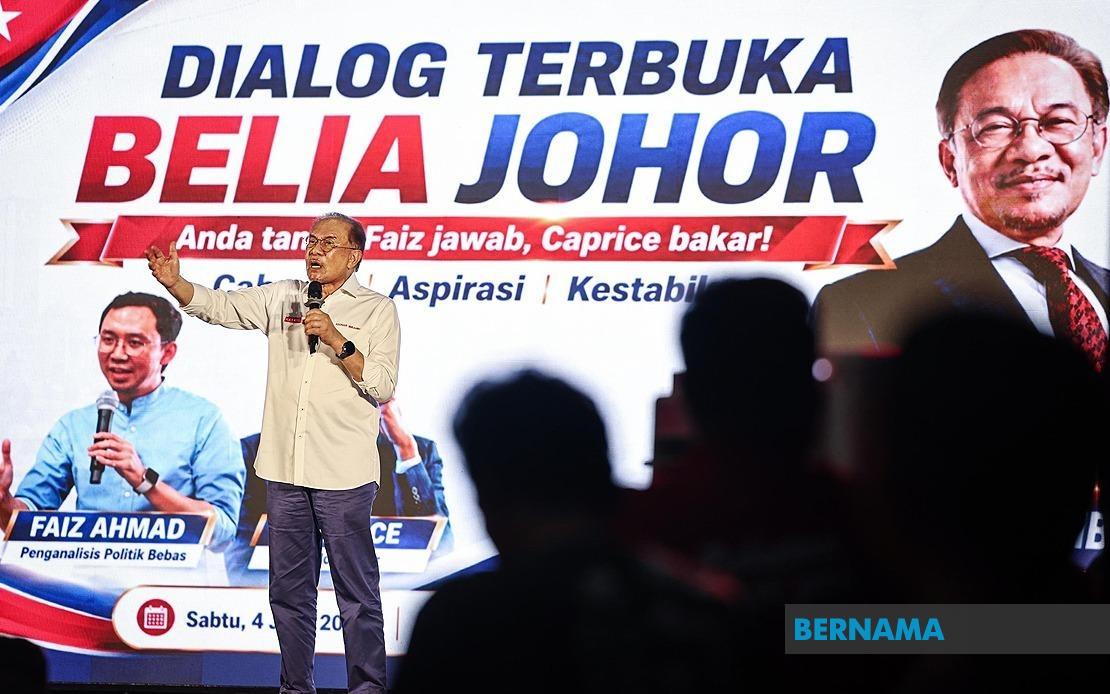
Prime Minister Datuk Seri Anwar Ibrahim has called for a fundamental shift in how Johor approaches economic development, emphasizing that growth must be distributed more fairly across rural districts, villages, and among the urban poor rather than concentrated in major urban centres. Speaking at a political gathering in Johor Bahru on July 4, Anwar underscored the need for continued investment in high-impact initiatives while ensuring that basic amenities reach communities beyond the scope of headline-grabbing mega-projects.
The Prime Minister highlighted a stark disparity in living standards within the state, pointing to the contrast between well-developed Johor Bahru and neighbouring districts like Ulu Tebrau, which lie just thirty minutes away yet lack comparable infrastructure and services. This observation reflects a broader challenge facing Malaysia's most developed state: the uneven distribution of economic benefits across its diverse geography. Rather than pursuing tall residential or commercial structures in areas that lack foundational services, Anwar suggested that resources should prioritize tangible improvements that directly enhance residents' daily lives.
Among the essential facilities that warrant immediate attention, the Prime Minister identified affordable housing as a cornerstone priority. In a region where property prices have climbed significantly over recent years, ensuring accessible housing options for lower-income families remains critical for social stability and economic inclusion. Alongside housing, educational infrastructure demands strengthening, with schools in underserved areas requiring adequate funding and facilities to provide quality learning opportunities for rural and semi-urban students.
Community gathering spaces such as halls and religious facilities also emerged as crucial components of balanced development in Anwar's vision. These venues serve multiple functions beyond their primary purposes, often becoming focal points for social cohesion, emergency response, and civic engagement. The absence of such facilities in smaller towns and villages effectively isolates these communities from essential gathering spaces and, symbolically, from the broader development narrative. By emphasizing these amenities, Anwar's remarks suggest that development should be measured not merely by architectural grandeur but by its functional contribution to community welfare.
The strategic timing of Anwar's comments—delivered during the Kita Geng MADANI Johor: Malam Anak Muda Kempas programme in support of Pakatan Harapan candidate Faezuddin Puad for the Kempas state seat—indicates that equitable development has become a central electoral and policy message. Muhammad Kamil Abdul Munim, PKR Youth chief, and other party leaders present at the event underscored the coalition's commitment to this inclusive development model. This messaging resonates particularly with younger voters and rural constituencies who may feel marginalized by urban-focused planning.
Johor's development trajectory has historically been dominated by major infrastructure projects, industrial zones, and urban renewal programmes centred around the state capital and surrounding areas. While these initiatives have contributed significantly to Johor's status as Malaysia's second-largest economy, their benefits have not uniformly permeated into more peripheral regions. Anwar's intervention suggests that the federal government recognizes this imbalance and is willing to recalibrate resource allocation priorities.
The emphasis on basic amenities represents a philosophical departure from trickle-down economics, which assumes that investment in large-scale projects will eventually benefit all communities. Instead, Anwar's approach advocates for direct, targeted provision of services to underserved populations. This strategy aligns with principles of inclusive growth increasingly championed across Southeast Asia, where rapid urbanization has left many rural areas struggling with inadequate services despite their proximity to developed urban centres.
From a Malaysian governance perspective, Anwar's remarks carry implications for how development funds are distributed between federal, state, and local authorities. The tension between mega-projects that generate visible economic activity and basic infrastructure that serves immediate community needs has long complicated budget allocation decisions. By publicly championing the latter, the Prime Minister is signalling that his administration will not judge development success solely through large-scale construction metrics.
For Johor specifically, this repositioning could reshape the state's development framework over the coming years. Smaller towns and rural municipalities may see increased allocation for school improvements, affordable housing schemes, and community facilities. This shift could particularly benefit constituencies like Kempas, where mixed urban-rural demographics require policies that address both types of communities' distinct needs.
The underlying challenge remains implementation. Articulating a balanced development philosophy is considerably easier than executing it consistently across a large, economically diverse state with competing interests and limited resources. Johor's state government, state assembly members, and local councils will need to translate this vision into specific projects and budgets. Success will require coordination between multiple administrative levels and genuine commitment to redirecting resources from high-profile projects to less glamorous but equally vital basic services.
Moreover, Anwar's comments suggest that the federal government intends to scrutinize how Johor's leadership implements equitable development principles. This oversight reflects broader concerns within the federal administration about ensuring that development gains do not concentrate exclusively in wealthier areas, thereby widening socioeconomic disparities. For Malaysian readers nationwide, Johor's experience may serve as a pilot for how similar development imbalances across other states could be addressed through similar policy reorientation.

