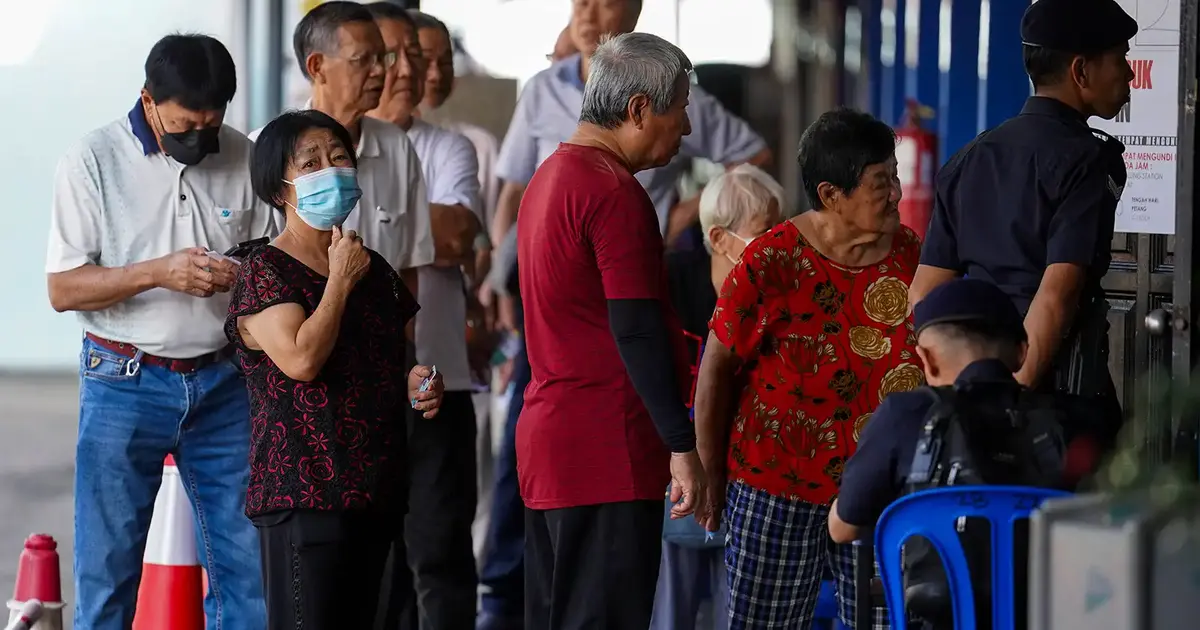
The Pakatan Harapan coalition's struggle to retain support among Chinese voters in Johor's recent election stemmed primarily from weak voter participation rather than a wholesale shift toward Barisan Nasional, according to analysis by former Bangi MP Ong Teng Cheong. His assessment suggests that understanding the mechanics of electoral decline requires distinguishing between voters who actively switch allegiance and those who simply disengage from the voting process—a crucial distinction with implications for opposition strategy moving forward.
Ong's interpretation challenges the conventional narrative that might attribute PH's difficulties in Johor directly to Chinese voters embracing BN's platform or message. Instead, his reading emphasizes an engagement problem: the coalition failed to motivate sufficient numbers of its traditional supporters to cast ballots in the state election. This interpretation carries significant weight given the demographics at stake. Chinese voters, particularly in urban and semi-urban Johor constituencies, have historically formed a substantial voting bloc with considerable influence over tight electoral contests.
The distinction between turnout and defection matters enormously for opposition parties seeking to rebuild their electoral fortunes. A drop in turnout can be addressed through mobilization efforts, renewed messaging, and grassroots activation during future campaigns. Defection, by contrast, suggests deeper dissatisfaction with party performance or policy direction that requires more fundamental strategic recalibration. If Ong's analysis proves accurate, it implies that PH retains a reservoir of potential support that remains latent rather than permanently lost to competitors.
Johor occupies a pivotal position in Malaysian politics as the nation's largest state by population and a consistent battleground between opposing coalitions. The state's Chinese community, concentrated particularly in constituencies around Johor Bahru, Kota Tinggi, and Johor areas, has traditionally played a decisive role in determining electoral outcomes. When Chinese voter participation declines, the overall composition of the electorate shifts in ways that can benefit parties with stronger support among other demographic groups. This mechanical effect on electoral mathematics may partially explain PH's setback independent of any shift in voter preferences.
Ong's analysis identifies only a modest number of Chinese voters who actively transferred their support from PH to BN during the election in question. This calibrated assessment suggests that while some switching certainly occurred—as happens in any electoral cycle—the phenomenon was limited in scope rather than representing a genuine realignment of Chinese electoral preferences. The contrast between this modest switching and the overall electoral damage sustained by PH points decisively toward participation as the governing variable in determining the coalition's electoral performance.
Such findings have implications extending beyond Johor's state politics. Chinese voter engagement levels influence outcomes in federal elections as well, particularly in mixed or urban constituencies where the Chinese community comprises a significant share of the electorate. If Malaysian Chinese voters are experiencing declining motivation to participate in electoral processes, that trend could reshape the national political landscape regardless of which coalition secures their active support. Understanding the root causes of this engagement problem becomes essential for all major political groupings.
The former Bangi MP's assessment also highlights the challenge of drawing accurate conclusions from surface-level electoral results. A coalition that loses significantly in electoral terms may not have necessarily lost the affection or support of large voter cohorts; rather, it may have lost the competition for turnout. This distinction proves critical when analyzing whether setbacks represent temporary tactical disadvantages or fundamental strategic problems requiring wholesale repositioning. For PH, the implication is that concentrated effort on voter registration, campaign mobilization, and grassroots activation could potentially recover substantial ground in future contests.
Johor's recent election occurred within a broader context of shifting voter behavior across Malaysia. Multiple elections in recent years have demonstrated the volatility of the contemporary electorate and the growing importance of turnout variables. Parties that mobilize effectively during campaign periods often outperform their baseline support levels, while those that fail to energize their base frequently underperform relative to underlying sentiment. The pattern evident in Johor's Chinese voter engagement may reflect broader trends worth monitoring in upcoming electoral contests.
For the Pakatan Harapan coalition, Ong's analysis suggests a targeted avenue for recovery. Rather than assuming that Chinese voters have fundamentally abandoned the coalition for Barisan Nasional, party strategists might concentrate resources on understanding the specific barriers to participation—whether practical obstacles like transportation and information accessibility, or attitudinal challenges involving confidence or enthusiasm. Different root causes would warrant distinct remedial strategies. Addressing logistical participation barriers requires different solutions than rebuilding confidence in the coalition's overall direction.
The Johor outcome, when interpreted through Ong's lens, becomes less a verdict on PH's viability as an alternative government and more a diagnostic indicator of mobilization challenges requiring targeted responses. This framing allows opposition strategists to maintain optimism about underlying support levels while acknowledging the urgent need to improve their capacity to convert that support into actual votes. As Malaysian politics moves toward the next cycle of electoral contests, the degree to which parties succeed in translating underlying support into voting participation may prove decisive.

