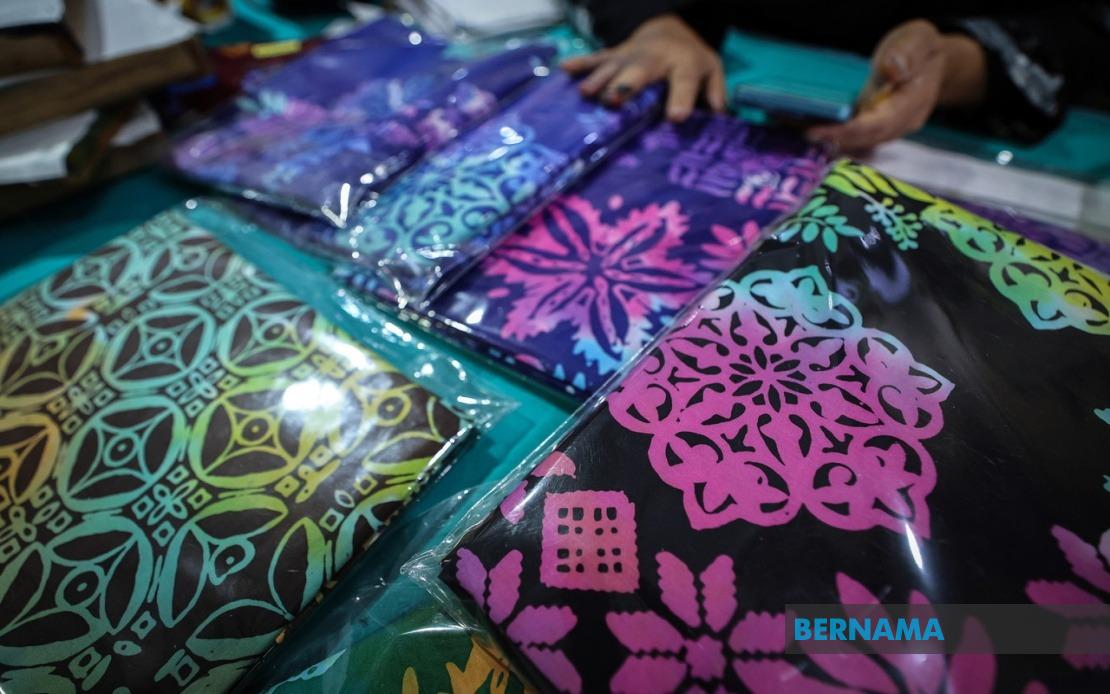
While batik production has historically been synonymous with Malaysia's East Coast states, Johor artisans are successfully carving out their own identity in the textile industry by drawing inspiration from the state's unique natural landscape, commercial heritage and cultural symbols. Designs featuring motifs rooted in black pepper cultivation, gambir production, mangrove ecosystems, coral reefs and tiger-stripe patterns are helping Johor establish a distinct batik tradition that reflects both its environmental character and historical significance across different regions of the state.
Among the driving forces behind this emerging craft renaissance is Maimunah Yaacob, 58, a batik pioneer who has devoted the past 31 years to developing and promoting the art form throughout Johor. Her journey into batik-making began in 1993 when she undertook foundational training in hand-drawn canting techniques in Terengganu, followed by two years of intensive instruction at Jalan Conlay in Kuala Lumpur. Armed with minimal capital of RM2,000 and operating initially from her kitchen, Maimunah recognised early that market differentiation would be critical to success in an industry where consumer interest remained limited at that time.
Maimunah's strategic approach centred on developing designs that diverged substantially from established batik offerings already circulating in Malaysian markets. This differentiation strategy proved instrumental in building demand for her work and eventually establishing Ranorm Batik Creation in Kampung Singapura, Tanjung Sedili, Kota Tinggi. Her understanding of how to translate regional identity into textile design has become increasingly valuable as consumers seek products that reflect local authenticity rather than generic patterns.
The specificity of Johor Batik's design language reveals how thoroughly artisans have integrated geographical and historical research into their creative practice. Different districts within the state are represented through carefully selected motifs: Muar and Pontian districts feature the berembang tree and pineapple, crops intrinsically linked to their agricultural heritage, whilst Kota Tinggi and Sedili incorporate mangrove and coral reef imagery that acknowledges their maritime geography and economic dependence on coastal resources. This place-based approach to design serves multiple functions simultaneously, operating as both a cultural preservation mechanism and a sophisticated marketing tool that communicates regional identity to buyers.
In an industry increasingly dominated by mechanised production methods, Maimunah remains steadfastly committed to traditional hand-drawn batik techniques using hot wax and canting tools. This commitment distinguishes authentic Johor Batik from machine-printed alternatives through a readily observable characteristic: genuine hand-batik allows dye to penetrate evenly across both sides of the fabric, creating a visual consistency that printed textiles cannot replicate. Maintaining these labour-intensive methods requires considerable dedication, yet Maimunah views traditional technique as inseparable from the product's authenticity and market value.
The commercial viability of Johor Batik has been validated through both domestic and regional recognition. Products have generated positive responses at significant events including the National Craft Day celebration in Kuala Lumpur and dedicated Johor Craft Festival showcases, whilst international interest from Singapore buyers demonstrates the product's cross-border appeal. The pricing structure reflects both the artisanal nature and market positioning of the work: simple headscarves retail from RM35, whilst more elaborate silk attire sets command several hundred ringgit, creating a tiered product range accessible to diverse consumer segments.
Recognising that preserving traditional crafts requires sustained engagement from younger generations, Maimunah has strategically broadened the product range to appeal to younger consumers through more contemporary and casual design interpretations. This generational marketing approach acknowledges that without updating design sensibilities and fashion orientation, batik risks becoming perceived as heritage-bound rather than fashion-relevant, potentially limiting its appeal to consumers under 35 years old. By maintaining design innovation alongside traditional technique, Johor Batik can position itself as both culturally grounded and contemporary.
The development of Johor's batik sector carries particular significance for Malaysia's broader craft preservation agenda at a moment when traditional artisanal production faces sustained pressure from industrial manufacturing. Johor's emergence as a batik production centre demonstrates that regional craft specialisation need not be geographically predetermined, and that communities outside traditionally dominant production areas can establish competitive advantage through creative differentiation and heritage-based authenticity. This model offers valuable lessons for other Malaysian states seeking to develop distinctive craft industries.
Maimunah's explicit advocacy for expanded training programmes and formal instruction in Johor Batik production reflects a realistic assessment of the challenges facing craft preservation. Without institutional support through educational programmes and skills development courses, knowledge transfer becomes dependent on informal apprenticeship arrangements that prove increasingly difficult to sustain as younger cohorts pursue alternative career pathways. Structured training provision would facilitate broader participation whilst ensuring consistent maintenance of quality standards and technical knowledge across a dispersed community of practitioners.
The trajectory of Johor Batik illustrates how cultural products can function simultaneously as commerce, heritage preservation and regional identity markers. As Malaysian consumers demonstrate growing interest in locally-made products with transparent supply chains and authentic provenance, Johor artisans have positioned their work at an advantageous intersection of cultural authenticity, environmental storytelling and contemporary design sensibility. The persistence of pioneers like Maimunah Yaacob has established proof of concept for a sustainable craft economy rooted in the state's distinctive characteristics, creating a template for how other regions might develop their own culturally-specific textile traditions whilst building viable commercial enterprises.

