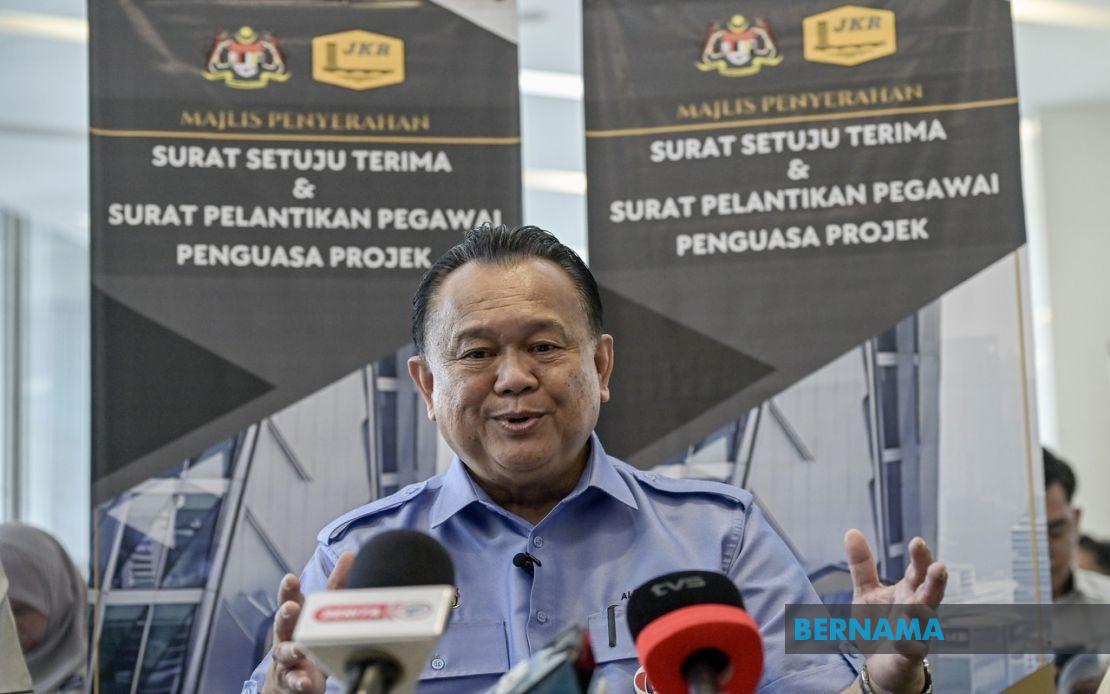
Works Minister Datuk Seri Alexander Nanta Linggi has reinforced that the Public Works Department's (JKR) project performance cannot be judged merely on whether work finishes ahead of deadline. Instead, genuine success demands that construction contracts achieve all three critical benchmarks simultaneously: the agreed timeline, the allocated budget, and the specified quality standards. Without this triple alignment, early completion becomes meaningless and can mask deeper structural or functional defects that undermine the project's true value.
Speaking after inaugurating the Letter of Acceptance and appointing the Superintending Officer for the Perak police contingent headquarters and associated housing development in Ipoh, Nanta articulated a philosophy that signals shifting attitudes within Malaysia's construction management frameworks. He cautioned that contractors face significant pressure to deliver rapidly, yet rushing to meet timelines while compromising on costs or quality ultimately produces what the sector terms "sick projects"—completed structures that fail to perform their intended function or require expensive remedial work. His remarks suggest the ministry recognizes that false economy in project delivery creates long-term liabilities rather than achievements.
The minister's emphasis on integrated performance metrics reflects mounting frustration within government circles over Malaysia's historically problematic relationship with infrastructure delivery. By insisting that acceleration must occur within budgetary and quality constraints, Nanta is essentially rejecting the notion that speed can substitute for proper planning, supervision, and material standards. This represents a necessary recalibration, as previous administrations often celebrated projects finished early without examining whether those expedited timelines came at the expense of durability, safety, or functionality.
To operationalize this philosophy, the Ministry of Works (KKR) and JKR have instituted key performance indicators specifically designed to eliminate sick and abandoned projects from their portfolios. These metrics work alongside formalized standard operating procedures and monitoring guidelines that track implementation across all active construction sites. The institutional framework now emphasizes prevention rather than reactive damage control, though the effectiveness of these systems ultimately depends on consistent enforcement and transparent reporting throughout the project lifecycle.
Encouraging evidence suggests these interventions are yielding results. Deputy Minister of Works Datuk Seri Dr Ahmad Maslan reported yesterday that the proportion of sick projects under JKR supervision has declined to 4.13 per cent from a previous 5 per cent. Currently, 36 projects out of 871 under construction carry the sick project designation, indicating that while challenges remain, the downward trajectory reflects genuine operational improvements. For a massive construction portfolio of this scale, even incremental percentage reductions translate into millions of ringgit salvaged from waste and inefficiency.
The Perak police contingent headquarters and housing project exemplifies the type of strategically important infrastructure Malaysia is attempting to deliver with renewed discipline. Valued at approximately RM366 million, this Ministry of Home Affairs initiative will occupy a 25-hectare site adjacent to Bulatan Sultan Azlan Shah in Bandar Meru, Ipoh, and developer Serada Realty Sdn Bhd has committed to completing the work within 42 months, with handover scheduled for February 2030. For the Perak Police Department, this represents a critical modernization effort, as the existing headquarters complex has deteriorated significantly over its 58-year operational lifespan and no longer justifies the cost of comprehensive renovation.
Beyond mere facility replacement, the new complex carries measurable performance targets that bind the project to tangible public security outcomes. Authorities anticipate the modernized headquarters will enhance the Police Department's operational effectiveness and control capabilities, with specific goals of reducing Perak's crime index by five per cent annually and improving police response times from the current 15 minutes to 10 minutes. These commitments transform the construction project from a purely capital expenditure into an instrument of public policy, making the quality and timeliness of delivery directly consequential for citizen safety and trust in law enforcement.
Nanta's address to the contractors receiving Letters of Acceptance emphasized that accepting such appointments carries profound fiduciary obligations. He called for full integrity, responsibility, and commitment throughout the contract period, with particular focus on meeting original specifications, achieving the highest quality standards, and adhering to agreed schedules. This language, while standard in ceremonial contexts, underscores that the ministry views contractor selection as a trust relationship rather than a purely transactional arrangement. The implicit message is that future contract awards may depend not just on bid competitiveness but on demonstrated capacity to execute complex projects with consistency and accountability.
The superintending officer's role has also been elevated in this governance model. Rather than passively observing construction progress, these officials are now expected to act proactively, identifying potential delays or quality issues on site and implementing corrective measures before problems cascade. This shift from reactive inspection to active project management requires higher-caliber personnel and sustained engagement throughout construction phases, representing an implicit recognition that effective government oversight demands more than occasional site visits and documentation reviews.
For Malaysian readers and regional observers, these developments carry implications extending beyond individual construction projects. The construction sector remains strategically important to Malaysia's infrastructure ambitions, with major initiatives planned across transportation, utilities, and institutional facilities. If the Works Ministry can successfully institutionalize quality-cost-timeline integration, it may establish a replicable model that other government agencies can adopt. Conversely, if implementation falters or metrics are manipulated to present false improvement, the credibility of official project management claims will suffer further deterioration.
The regional context also matters. Southeast Asian nations frequently grapple with infrastructure delivery challenges, and Malaysia's approach to managing the tension between speed and quality will be observed by neighbouring governments seeking solutions to their own construction sector inefficiencies. Whether the current reform agenda produces sustained transformation or represents another cycle of well-intentioned policy that fades under implementation pressure remains to be seen. The next critical benchmark will arrive when the Perak police headquarters project moves from planning into active construction, testing whether institutional frameworks translate into tangible delivery improvements on the ground.

