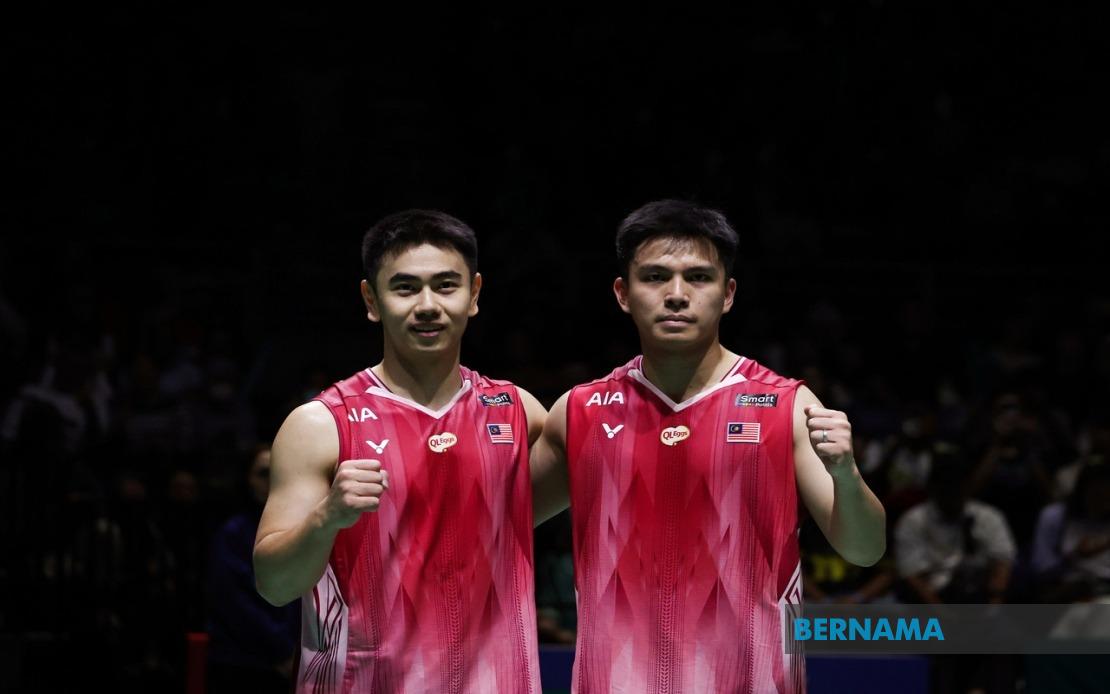
Malaysia's badminton contingent continued its impressive showing at the Japan Open 2026 with two pairs securing semifinal berths in Tokyo, demonstrating the depth and resilience of the national programme across multiple disciplines. The victories highlight Malaysia's competitive standing in East and Southeast Asian badminton, where tournament success translates into crucial ranking points and momentum heading into the latter half of the season.
The unseeded mixed doubles combination of Jimmy Wong and Cheng Su Yin delivered the day's most dramatic result, eliminating Denmark's Mathias Christiansen and Alexandra Boje in the quarterfinals. The Malaysian pair's clinical performance across 39 minutes saw them dispatch the tournament's third seeds with identical 21-17 scorelines in both games, a result that carries particular significance given the Danes' ranking and experience on the international circuit. The victory proved especially satisfying for Jimmy-Su Yin, as it leveled their career head-to-head record against the Nordic pairing at 1-1, erasing the memory of a previous defeat and establishing themselves as legitimate challengers in this particular matchup.
This triumph positions Jimmy-Su Yin for a maiden encounter against Hong Kong's seventh-seeded Tang Chun Man and Tse Ying Suet in the semifinals, presenting an opportunity for the Malaysian pair to continue their upward trajectory. The Hong Kong combination, while seeded, represents a more manageable assignment than the third-seeded Danes they have just dispatched, though tournament semifinals offer no guarantees and both pairs carry the experience of competing at Japan's premier badminton showcase.
Meanwhile, the men's doubles pairing of Goh Sze Fei and Nur Izzuddin Rumsani required greater endurance to secure their semifinal passage, grinding out a demanding three-game victory against the American pair of Chen Zhi Yi and Presley Smith. The 50-minute encounter went the distance before Malaysia's fifth-seeded duo prevailed 21-18, 15-21, 21-13, reflecting the Americans' competitive pedigree and their ability to force the issue in the middle set. The result extended Goh-Nur Izzuddin's record against Chen-Presley to four consecutive victories, suggesting the Malaysian pair has identified tactical patterns and execution strategies that neutralise the American threat.
However, the path to the final becomes substantially more demanding for Goh Sze Fei-Nur Izzuddin, as they face South Korea's Kim Won Ho and Seo Seung Jae in the semifinal round. The top-seeded Korean pairing represents the tournament's highest threat, though the Malaysian men's doubles duo enters the matchup with legitimate confidence. Their head-to-head record against Won Ho-Seung Jae stands precisely balanced at 2-2, with Goh-Nur Izzuddin's most recent triumph arriving at the Indonesia Open 2026, proof that they possess the tactical awareness and execution capability to dismantle even the world's premier men's doubles team.
The significance of this particular rivalry extends beyond mere tournament results. South Korea has established itself as a powerhouse in doubles disciplines throughout East Asia, and any victory by Malaysian athletes against their top-ranked counterparts carries immense value for confidence and psychological momentum. The 2-2 record between these pairings suggests neither team holds a comprehensive tactical advantage, rendering the semifinal meeting essentially a competitive contest decided by execution, form, and pressure management on the day.
Earlier in proceedings, another Malaysian men's doubles pair encountered the top-seeded Koreans but proved unable to mount effective resistance. Kang Khai Xing and Aaron Tai fell decisively to Kim Won Ho-Seo Seung Jae with scorelines of 21-13 and 21-10, indicating the efficiency with which the Korean pair dismantled a second Malaysian challenge during the quarterfinal stage. This defeat provided further evidence that while Malaysian doubles players possess considerable skill, the elite Korean pairings operate at a marginally elevated level.
The simultaneous advancement of two Malaysian pairs to the semifinals underscores the stability and development trajectory within Malaysia's badminton programme, particularly in doubles disciplines where coaching infrastructure and training methodologies have improved substantially over recent seasons. Multiple pairs reaching the latter stages of Japan's premier tournament validates investment in player development and suggests the national federation's strategic approach is yielding measurable international results.
From a regional perspective, Malaysia's performance at Tokyo reinforces its position as a badminton nation capable of competing effectively against established powerhouses across mixed and men's doubles. While singles disciplines have traditionally received greater attention and sponsorship, the success of multiple doubles combinations at tournaments of Japan Open calibre demonstrates that Malaysia's tactical depth extends across multiple event categories.
The semifinal matches for both Malaysian pairs represent crucial junctures in their respective tournament campaigns. For Jimmy-Su Yin, victory over Hong Kong provides a pathway toward the final and potential triumph at one of Asia's most competitive badminton venues. For Goh Sze Fei-Nur Izzuddin, overcoming the world's top-ranked men's doubles team would constitute a significant scalp and elevate their credentials as legitimate challengers to Korean dominance in the discipline.

