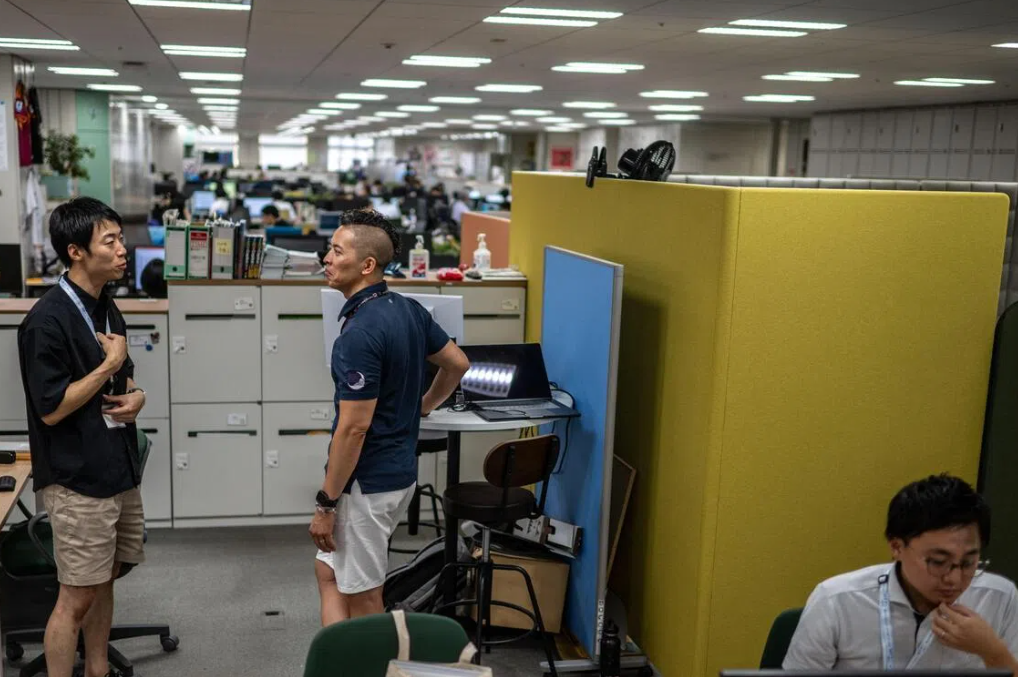
Japan's capital is grappling with an unexpected social friction as it pushes workers to abandon formal dress codes in response to extreme summer temperatures. The Tokyo metropolitan government's expansion of its Cool Biz initiative—which now explicitly permits shorts alongside T-shirts and trainers—has inadvertently triggered workplace discomfort centered on a decidedly unglamorous concern: visible shin hair on male colleagues. The phenomenon has generated online discussion under the term "sunehara" or "leg hair harassment", reflecting broader tensions about workplace norms, gender perspectives, and bodily propriety in Japanese corporate culture.
The expanded Cool Biz campaign, officially promoted from April onwards, represents Tokyo's latest attempt to tackle the public health crisis posed by Japan's increasingly severe summer climate. Officials frame the initiative as a means of granting workers greater flexibility in dressing appropriately for dangerous heat conditions rather than imposing specific requirements. Noboru Watanabe, an environmental official with the Tokyo metropolitan government, emphasised to the BBC that the administration seeks to expand choice rather than dictate appearance, stating that clothing should simply avoid causing offense to colleagues. This nuanced messaging, however, has proven inadequate to prevent the emergence of precisely such offense among portions of the workforce.
A survey conducted in June by Gorilla Clinic, a chain specialising in male cosmetic treatments, reveals the depth of division on the matter. The poll found that 53.5 per cent of respondents opposed the practice of wearing shorts to work, while 46.5 per cent supported it—a nearly even split that reflects genuine disagreement within Japanese society about workplace norms. Among those opposed, concerns about both body shape and the visibility of body hair ranked prominently in their reasoning. Notably, women constituted a significantly larger proportion of survey respondents than men, a demographic skew that suggests considerable female discomfort with witnessing male colleagues displaying hairy legs in office environments. The data implies that the push for casual summer dressing may be generating unintended consequences for workplace comfort across gender lines.
The leg hair controversy has extended beyond mere social commentary to influence consumer behaviour and self-perception among Japanese men. Akifumi Funatsu, a director at Gorilla Clinic, reports that the clinic has experienced increased demand for laser hair removal services, with male clients now seeking treatments not purely for aesthetic enhancement but as a matter of what they perceive as "social etiquette when wearing shorts". This development illustrates how workplace pressure, whether explicitly stated or implicitly understood, can translate into physical modification of the body. Men appear increasingly conscious that visible leg hair might generate discomfort among female colleagues, prompting them to pursue cosmetic interventions to align with perceived professional standards.
The roots of Cool Biz extend back nearly two decades, to 2005, when Yuriko Koike—then serving as Japan's environment minister and now Tokyo's governor—introduced the original campaign. The initial version encouraged workers to adopt short-sleeved shirts while abandoning jackets and ties, a modest relaxation aimed at reducing workplace air-conditioning consumption and thereby lowering energy demand. The campaign gained significant momentum when then Prime Minister Junichiro Koizumi appeared publicly without formal neckwear or jacket, lending political legitimacy to casual workplace attire. This high-profile endorsement helped normalise the practice across Japanese office culture.
Following the catastrophic 2011 earthquake and tsunami, which severely strained Japan's electricity supply and forced rolling blackouts across the country, the government introduced an enhanced version called "Super Cool Biz". This iteration substantially loosened workplace dress codes beyond the original short-sleeved shirts, encouraging even more relaxed attire. Over the subsequent decade, casual clothing gradually permeated Japanese workplaces, particularly within growth sectors such as technology companies and start-ups. However, the Tokyo metropolitan government's explicit extension to shorts represents a more aggressive boundary shift than previous iterations, moving from simply relaxing formal dress to actively promoting garments that expose legs—thereby introducing the current controversy.
The policy urgency underlying Cool Biz stems from Japan's confrontation with genuinely dangerous climatic conditions. Japan faces exceptionally high summer temperatures paired with intense humidity that severely compromises the human body's ability to regulate its internal temperature through perspiration. Official health statistics underscore this threat: during a single week in July, the Fire and Disaster Management Agency recorded seven deaths attributable to heatstroke, with another 4,580 individuals requiring hospitalisation. These figures represent not mere inconvenience but genuine public health crisis, lending substantial weight to governmental efforts to facilitate worker adaptation to extreme heat.
In response to these hazards, Japanese health authorities are urging residents to adopt multiple protective measures. Recommendations centre on maintaining hydration, making consistent use of air-conditioning, and gradually acclimating the body to heat exposure through measured exposure. Simultaneously, Japanese consumers have demonstrated considerable creativity and commercial ingenuity in developing supplementary cooling technologies. The marketplace now offers clothing embedded with miniature electric fans, cooling towelettes designed for rapid application to the body, umbrellas engineered to block solar radiation rather than merely shield from rain, and lightweight portable fans powered by batteries. These innovations reflect widespread recognition that summer survival requires multifaceted approaches.
The leg hair controversy captures broader tensions within contemporary Japanese society regarding the balance between practical necessity and social convention. The government's attempt to prioritise worker safety and comfort during extreme heat conditions has collided with deeply embedded workplace norms surrounding personal appearance and gender relations. The question of acceptable leg exposure in professional settings proves surprisingly contentious, suggesting that Japanese office culture remains substantially more formal in its expectations regarding bodily presentation than many Western counterparts. The unresolved debate also illuminates how policy changes, even those motivated by legitimate health concerns, can generate unexpected social friction when they challenge established behavioural patterns.
Looking forward, the ultimate extent to which shorts will become normalised in Tokyo workplaces remains uncertain. The near-parity in survey responses suggests that no clear consensus exists, and individual workplaces may develop divergent approaches depending on their specific cultures and leadership preferences. The controversy may ultimately resolve through gradual normalisation as younger workers with fewer attachment to formal dress norms enter the workforce, or alternatively through continued pressure from female colleagues uncomfortable with visible leg hair. What seems clear is that Japan's response to climate change and extreme heat is proving to extend beyond technological or infrastructural solutions into the cultural and social realm, forcing examination of workplace norms previously considered settled.

