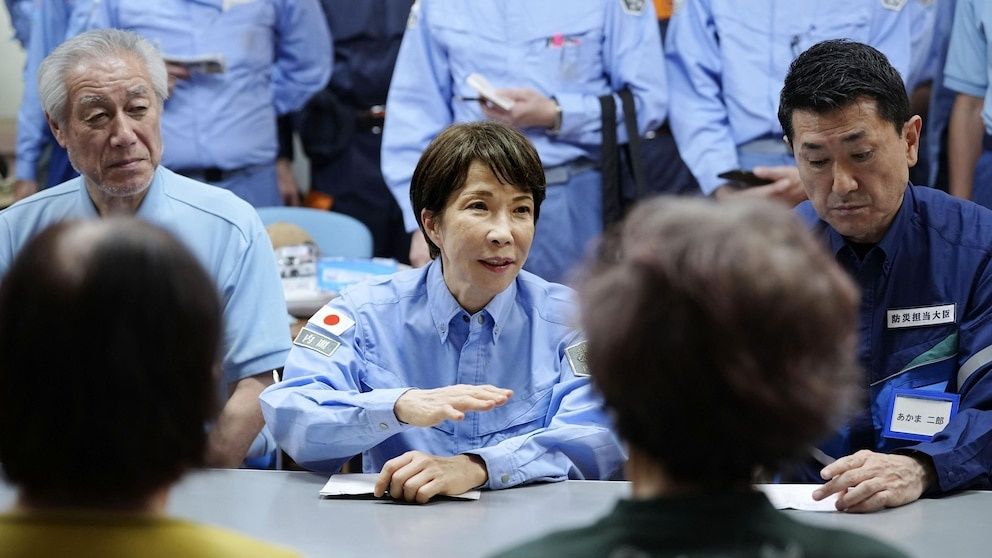
Japan's Prime Minister Sanae Takaichi made her first visit to Kumamoto Prefecture on Monday, one day after a devastating magnitude 7.1 earthquake struck the southwestern region on Kyushu's main island on Tuesday, August 4. The earthquake has claimed 38 lives, including one person who died of apparent heat stroke while sheltering in a vehicle and another whose cause of death remains under investigation. As cleanup operations gathered momentum across the affected areas, residents and officials grappled with compounding crises that extended far beyond the initial structural damage.
The disaster unfolded during a period of extreme weather, transforming the recovery effort into a multi-layered emergency. The Japan Meteorological Agency predicted temperatures would reach nearly 40 degrees Celsius on Monday, turning the region into a furnace for people already traumatized and displaced by the quake. This climatic assault arrived precisely when the infrastructure to support survivors had been compromised or destroyed. More than 46,000 households found themselves without water supplies, while fuel shortages rippled across communities still reeling from the earthquake's impact. The combination of inadequate sanitation facilities, extreme heat, and resource scarcity created conditions that experts warn frequently lead to secondary health crises in disaster zones.
The shelter situation exemplified the magnitude of the humanitarian challenge. Over 8,500 people remained crowded into emergency facilities—makeshift centers hastily converted from community buildings, school gymnasiums, and classrooms. Many of these shelters lacked air-conditioning, essential given the dangerous heat conditions. Others among the displaced population had resorted to sleeping in vehicles parked at town halls and public spaces, or attempting to shelter outside their homes with no protection from the elements. For Malaysian observers accustomed to tropical climates and monsoon-related disasters, this scenario underscores how earthquake-induced displacement differs fundamentally from flood evacuations—the sudden loss of housing combined with infrastructure collapse creates uniquely severe hardship when paired with extreme temperatures.
Governor Takashi Kimura directly confronted Takaichi during their meeting, emphasizing that the "abnormal heat" represented an existential threat to people already pushed to their limits by homelessness and uncertainty. His appeal highlighted deficiencies extending beyond mere shelter—many evacuation centers lacked clean water for drinking and hygiene, while medical care remained patchy and inadequate. Kimura explicitly requested enhanced government intervention to upgrade living conditions, recognizing that temporary solutions would prove insufficient if heat-related illness and disease outbreaks began occurring among the vulnerable shelter population. The governor's pointed references to these failures suggested frustration with the initial response, particularly given that Japan's wealthy developed economy should theoretically deploy resources faster than developing nations facing similar disasters.
Takaichi's response acknowledged the severity but remained carefully noncommittal. She stated that the government would "quickly examine" what support it could provide and "move proactively," language that suggested deliberation rather than immediate action. Her actual visit proved controversial in ways that illustrated the gap between political optics and ground-level reality. Takaichi toured the affected areas from an army helicopter and visited one of the region's best-equipped shelters, which featured cardboard partitions, beds, and functioning air-conditioning. Social media critics pounced on this carefully curated visit as misleading, arguing that her exposure to premium accommodations bore little resemblance to the crowded, sweltering conditions where the vast majority of evacuees actually sheltered. This dynamic—where political leaders tour model facilities while actual conditions remain dire—represents a recurring challenge in disaster response across multiple nations.
The human dimensions of the tragedy extended beyond the immediate quake casualties when a commercial establishment's catastrophic decision contributed to additional deaths. A shopping mall in the town of Kashima operated by Aeon collapsed following the earthquake, and an explosion subsequently occurred within the structure. The explosion killed at least seven people and injured several others, including two young employees of Habita, a general store operator within the mall. One victim, 22-year-old Kurumi Otake, died after company managers instructed her and a colleague to return to the collapsed structure to deposit sales proceeds into a safe. Two Habita executives attended the young woman's funeral wake, where they apologized to her parents.
The circumstances surrounding these deaths raised uncomfortable questions about corporate responsibility during emergencies. Company sales manager Goji Yuse acknowledged that management had instructed the two employees to secure the day's takings if possible, a directive issued after the initial evacuation had already removed approximately 3,000 shoppers from the mall. The mall operator attributed the explosion to a gas leak, suggesting it occurred after most people had evacuated to a parking area. However, the fact that employees remained inside the building despite the earthquake and subsequent damage illustrated gaps in emergency protocols. Otake's mother, grief-stricken and meeting the executives, expressed the universal anguish of loss: "I wish someone had stopped her. My daughter is not coming back." Her words carried an indictment of the priorities that had sent young workers back into danger for financial concerns.
The broader damage assessment revealed an earthquake of substantial destructive force across the prefecture. Approximately 700 homes had been destroyed outright, while authorities reported over 11,300 buildings sustained varying degrees of damage. The 114 injured added to the human toll, though this figure reflected the relative fatality rate once improved emergency medical response reached affected populations. Rescue operations recovered five living individuals from the collapsed Aeon Mall and the bodies of seven others, underscoring the danger the structure represented and the narrow margin that separated survival from tragedy for those who had remained inside.
For Malaysia and other Southeast Asian nations with significant seismic risk—including Indonesia, the Philippines, and eastern Thailand—Kumamoto's experience offers instructive lessons. The region demonstrated that even wealthy, well-organized societies face severe coordination challenges when earthquakes strike during extreme weather. The tendency to locate shelter populations in overcrowded, under-resourced facilities reflects a consistent shortfall in disaster planning across multiple national contexts. The Kumamoto emergency revealed how quickly water systems fail, how fuel shortages cascade through communities, and how heat transforms a manageable displacement into a life-threatening crisis. Furthermore, the incident involving the shopping mall employees highlighted how commercial establishments and their management sometimes prioritize asset protection over human safety during genuine emergencies.
The ongoing recovery in Kumamoto will likely extend months, testing both Japan's governmental resources and the resilience of affected communities. The prefecture's experience demonstrates that earthquake response success cannot be measured only in immediate rescue operations but in the quality and adequacy of support extended during the crucial recovery phase when survivors must rebuild shelter, restore services, and regain stability. The combination of structural damage, environmental extremity, and resource shortage created conditions that demanded coordinated, well-resourced intervention at scales that many governments struggle to mobilize. As cleanup operations continue and temporary housing construction proceeds in Uki and Hikawa, the prefecture's trajectory will offer valuable data for disaster management professionals across the Asia-Pacific region grappling with the challenge of protecting populations from overlapping natural and environmental hazards.

