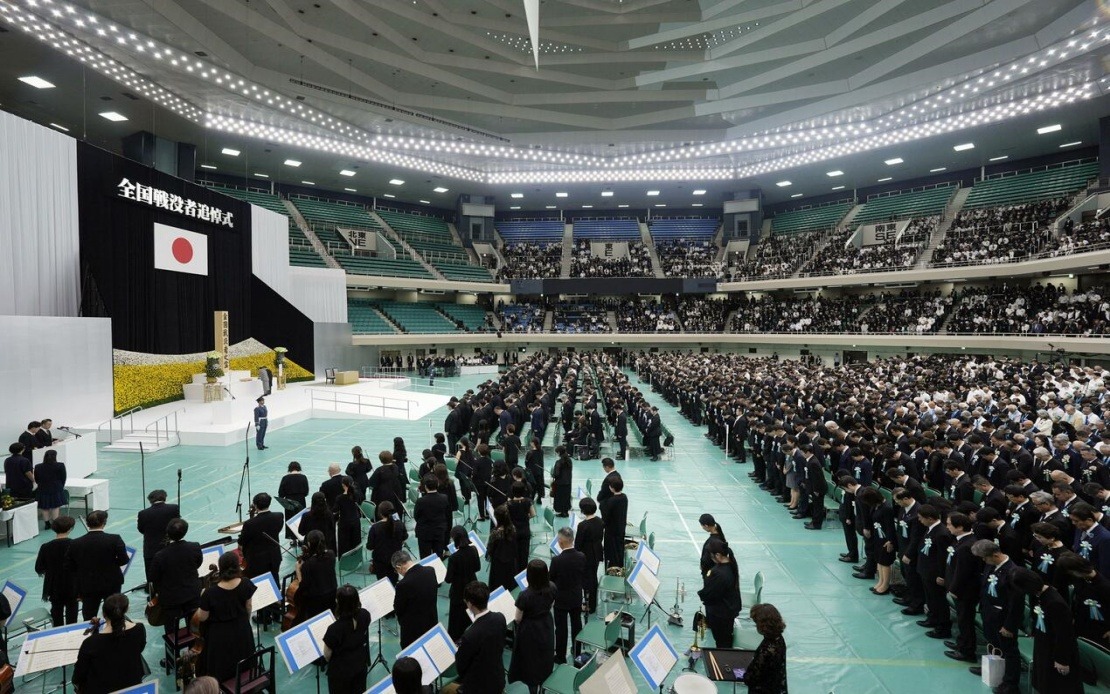
Japan on Saturday commemorated the 81st anniversary of its surrender in World War II at a solemn government ceremony in Tokyo, but the occasion was marked by a notable linguistic omission that underscores an evolving tension within Japanese political circles over how the nation should remember its wartime past. Prime Minister Sanae Takaichi, delivering her first memorial address since taking office in October, emphasised Japan's commitment to peace and prosperity without employing the word "remorse"—a deliberate departure from language used just a year earlier by her predecessor, Shigeru Ishiba, and a rhetorical choice that signals broader shifts in how Tokyo's leadership is framing its historical narrative.
The annual ceremony drew the participation of Emperor Naruhito and Empress Masako in honouring approximately 2.3 million military personnel and roughly 800,000 civilians who perished during the conflict that ended in 1945. The imperial couple's presence underscores the ceremonial importance Japan places on this day, which falls on August 15, marking the date when then Emperor Hirohito announced the nation's capitulation through a radio broadcast. Despite the solemn occasion, the political dimensions of how different leaders choose to frame the memorial have become increasingly pronounced in recent years, reflecting internal debates within Japan's conservative establishment.
Takaichi's carefully worded speech stated that Japan has "consistently walked the path of a nation that values peace and made all possible efforts for world peace and prosperity." This formulation places emphasis on Japan's contemporary commitment to peaceful conduct rather than acknowledging specific historical grievances or regional resentments stemming from Japan's imperial expansion and military aggression across Asia. The absence of explicit reference to "remorse"—a term Japanese leaders had routinely employed before 2009—represents a departure that observers of Japanese politics have noted with particular interest given Takaichi's known hawkish positions on national security matters.
The contrast with her immediate predecessor is instructive. Shigeru Ishiba, perceived as a relative moderate within the ruling Liberal Democratic Party despite the party's overall conservative orientation, made headlines last year by becoming the first Japanese prime minister in 13 years to explicitly invoke the language of national "remorse" at an August 15 ceremony. He coupled this acknowledgement with a "resolute pledge to renounce war," language that resonated with those advocating for Japan to maintain its postwar pacifist tradition. Takaichi's reversion to more ambiguous phrasing suggests a tightening of official rhetoric around Japan's wartime conduct.
This rhetorical recalibration reflects broader political currents within Japan's governance. Before Shinzo Abe assumed the prime ministership for his second tenure in December 2012, Japanese leaders had consistently and explicitly acknowledged the nation's wartime aggression, particularly across China and the Korean Peninsula. Abe, Takaichi's political mentor and a towering figure in postwar Japanese conservatism, fundamentally altered this pattern, moving away from unambiguous expressions of remorse. Under his influence and that of successive conservative administrations, official discourse has gradually shifted toward formulations emphasising Japan's peaceful present rather than scrutinising its militaristic past.
Importantly, the current prime minister, like many recent Japanese leaders, deliberately refrained from directly naming Japan's wartime aggression in Asia or engaging with the historical grievances of neighbours like China and the Korean Peninsula. This strategic vagueness serves multiple domestic purposes: it allows Takaichi to project commitment to peace without appearing to validate regional criticisms or reopening historical disputes that remain politically sensitive. For Southeast Asian nations with their own complex histories of Japanese occupation during World War II, such omissions carry particular weight, as they affect how Japan's postwar narrative resonates across the region.
Emperor Naruhito, maintaining the imperial tradition, expressed "deep remorse" in his own remarks—language he consistently employs each year at this ceremony. His continued use of such language provides a counterpoint to the prime minister's circumlocution, suggesting that the imperial institution retains a different understanding of historical responsibility than the current political leadership. The emperor also referenced hope that people would "pass down the memories of the suffering endured during and after the war," echoing language from the previous year's ceremony and emphasising the importance of historical memory to future generations.
The timing of this commemoration carries particular weight given Japan's contemporaneous strategic reorientation. The 81st anniversary occurred against a backdrop of escalating tensions in West Asia and a significant transformation in Japan's defence posture. The nation has substantially increased military spending and reformed regulations governing defence equipment exports, moves that many analysts interpret as Japan gradually recalibrating its postwar security architecture in response to regional threats and shifting great-power dynamics. This defence policy evolution lends added significance to how political leaders choose to characterise Japan's historical relationship with warfare and military power.
For Southeast Asian observers, the trajectory of official Japanese rhetoric around World War II carries implications extending beyond ceremonial nicety. Nations in the region that experienced Japanese occupation, resource extraction, and military administration during the war years remain attentive to how Tokyo frames its past. A leadership that emphasises remorse and historical accountability sends different signals about postwar commitment to peaceful multilateralism than one that privileges forward-looking peace rhetoric while declining to engage substantively with historical grievances. The divergence between imperial and prime ministerial messaging suggests internal Japanese debates about how to balance historical honesty with contemporary strategic autonomy remain unresolved.
The moment of silence observed at noon, corresponding to the moment Hirohito's surrender broadcast reached Japanese audiences in 1945, provided a solemn punctuation point to the ceremony. Yet this year's memorial, while maintaining the ritual forms of remembrance, revealed fractures in the political consensus about what that remembrance should entail. As Japan navigates heightened security challenges and evolving international relationships, the question of how it publicly reckons with its wartime past continues to shape its diplomatic relationships, particularly within Asia-Pacific communities with living memories of Japanese imperial occupation.

