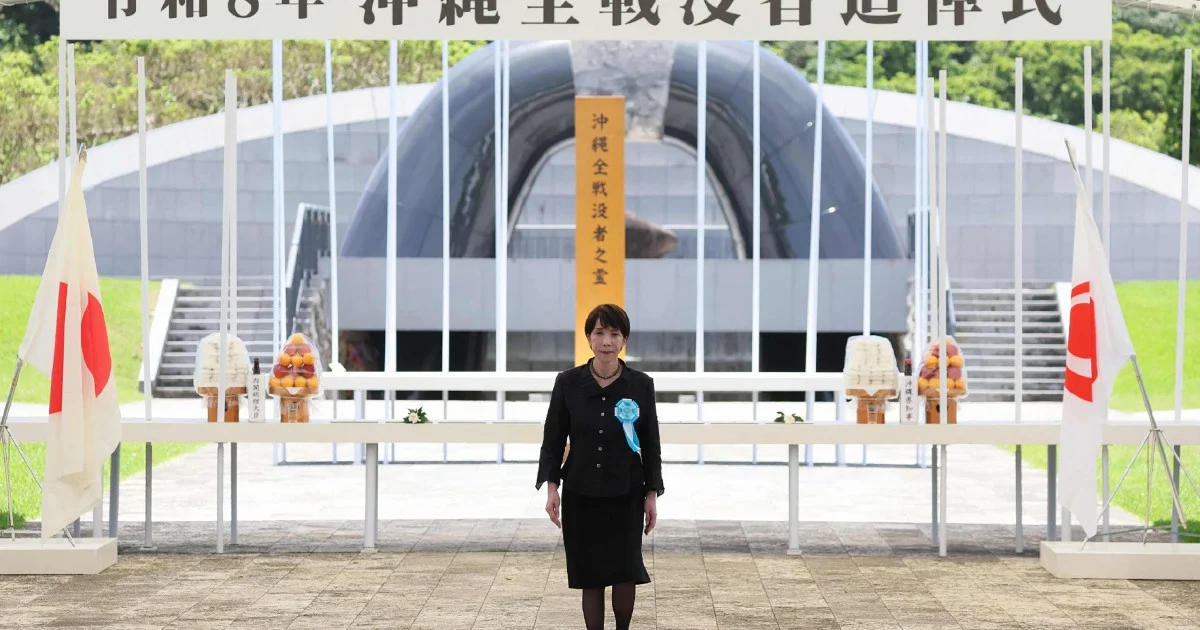
Prime Minister Sanae Takaichi encountered sustained heckling during a World War II memorial event in Tokyo, as protesters voiced strong opposition to Japan's gradual departure from the pacifist principles that have defined its postwar identity. Television coverage captured the tense confrontation, underscoring the profound domestic divisions that have emerged as successive Japanese governments move toward expanded military capabilities and a more assertive regional posture.
The incident reflects deeper anxieties among Japanese citizens who remain committed to the constitutional principles established after 1945. Japan's 1947 constitution, drafted under American occupation, explicitly renounced war and prohibited the maintenance of military forces, creating a unique framework that distinguished the nation from other major economies. For nearly eight decades, this pacifist foundation provided Japan with moral authority in international relations and allowed it to focus resources on economic development, ultimately making it the world's third-largest economy.
Recent policy shifts orchestrated by the Liberal Democratic Party have steadily eroded this postwar consensus. Japan has incrementally increased defence spending, acquired advanced military equipment, and reinterpreted constitutional restrictions on collective self-defence—fundamentally changing how the nation can engage in military operations. The Government's initiatives have accelerated noticeably, with discussions about developing offensive military capabilities and expanding the Self-Defence Forces' mandate beyond territorial defence. These moves address genuine security concerns, particularly regarding China's military modernization and North Korea's missile programmes, yet they simultaneously trigger anxiety among voters who grew up under pacifist frameworks.
Takaichi, who assumed office recently, represents a faction within Japan's ruling party that advocates for bolder military policies and closer strategic alignment with the United States and other Western allies. Her administration's embrace of military modernization contrasts sharply with the cautious incrementalism of her predecessors, intensifying public debate about Japan's future strategic orientation. The timing of the World War II memorial event—typically occasions for solemn reflection rather than political controversy—made the disruption particularly significant, as it brought these simmering tensions into stark relief.
For Southeast Asian nations, Japan's military trajectory carries considerable implications. The region has long benefited from Japan's economic investment, technological prowess, and ostensibly non-threatening regional role. A militarily assertive Japan could reshape the balance of power in ways that affect every country sharing waters with China or dependent on freedom of navigation guarantees. Nations like Singapore, Vietnam, the Philippines, and Malaysia have carefully calibrated relationships with Tokyo, valuing its economic engagement while maintaining strategic distance from potential great-power conflicts. Japan's military expansion thus intersects directly with regional stability concerns that dominate Southeast Asian foreign policy calculations.
The protesters represented a significant constituency that remains sceptical of rearmament narratives. Opinion polling suggests that substantial portions of Japan's population, particularly older generations who remember the postwar commitment to pacifism, harbour reservations about military expansion regardless of the stated rationale. They argue that Japan's soft power, economic influence, and diplomatic skills provide more effective security tools than weapons systems, and fear that abandoning pacifism could trigger regional arms races or reduce Japan's capacity to mediate regional disputes. These concerns echo throughout Japanese civil society, where peace advocacy groups continue to wield considerable cultural influence.
The economic dimension deserves consideration as well. Increased military spending redirects resources from social programmes, infrastructure, and research into areas that provide less direct economic benefit to ordinary citizens. Japan faces demographic challenges, regional economic stagnation, and ageing infrastructure—issues that voters might argue deserve greater budgetary priority than new weapons systems. The contradiction between government messaging about economic recovery and simultaneous acceleration of defence expenditure creates cognitive dissonance for many Japanese voters, particularly those experiencing financial precarity.
Geopolitically, Takaichi's government navigates a delicate balance. Security threats from China and North Korea are genuinely serious, and Japan's military capabilities require modernization to maintain credible deterrence. Strategic alignment with the United States remains essential for Japanese security architecture, and Washington actively encourages Japanese rearmament as part of its broader Indo-Pacific strategy. Yet domestic political constraints prevent wholesale abandonment of pacifist traditions, requiring Japanese policymakers to frame military expansion as defensive adaptation rather than strategic reorientation—a distinction that rings increasingly hollow to sceptical citizens.
The heckled memorial event highlights the political costs of pursuing transformative security policy without broader public consensus. Japanese prime ministers typically enjoy considerable latitude in foreign and defence matters, but Takaichi's approach appears to be testing the limits of that deference. Future policy initiatives may encounter organized opposition, potentially constraining the government's ability to implement its strategic agenda. Whether Takaichi can build sufficient public support for her vision of a more militarily capable Japan while respecting enduring pacifist sentiment remains an open question with implications extending well beyond Tokyo.