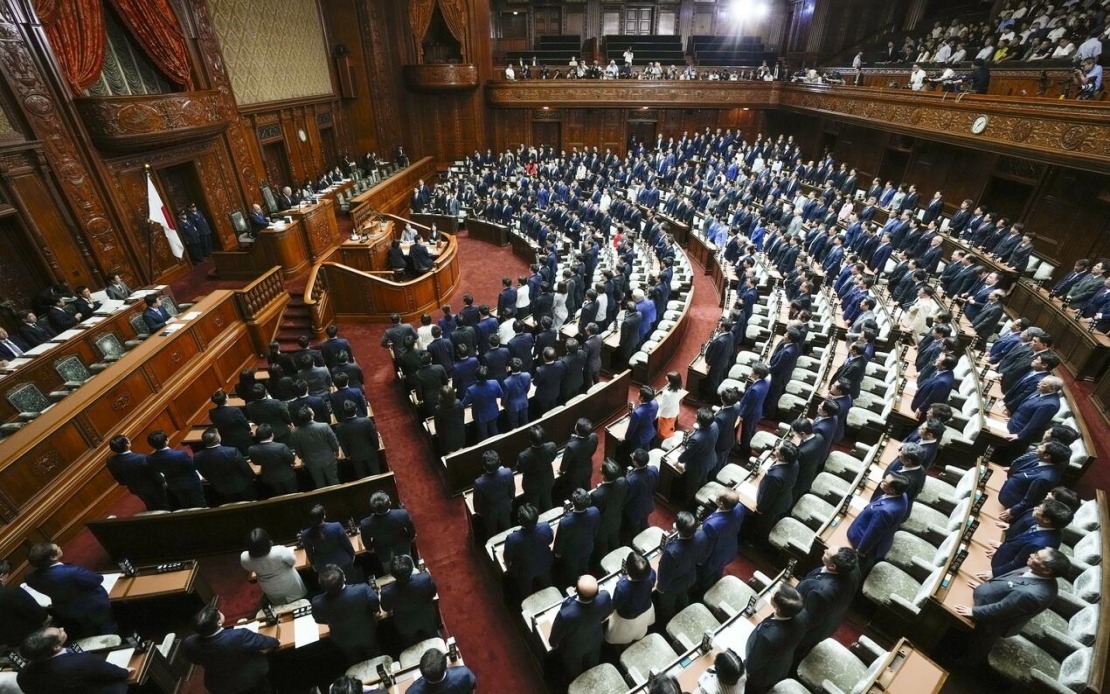
Japan's House of Representatives cleared a landmark amendment to the Imperial House Law on Friday, marking the first substantial overhaul of the 1947 statute that governs succession and membership in the imperial family. The vote came just hours after parliamentary deliberations commenced, reflecting the government's determination to resolve a longstanding institutional challenge that threatens the continuity of one of the world's oldest monarchies.
Prime Minister Sanae Takaichi's administration submitted the legislative package in late June, but parliamentary gridlock had stalled its progress for weeks. Opposition parties had boycotted discussions on several key government bills, citing concerns about the ruling coalition's parliamentary tactics and demanding accountability from Takaichi over alleged inappropriate campaign practices revealed in media reports since April. Following a breakthrough agreement on Tuesday between the ruling bloc and opposition parties, the pathway cleared for debate and voting to commence on the imperial reform.
The bill's core provisions address a demographic crisis affecting Japan's imperial institution. Currently, the imperial succession is restricted to males descended patrilineally from emperors, while female members automatically forfeit their status upon marrying non-imperial citizens. This rigid framework has created a dwindling pool of eligible successors and contributed to the overall decline in imperial family size. The new legislation seeks to remedy this through two complementary mechanisms: permitting the adoption of males aged 15 or older from eleven former imperial branch families whose male lineage connects to the imperial throne, and granting female members the right to maintain their imperial status following marriage to commoners.
However, the reforms contain significant limitations that have drawn criticism from some quarters. While male adoptees themselves are barred from ascending the throne, their male descendants would become eligible for succession, creating a pathway for imperial continuity through adopted lines. This provision notably represents a departure from the multiparty consensus proposal that preceded the bill's submission, adding a layer of controversy. Furthermore, the legislation deliberately avoided addressing two alternative proposals that have gained considerable public support: the possibility of female emperors or succession through the maternal line, both concepts that polls suggest resonate with Japanese citizens seeking modernisation of the imperial system.
The structure of the revised law reflects a careful balancing act between constitutional tradition and institutional survival. By limiting adoptee eligibility while preserving the principle of patrilineal descent, the government has attempted to accommodate succession concerns without fundamentally recasting imperial identity. This compromise stance appears designed to secure passage while managing the sensitivities surrounding rapid transformation of institutions deeply embedded in Japanese culture and constitutional practice.
The legislative process itself reveals ongoing tensions within Japan's parliament. The bill's passage required the support of the ruling Liberal Democratic Party and its junior coalition partner, the Japan Innovation Party, which together command more than two-thirds of lower house seats. This supermajority threshold proved crucial, as it enables the coalition to bypass potential obstruction in the upper chamber, the House of Councillors. The rapid one-day processing of what amounts to constitutional-level reform has heightened opposition concerns about the ruling camp's willingness to advance major legislation through compressed procedures.
The passage through the lower house represents merely the initial hurdle in the legislative journey. The coalition has signalled its intention to shepherd the bill through the House of Councillors during the current parliamentary session, which concludes on July 17. Securing upper house approval would enable the legislation to become law before the summer recess. Such acceleration, while logistically feasible given the coalition's parliamentary arithmetic, may further fuel debate about the adequacy of deliberation on matters touching the imperial succession.
This reform initiative emerged as a coalition agreement between Takaichi and the Japan Innovation Party, concluded in October of the previous year when that same alliance facilitated her election as Japan's first female prime minister. The inclusion of imperial law revision in coalition negotiations underscores how institutional matters remain intertwined with contemporary political management in Japan's parliamentary system. The sequencing of Takaichi's appointment and the imperial reform underscores the salience of such constitutional questions within elite political bargaining.
For regional observers, Japan's effort to modernise its imperial succession rules carries broader implications. As East Asian democracies grapple with constitutional reform and institutional adaptation, Tokyo's experience navigating tensions between tradition and institutional necessity offers instructive parallels. Malaysia, like other Commonwealth and Asian nations maintaining hereditary monarchies, faces periodic questions about succession frameworks and constitutional relevance. Japan's deliberative process, however rushed, demonstrates the complex political terrain surrounding royal institution governance in contemporary democracies.
The parliamentary standoff preceding this vote also illuminated fault lines in Japanese political culture. The opposition's insistence on intensive debate sessions and accountability measures reflected broader frustrations with executive agenda-setting and legislative procedure. The eventual compromise, wherein the government ceded ground on other measures whilst advancing the imperial law revision, indicates negotiation dynamics that will likely persist as Japan's coalition navigates remaining legislative priorities through the current session.
Looking ahead, the imperial reform's passage through the upper house appears probable given the coalition's numerical strength, yet the substance of the enacted law will have profound implications for Japan's imperial institution. The provisions around adoption and female status represent incremental evolution rather than radical restructuring, preserving core patrilineal principles while expanding the pool of potential imperial family members. Whether these measures prove sufficient to stabilise the institution over the coming decades remains an open question that Japan's policymakers and public will continue to contemplate.

