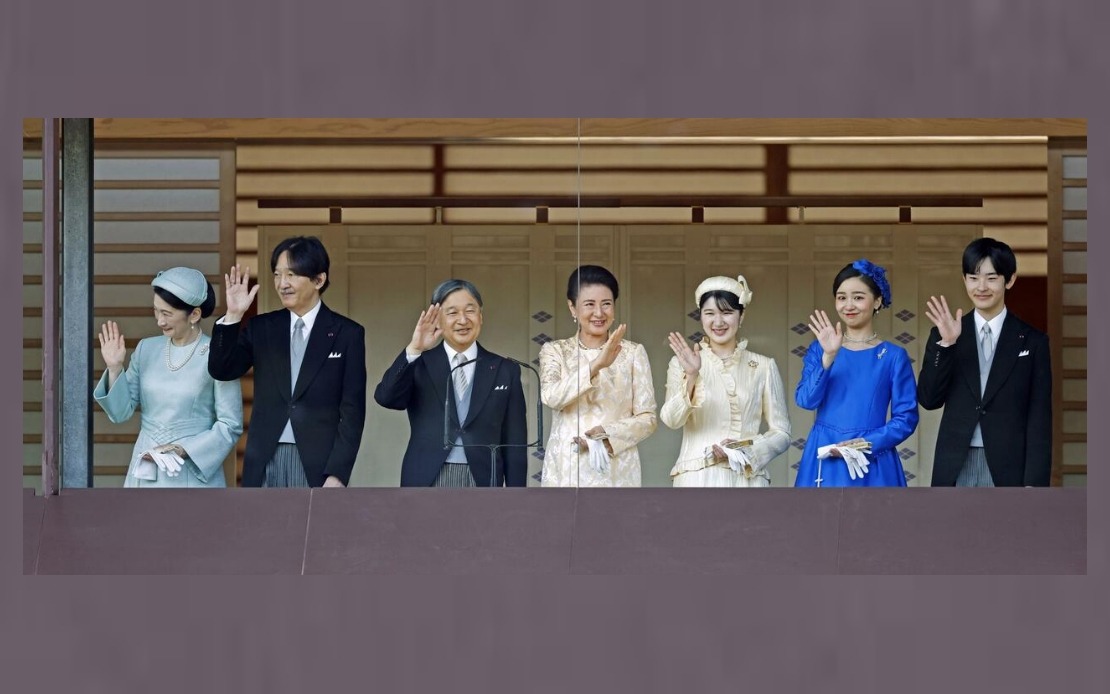
Japan's revamped Imperial House Law, the first substantive overhaul since 1947, is generating deep uncertainty within the Imperial Household Agency and revealing stark divisions among ordinary Japanese citizens over the direction of the world's oldest hereditary monarchy. Staff members supporting the imperial family confront an unprecedented challenge: navigating how their professional responsibilities will evolve under rules that venture into legal and practical territory the institution has never previously explored. The constitutional amendment, which Parliament ratified on Friday, addresses one of Prime Minister Sanae Takaichi's paramount policy objectives—reversing the demographic collapse of the imperial household, which has contracted to just 16 members.
The legislative compromise, however, exposes a fundamental tension between the government's conservative vision for imperial succession and shifting public expectations about gender equality and representation. Whilst both Imperial Household Agency bureaucrats and sections of the Japanese population acknowledge merit in certain provisions—particularly the ability for women married to commoners to retain their royal titles, or the possibility of adopting qualified males from the eleven former branch families that lost their status in 1947—these concessions exist alongside a critical omission. The revised law conspicuously preserves the male-only succession line, reflecting what critics characterise as a rear-guard action by traditionalist politicians to circumvent the genuine appetite among many Japanese voters to see a reigning female emperor, potentially including Emperor Naruhito's only child, Princess Aiko.
Imperial Household Agency officials have publicly embraced the legislative framework as a necessary pragmatic measure. One agency representative articulated this position by emphasising that the law creates "a path toward securing a stable number of imperial members," recognising that the existing trajectory was unsustainable. The same official acknowledged the magnitude of adjusting institutional practice should an adopted male actually enter the imperial system, stating the agency would "have no choice but to support them so they steadily carry out their official duties and earn the affection of the people." This language reflects an awareness that implementing adoption protocols represents a departure from centuries of palace convention and will demand careful management to preserve the institution's public legitimacy.
Yet candid scepticism emanates even from the ranks of potential candidates for imperial adoption. Asahiro Kuni, an 81-year-old member of the Kuninomiya branch family—one of the eleven lineages eligible under the new regulations—dismissed the prospect as fanciful, telling journalists that "it doesn't seem very realistic" that individuals would voluntarily surrender their private lives to join the imperial system. His doubts highlight a crucial gap between legislative design and human motivation: the law creates mechanisms that may never actually activate if those theoretically eligible decline to participate. Beyond practical concerns about recruitment, Imperial Household Agency staff have articulated deeper worries about institutional continuity and the capacity of adoptees to genuinely embody the symbolic constitutional role that Emperor Naruhito and his immediate predecessors have come to define. One official fretted whether adoptees would "understand the nature of the symbolic imperial system and be able to properly carry on the wishes" of recent emperors—a concern rooted in recognition that the contemporary imperial institution has evolved into something more intimately connected to public engagement and disaster response than its pre-war antecedent.
The new regulations create what agency aides describe as "rather harsh" personal dilemmas for the five unmarried female imperial family members, including Princess Aiko and Princess Kako, who may face marriage decisions with constitutional implications. Under the revised law, whilst women can now retain imperial status after marrying commoners, their spouses and children would remain ordinary citizens—an arrangement that agency staff worry could produce awkward family dynamics where different members possess fundamentally different legal statuses. A senior official characterised the situation with evident discomfort, noting that "given the current state of the Imperial Household and public expectations, it will be quite difficult for them to leave." This formulation—casting departure from imperial status as an option that is theoretically available but practically untenable—reveals how the law preserves patrilineal succession whilst leaving female members in a constrained position.
Additional criticism focuses on what agency aides detect as the government's unstated intention: the legislative package appears designed to "rule out female emperors or emperors from the matrilineal line," effectively closing pathways toward succession models aligned with contemporary gender norms and popular sentiment. Opinion polling consistently demonstrates that substantial majorities of Japanese voters support the possibility of a female emperor, yet the government has constructed a system that studiously avoids directly confronting this preference. The amendment essentially offers procedural accommodations—allowing women to retain rank following marriage—without granting women access to the throne itself. This approach reflects what many observers view as an ideologically-driven attachment to male succession that persists despite losing public support.
Public responses to the revised Imperial House Law reveal a population fragmented along generational and ideological lines. Some citizens express pragmatic acceptance, suggesting that provided adopted members "can stand by the people just as the emperor does," practical competence would overcome any reservations about their origins. One such supporter, 76-year-old Shinichi Kokubun, based his perspective on direct observation of the imperial family's engagement during their April visit to Fukushima Prefecture, which remained scarred by the 2011 earthquake, tsunami, and nuclear catastrophe. His assessment prioritises demonstrated commitment to public service over historical precedent.
Conversely, younger Japanese articulated frustration with both the substance and process of the reform. A 22-year-old woman from Hiroshima, Miyu Nakao, pointed to the disconnect between public opinion—which substantially favours female succession—and the government's unilateral legislative decision. She accused leaders of executing an "imperial system" overhaul "all by itself," leaving citizens disconnected from deliberation about the monarchy's future. This criticism encompasses not merely disagreement with policy outcomes but rejection of the decision-making methodology itself, with respondents lamenting inadequate public education or consultation before Parliament ratified such a constitutionally significant amendment. A 20-year-old college student in Osaka similarly observed that government has conducted insufficient outreach, with many Japanese remaining unfamiliar with the Imperial House Law's provisions or rationale.
The contemporary debate reflects broader tensions within Japanese society regarding the appropriate balance between institutional tradition and democratic participation. The imperial family occupies a unique constitutional position, defined as the "symbol of the state," yet decisions reshaping the institution's fundamental structure have proceeded with limited inclusive deliberation. The government's apparent determination to maintain male-only succession whilst offering ancillary reforms addressing women's retention of status represents a studied compromise that may ultimately satisfy neither traditionalist voices demanding unreformed hereditary succession nor progressive constituencies advocating genuine equality in succession eligibility. For the Imperial Household Agency, this ambiguous settlement creates substantial operational uncertainty as officials anticipate managing unprecedented scenarios—adoptions, female members navigating status decisions, and the necessity of justifying institutional continuity to an increasingly sceptical younger generation. The ultimate sustainability of the monarchy may ultimately hinge not on legislative mechanics but on whether the imperial institution can demonstrate renewed relevance to Japanese citizens who increasingly question whether inherited institutional arrangements remain compatible with democratic values.

