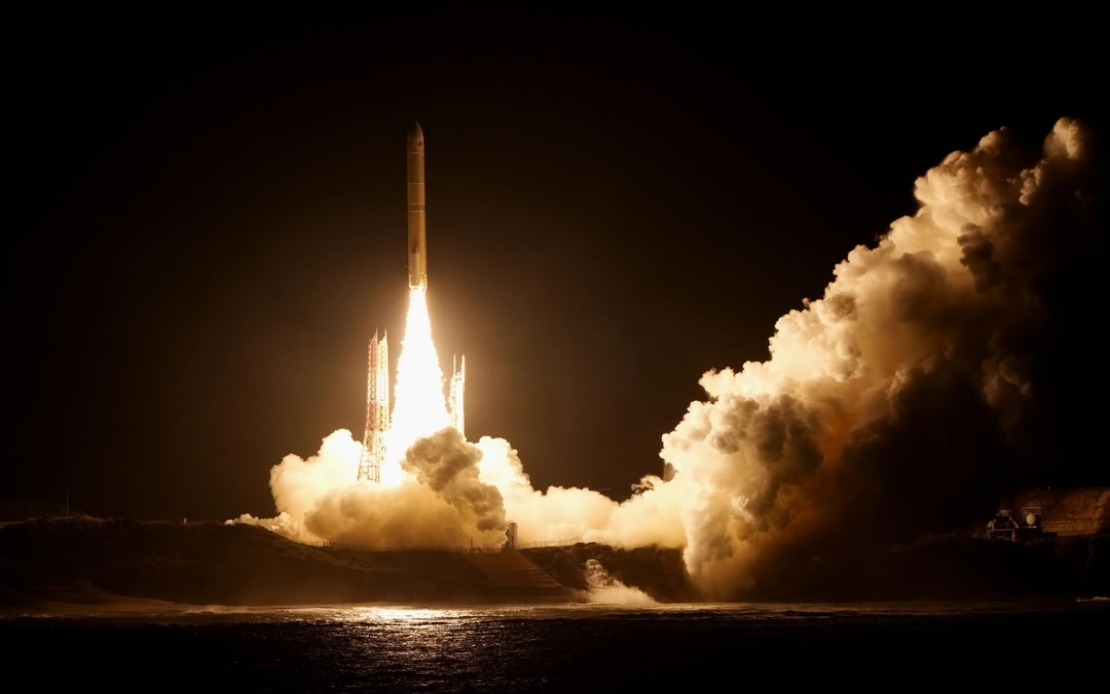
Japan's ambitious effort to establish independent satellite positioning capabilities moved a significant step forward this week when the Japan Aerospace Exploration Agency successfully launched an H3 rocket from the Tanegashima Space Centre in southwestern Japan. The rocket carried the Michibiki No. 7 positioning satellite into orbit, representing a crucial recovery following a launch failure that had hampered the nation's space programme eight months earlier. The achievement underscores Japan's determination to build a fully operational indigenous navigation system that would reduce reliance on foreign satellite networks.
The H3 rocket, designated as vehicle number nine in the flight sequence, lifted off early Tuesday morning from Japan's principal space launch facility on Tanegashima island. This mission marks the second successful consecutive launch of the H3, Japan's newest flagship orbital vehicle, following a June flight that deployed multiple small satellites. The successful deployment comes as Japan works methodically to overcome technical challenges that have periodically disrupted its space launch calendar and threatened its space exploration agenda.
Weather conditions presented obstacles to maintaining the originally scheduled launch timeline. The mission was first postponed from Friday to Monday due to approaching typhoon conditions, then delayed a further twenty-four hours because of unfavourable atmospheric conditions directly affecting launch operations. These delays, while frustrating for programme managers, allowed additional time for final system checks and reflected cautious operational practices at the Tanegashima facility.
The December setback involving H3 number eight had cast shadows over Japan's spacefaring ambitions. That failed launch prevented the Michibiki No. 5 satellite from reaching its intended orbit, causing a domino effect that postponed this week's Michibiki No. 7 launch from February to August. The mission failure prompted intensive troubleshooting and engineering reviews within the space agency, ultimately leading to the corrective steps that enabled successful June and now August launches. This pattern of failure and recovery demonstrates both the technical difficulties inherent in rocket development and Japan's systematic approach to addressing engineering problems.
The Michibiki series represents the foundation of Japan's Quasi-Zenith Satellite System, a positioning infrastructure designed to furnish accurate location data for civilian and commercial applications including smartphone navigation and vehicle guidance systems. Currently, five Michibiki satellites are actively transmitting positioning signals across Japanese territory and surrounding regions. The Japanese government has established an objective of achieving seven operational satellites in orbit, which would enable continuous, uninterrupted service without depending on external international positioning systems controlled by other nations.
This strategic independence in satellite positioning technology carries significant implications for Japanese economic and security interests. By maintaining an autonomous navigation capability, Japan reduces vulnerability to potential disruptions in foreign satellite networks and establishes technological self-sufficiency in a critical infrastructure domain. For regional observers, Japan's progress toward a complete seven-satellite constellation demonstrates the sophistication of its space industrial base and its capacity to execute long-term technical programmes despite encountering setbacks.
The H3 represents Japan's technological evolution in space launch systems, succeeding the H2A rocket family that served as the nation's primary heavy-lift vehicle for over twenty years. The H2A established an enviable reliability record and became a cornerstone of Japanese space activities, but the newer H3 was designed to achieve greater efficiency, reduced operational costs, and enhanced capability. The transition from one generation of launch vehicles to another typically involves a learning curve, and Japan's experience with the H3 has reflected this pattern, with early technical issues gradually giving way to operational success.
The mixed operational history of the H3 programme, encompassing both the December failure and subsequent successful launches, remains within normal parameters for next-generation rocket development. Space agencies worldwide have experienced similar trajectories when introducing new launch vehicles. The critical measure is whether the underlying technical issues are systematically resolved and whether confidence in the vehicle gradually increases through successive successful missions. Japan's progression from the H3 number eight failure through successful H3 number nine launch suggests the corrective measures have proven effective.
For Malaysia and other Southeast Asian nations, Japan's advancing satellite positioning capabilities have practical implications. Regional users relying on navigation systems may eventually benefit from enhanced signal coverage and redundancy offered by a fully operational Quasi-Zenith system. Additionally, Japan's successful space programme supports broader regional technological cooperation in aerospace and satellite applications, areas where Japan increasingly partners with neighbouring countries on joint initiatives and commercial ventures.
The completion of the Michibiki constellation remains central to Japan's space strategy for the coming years. Each successful satellite deployment moves the programme closer to achieving the intended seven-unit configuration that will enable continuous positioning coverage. Subsequent H3 launches are scheduled as additional Michibiki satellites await their turns for orbital deployment. The August success provides confidence that Japan's space agency possesses both the technical capability and operational discipline to execute these remaining missions, thereby completing a navigation infrastructure project that has consumed significant resources and engineering effort over the past decade.

