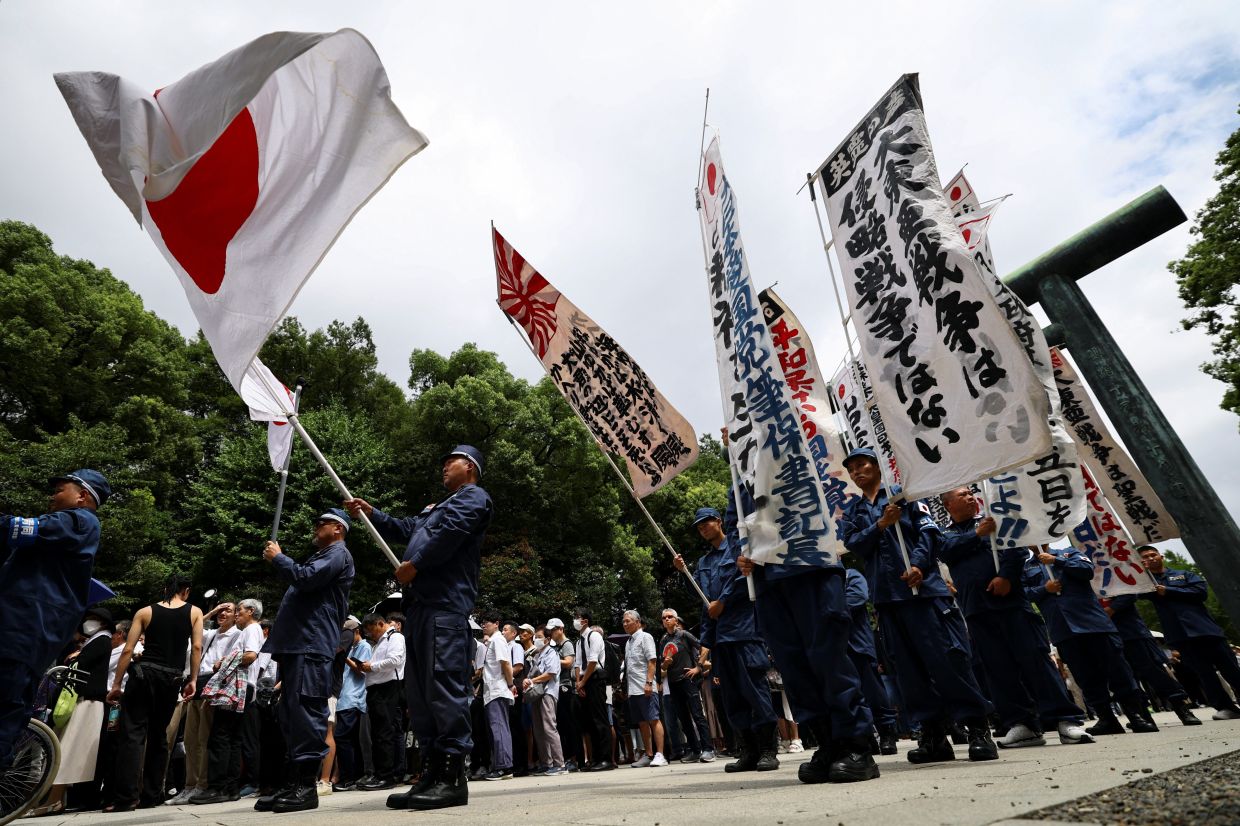
Japan's Defence Minister Shinjiro Koizumi visited the Yasukuni Shrine on Saturday to mark the 81st anniversary of his nation's surrender in World War II, underscoring the delicate balancing act Tokyo must maintain between domestic constituencies and regional neighbours increasingly wary of Japanese remilitarisation. The shrine, which honours 2.5 million war dead including convicted war criminals from Imperial Japan's invasions across Asia, remains one of the most fraught symbols in modern East Asian geopolitics, capable of derailing diplomatic efforts and inflaming historical grievances at a moment's notice.
Prime Minister Sanae Takaichi's decision to abstain from a personal visit—choosing instead to send an offering—represents a subtle but significant departure from the path taken by her mentor Shinzo Abe, who attended the shrine in December 2013 and triggered diplomatic firestorms in Beijing and Seoul that reverberated internationally, drawing rare criticism even from close ally the United States. The distinction between a ceremonial offering and a physical visit may seem minor to outside observers, yet in the context of East Asian diplomatic language, the choice carries considerable weight and signals an attempt to navigate competing pressures without abandoning nationalist constituencies at home.
Koizumi's attendance as defence minister marks the first visit to Yasukuni by someone in that portfolio since Minoru Kihara in 2024, continuing a pattern of senior officials paying respects at the controversial site during the August 15 remembrance period. The defence minister's role makes his shrine visits particularly sensitive, as they symbolise Japan's military establishment's relationship with the past and carry implications for how Tokyo interprets its post-war security obligations and regional role. The timing of Koizumi's visit occurs against a backdrop of sharply elevated tensions between Japan and China over Taiwan, Japan's military expansion, and competing territorial claims in the East China Sea.
Takaichi herself has emerged as a polarising figure in regional capitals, characterised before her October ascension to the premiership as a China hawk and recently alarming Beijing by suggesting Japan might intervene militarily in any conflict over Taiwan. That November statement provoked immediate and sustained Chinese retaliation, including travel warnings to Chinese citizens and targeted trade restrictions, underscoring how quickly statements by Japanese leaders regarding military posture translate into concrete economic and diplomatic consequences. The Japanese government's acceleration of defence spending and gradual dismantling of the pacifist constraints embedded in the post-war constitution under Takaichi's leadership has further stoked alarm in Beijing and Pyongyang.
China's response to the shrine visits and broader Japanese military trajectory has been unambiguous and multi-faceted. Senior Colonel Chen Xi, speaking on behalf of China's defence ministry, warned explicitly against what Beijing characterises as Japanese "neo-militarism," invoking the historical record and demanding that Tokyo "earnestly reflect" on its wartime crimes, recognise the post-war international order, and abandon its "dangerous acts of remilitarisation." Russia's Chinese ambassador subsequently joined Beijing in issuing a joint statement emphasising their countries' sacrifices in World War II, a coordinated message that highlights how Japan's historical reckoning—or perceived failure to reckon adequately—has become entangled with contemporary great-power competition in East Asia.
The geopolitical context extending beyond the shrine itself underscores why Takaichi's restraint matters. Putin's visit to Russia's Far Eastern Kuril Islands on Thursday sparked immediate Japanese protest, as Tokyo maintains its own territorial claims to those islands, creating another flashpoint for regional competition. Japanese relations with South Korea have stabilised somewhat in recent months, with cultural exchanges between Takaichi and President Lee Jae Myung suggesting thawing ties, yet the historical animosities embedded in shrine visits remain potent enough to destabilise any diplomatic warming.
The Yasukuni Shrine authorities themselves sought to manage potential disorder by appealing to visitors to refrain from wearing military-style uniforms, framing the request as necessary for the "general public" to "worship in peace and quiet." The appeal itself reflects anxieties about the shrine becoming a flashpoint for nationalist mobilisation, with staff instructed to provide gentle "guidance" to those arriving in quasi-military attire. An AFP reporter documented approximately 20 to 30 uniformed visitors at the site, suggesting that efforts to discourage such appearances achieved only partial success, a microcosm of the broader challenge facing Japan's leadership in managing nationalism while maintaining regional stability.
For Southeast Asian observers, Japan's internal debate over historical responsibility and military posture holds direct relevance. Japan's willingness to constrain nationalist impulses while gradually expanding military capabilities shapes the regional security environment that affects smaller nations dependent on freedom of navigation and the sanctity of international law. Takaichi's defensive restraint regarding the shrine visit, even as she pursues ambitious military modernisation, illustrates the tension between acknowledging historical concerns and pursuing strategic autonomy—a tension that will likely intensify as China continues asserting itself across the region and the Biden administration presses Japan to assume greater security responsibilities in countering Beijing's rise.
The political calculus informing Takaichi's decision to stay away from the shrine reflects recognition that overt historical revisionism carries costs incompatible with Japan's strategic interests in the region. Yet by allowing her defence minister to visit and continuing defence spending increases that alarm China, the government maintains a delicate equilibrium in which it acknowledges regional sensitivities on historical matters while advancing a military modernisation agenda that fundamentally alters Japan's security posture. This duality—restraint on symbolic gestures coupled with concrete military expansion—may prove unsustainable as regional tensions mount, forcing future Japanese leaders to choose more definitively between nationalist constituencies and regional stability.

